Roundcube ships paired security updates and retires its 1.6 LTS line
Roundcube Webmail 1.6.22 and 1.7.7 both patch twelve security issues. The 1.6.22 build is also the last of its line.
Roundcube has now released paired security updates to both active versions of its webmail client. Roundcube Webmail 1.7.7 and Roundcube Webmail 1.6.22 fix the same twelve vulnerabilities, which span HTML sanitization bypasses, remote-content-blocking evasion, filter-script injection, a denial of service, and connection-security issues. There's one more detail worth flagging. The 1.6.22 release is the final version of the 1.6 LTS line. From now on, only 1.7 will get security fixes, and maintainers are telling 1.6 users to migrate "as soon as possible."
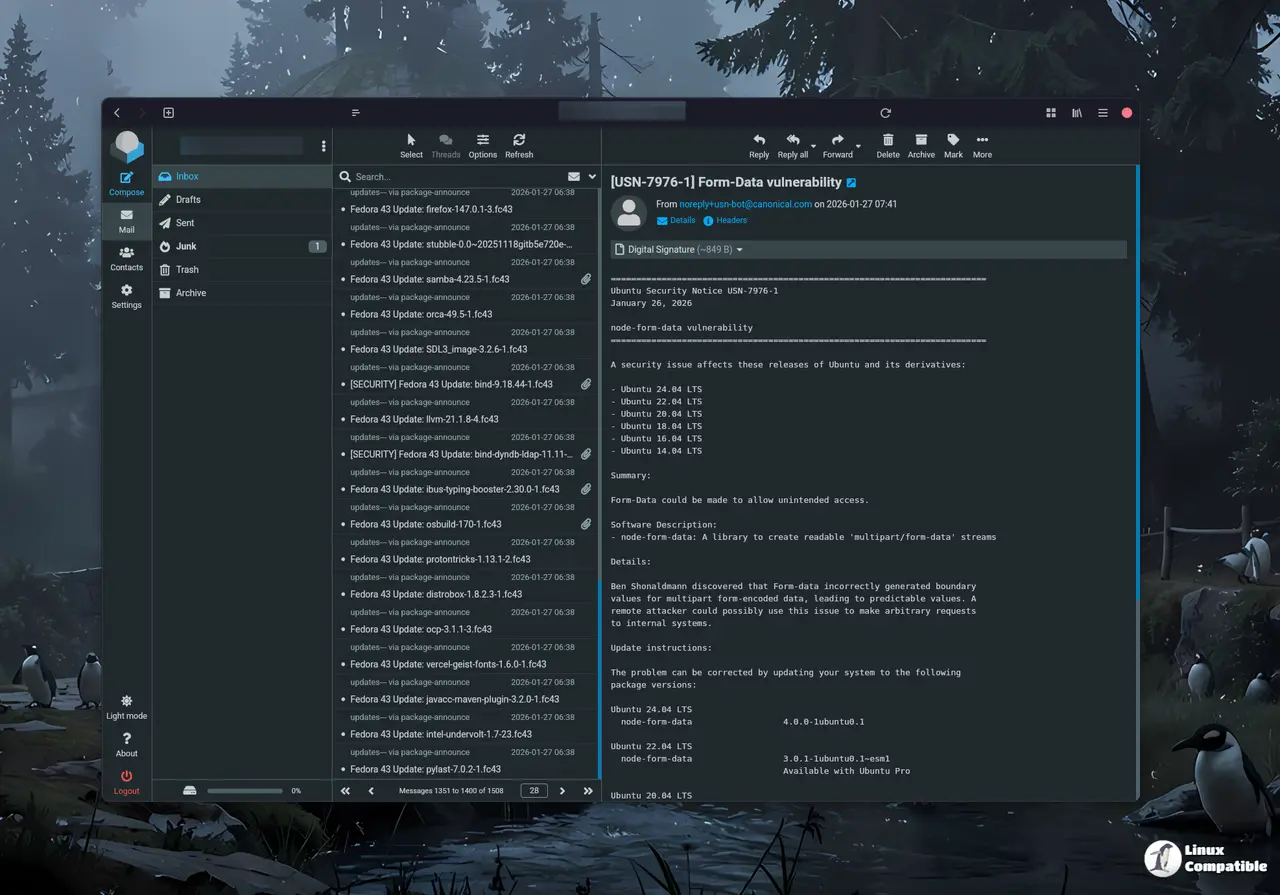
The announcement landed today, led by Aleksei Nikiforov, the maintainer known online as alecpl. Both releases carry an identical twelve-bullet security section, though the framing differs. Version 1.7.7 is the current line and now the only one that will receive future security patches. Version 1.6.22 carries a blunt end-of-life warning: "This is the last 1.6 release. Please, upgrade to 1.7 asap. It will be the only line that receives security fixes in the future."
Both lines were kept alive through backporting, but the team says the effort required is why it can't go on forever.
A rapid release cycle
Roundcube hasn't slowed down. It shipped 1.6.20 and 1.7.5 on 10 October 2026, closing a CSS scoping bypass via @layer at-rules (CVE-2026-114722). Two weeks later, on 9 November, came 1.6.21 and 1.7.6, a larger batch of CSRF, SSRF, and injection fixes reported largely by the Squirt1e, Atum, N0b0dy, Gh0u1L5 collective. Now 1.6.22 and 1.7.7 arrive. The back-to-back pace reflects an active responsible-disclosure relationship between the project and a fairly large community of security researchers.
The twelve issues, by area
The problems cluster into a few themes. The largest group touches HTML and CSS sanitization alongside the code that blocks mail from loading remote content. Roundcube scrubs incoming HTML before displaying it and keeps tracking pixels and external images at bay until you choose to load them. Several crafted messages can slip past all that.
One lets CSS comments inside an SVG FuncIRI attribute dodge remote-content blocking, reported by kleju13. (A related unclosed url() problem in that same area was CVE-2026-75003.) Another exposes the CSS proxy through leading whitespace or a byte-order mark, per Mohamed Elgzouli. And on servers running PHP older than 8.4, XML namespace prefixes can sneak attributes past the sanitizer's allowlist, according to nakko.
These are mostly privacy and UI-spoofing problems rather than instant remote-code-execution. A remote-content bypass means an email can phone home the instant you open it. A CSS-scoping bypass can restyle the webmail chrome itself, which is a straightforward way to make a forged login prompt look legitimate.
Sieve is Roundcube's language for server-side filters, and two injection paths let bad content into saved filter scripts. One comes through a comparator name (Lee); the other through the body, address, or envelope fields (Shu Jie). Filter injection has been a recurring headache here, following a bigger batch in 1.6.21/1.7.6 by the same collective.
There's also a denial-of-service path. The TNEF decoder, which handles those winmail.dat files some Outlook users send, can be pushed into an unbounded loop via an uncapped multi-value loop, reported by Sourabh Singh. (A similar DoS class in the same decoder was CVE-2026-62642.)
Two of the twelve are marked "again" because the announcement says the earlier patch didn't fully hold. Ankesh Singh found a way to inject HTTP requests through the ATD spellcheck backend, re-fixing a hole first closed in 1.6.21/1.7.6. Similarly, korosuke587 found that unsafe file types such as PDF, PostScript, and SVG could still reach ImageMagick on image resize. (The earlier fix was CVE-2026-114727.)
On the connection side, Dickson Wu of SEAL and CertiK found that a server configured for TLS can still fall back to an unencrypted IMAP, SMTP, or ManageSieve connection if it never reports TLS capability. That means login credentials can travel in the clear. It matters most where webmail runs apart from the mail cluster, and it ties back to RFC 8314 on implicit TLS. A lone plugin flaw rounds out the batch: Mohammed Fathy of Robusta Technology Group found XML injection in the XIMSS driver of the password plugin. That one only affects instances using that specific driver.
The missing CVEs
No CVE numbers came with this batch, and that's worth calling out. The official announcement lists none, and a post on the oss-sec mailing list from Valtteri Vuorikoski on 18 November noted the same for the prior release. It fits Roundcube's habit of disclosing through its own news channel and GitHub rather than chasing CVE assignments. Earlier batches did get CVEs, though. NVD lists CVE-2026-114722 for the @layer scoping bypass, CVE-2026-114727 for the ImageMagick attachment issue, and a run of 2026-75000-series IDs for everything from password-token leaks to an RCE in the markasjunk plugin. So these vulnerability classes have been catalogued and scored before; they just aren't getting fresh IDs this time.
What admins should do
Roundcube is self-hosted open-source webmail, so the people who need to act are those running it in production: hosting providers, universities, enterprises, public bodies. It often ships bundled through control panels like iRedMail, cPanel, or Plesk, or inside a Linux distro's packages. That last detail matters, because once it's bundled you may have to wait on the panel vendor or distro rather than patching on your own schedule.
Patch first. Update to 1.7.7, or to 1.6.22 as a stopgap if the migration to 1.7 isn't ready. Then plan the migration properly, since 1.6.22 is the last 1.6 release. Any future flaw will only land in 1.7, so test your plugins and skins against it now.
A few operational steps round it out. Inventory every installation, including anything bundled with a control panel. Verify your IMAP/SMTP/ManageSieve TLS settings and prefer the implicit-TLS ports from RFC 8314. If you use the password plugin or the ATD spellcheck backend, read the changelog closely. After the upgrade, restart your PHP workers and clear caches, or the patched code won't actually reach users.
Twelve fixes in about two months is a lot, though part of that just reflects how many eyes are on the code. Most of these flaws lean toward privacy and spoofing rather than a clean remote-code-execution win, so the practical stakes are real but uneven. Still, the TLS-fallback and TNEF-DoS issues are the clearest "send your credentials in the clear" and "deny service" stories, and the end-of-life angle makes 1.6 a moving target.
Head here to the release announcement.


