Triton Driver v0.3 Lands, Fixing a Major Performance Bug in QEMU's DirectX VM Stack
The long-simmering open-source driver for Windows 3D acceleration inside QEMU/KVM just got a critical patch that should finally make the stack usable.
osy has published v0.3 of the Triton kernel driver, bringing a long-needed fix to one of the most ambitious open-source projects for DirectX 11 gaming inside QEMU/KVM virtual machines. The release tackles a 12-millisecond-per-call bottleneck that was effectively turning the VirtIO-GPU 3D stack into a slideshow.
The project traces back to July 2023, when developer max8rr8 submitted pull request #943 to the upstream virtio-win repository. The goal was straightforward on paper. Expose a virtual PCI GPU to a Windows guest, route its D3D10 commands through QEMU, and let the host's Vulkan or OpenGL stack do the heavy lifting. The community response was immediate. The PR accumulated over 200 reactions and became a reference point for anyone trying to run Windows games on Linux or macOS ARM64 without resorting to hardware passthrough.
So why does v0.3 matter now? The kernel-mode driver had a race condition in how it handled blob resource mappings. When the guest driver requested access to a GPU resource, it got back a memory window handle before the host actually transferred the data. The driver then had to drain the entire command scheduler just to wait for the transfer to finish. Under load, that added roughly 12 milliseconds per operation. Multiply that by any texture streaming or render target swap, and you've got an unusable stack. The v0.3 patch introduces CtrlQueue::ResourceMapBlobSync, which synchronizes the host map before handing the window to the guest. It's a surgical fix, but it's exactly what the stack needed to move past the proof-of-concept stage.
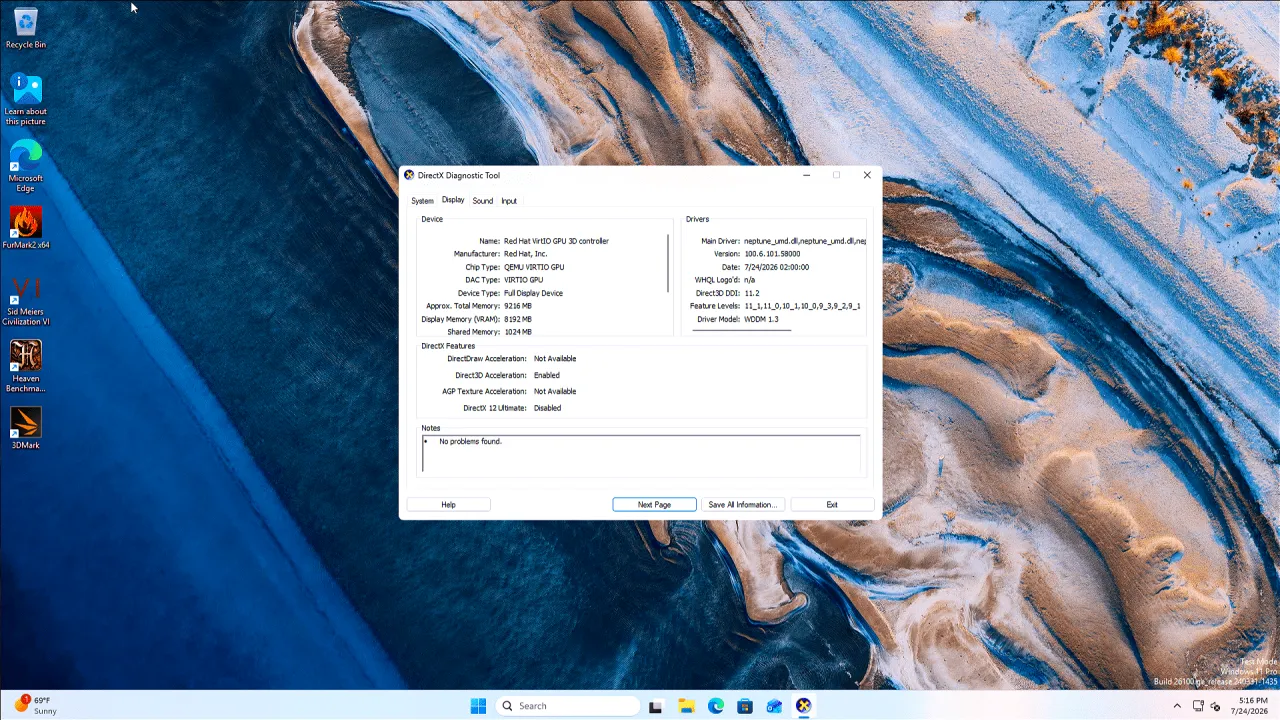
The Full Stack
What makes Triton notable isn't just the kernel driver. It's the complete pipeline. On the host side, you're looking at a patched virglrenderer and a custom Mesa build that compiles the viogpu_d3d10.dll user-mode driver. On the guest side, viogpu3d.sys acts as a WDDM miniport, managing resource scheduling and BAR window mappings inside the VM. QEMU ties it together with the -device virtio-vga-gl flag. It's a lot of moving parts, and getting them to play nicely together has been the real bottleneck for years.
Kernel driver development for Windows has always been a specialty of the masochistic. Getting WDDM preemption working in a paravirtualized environment adds a whole other layer of headaches.
Known Issues & Where It Stands
The v0.3 release doesn't magically solve everything. NVIDIA hosts are still out of luck due to a lingering GL_PRIMITIVE_RESTART_NV bug in the upstream virglrenderer, which throws illegal command buffer errors on virtually any non-trivial workload. VS Code and modern Electron apps render as black boxes without PIPE_QUERY_TIMESTAMP_DISJOINT support. WinUI3 interfaces flicker. ARM64 Windows guests still crash QEMU with SIGABRT on driver load, which leaves macOS UTM users staring at blue screens while waiting for cross-architecture builds.
And upstream integration remains firmly stalled. PR #943 has sat open since July 2023 with the original author having unsubscribed from notifications. Mesa's D3D10 UMD patches and the virglrenderer updates share the same fate. The complexity of WDDM driver development, plus the NVIDIA compatibility gap, means the mainline virtio-win maintainers haven't prioritized the merge.
It's a solid step forward, no question. But calling Triton production-ready would be generous. The WDDM scheduler still runs without preemption, meaning a poorly behaved guest application can hang the host's virtual display. The blob mapping fix solves the symptom, not the underlying architectural constraints of VirGL for D3D10 workloads. That said, for anyone running a Linux or ARM64 host and genuinely need native DirectX 10/11 in a VM, the v0.3 patch finally removes the wall that made the stack feel like an unreleased demo.
You can grab the v0.3 binaries, along with build instructions for the host-side Mesa and virglrenderer patches, over at the osy repository. If you're compiling from source, you'll need a Windows SDK for the kernel driver build and a custom Mesa branch with the viogpu_win target active.


