Strata 0.2.7 lets you run a 125-billion-parameter model now with a speed boost on AMD
Strata 0.2.7 is the update that turns a capable local model into a genuinely useful one, and the feature list is dense. The headline change speeds up 12 GB NVIDIA cards by having the router prefer experts already on the card, while AMD Radeon RX 9000 and AI PRO R9700 cards get faster Qwen and DeepSeek decoding.
Niko Veit runs Strata from Ljubljana, Slovenia, working completely alone. As of right now his 0.2.7 release does something that used to mean tens of thousands of dollars in data-center hardware. It puts Qwen3.8-Flash-Next, a 125-billion-parameter supermodel, on ordinary gaming PCs as small as a 12 GB NVIDIA card, and serves it through standard OpenAI and Anthropic APIs on your own machine. No cloud. No account. Prompts don't leave the building.
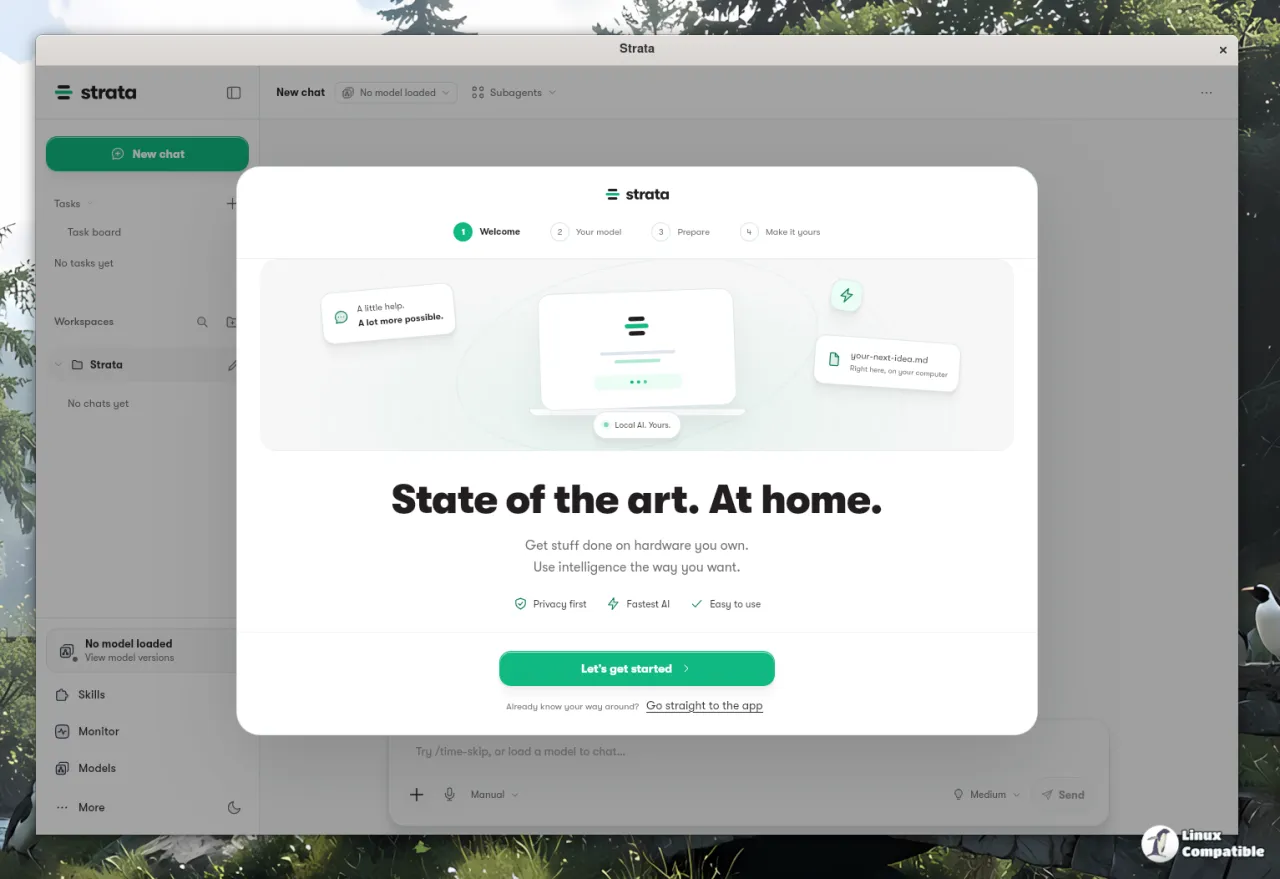
Strata is free. MIT license, single maintainer, funded by optional "Buy Me A Coffee" donations, and it has pulled in roughly 34,400 GitHub stars in about five weeks. For what it's worth, that's a one-person shop out-reaching paid cloud APIs on raw attention.
The model itself is a preview. Alibaba's Qwen team calls Flash-Next an early look at the architecture that will eventually back Qwen4, and it happens to be the first open-weight version of it. What makes it runnable on a home rig is the design. It's a mixture-of-experts model with 125 billion total parameters but only about 6 billion activated per token. Each of the 48 decoder layers routes one token to just 10 of its 512 experts plus a shared one. The model is enormous on disk but cheap to run word by word, provided you can get the right experts there quickly.
That last part is where Strata comes in.
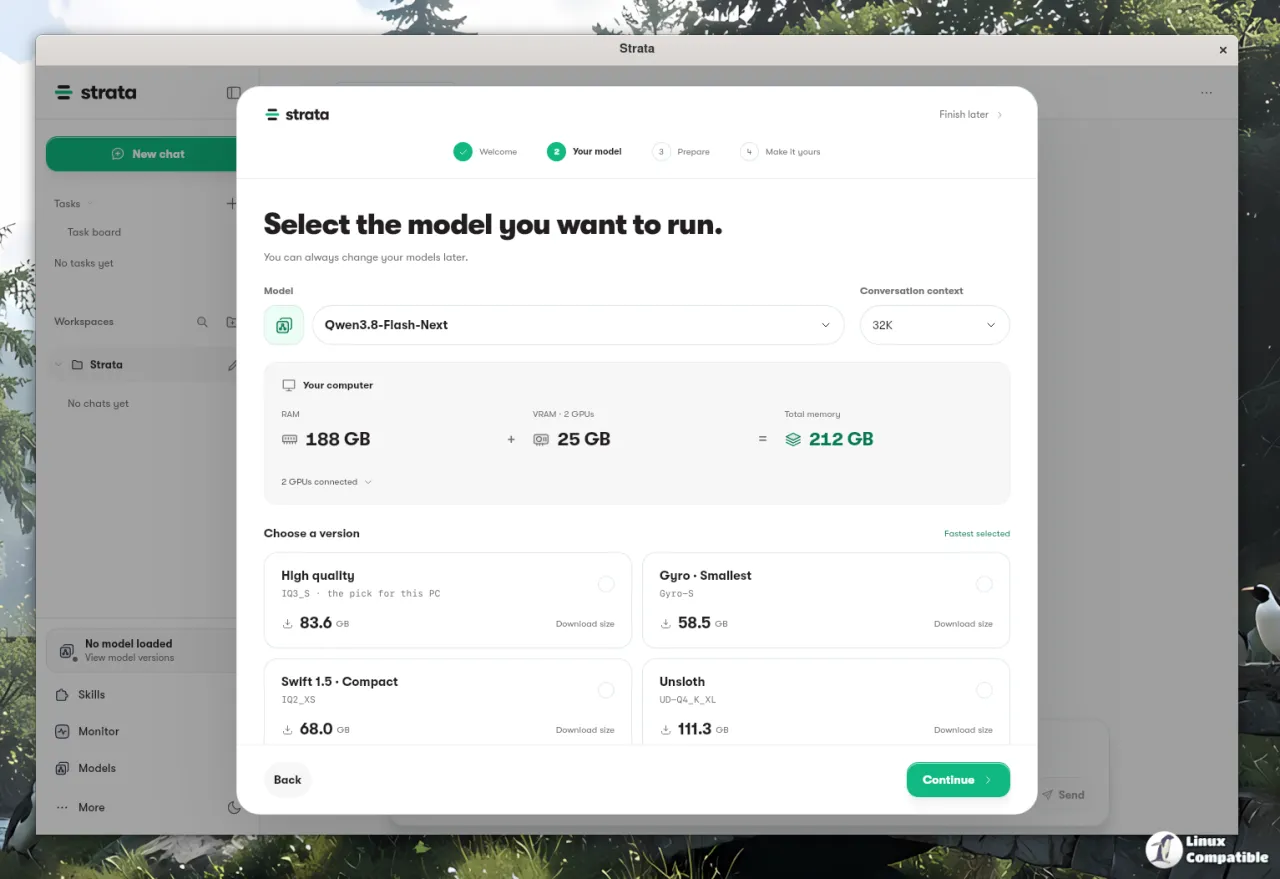
Rather than treat VRAM as the only place a model is allowed to live, the engine pools your whole PC, GPU, system RAM, even your SSD, and shuffles pieces of the model around while it runs. Veit's analogy is a kitchen: frequently used ingredients stay on the counter, the rest waits in the pantry. The guiding principle is blunt. He says an extra gigabyte of VRAM holds roughly 700 more experts, so every expert already sitting on the card is one the CPU doesn't have to compute. More VRAM matters more than a faster GPU.
What 0.2.7 actually changes
The update dropped October 27, two days after 0.2.6. It's mostly a performance and compatibility release. The app and Terminal run at 0.2.7, though Control and the engine packages sit at 0.1.52, because both engines changed underneath.
Take the change aimed at 12 GB NVIDIA cards. The router now prefers experts already on the card, which trims the trips back to RAM. On an RTX 3060 with 12 GB, a story answer jumped from 46.2 to 53.1 tokens per second. Code answers went from 45.7 to 62.5 tok/s, closer to a 37 percent gain.
Here's where it gets interesting. Strata picks a slightly different set of experts with that change, so the wording shifts. The trade-off shows up in agent loops: Veit reports that out of 10 agent tasks, only 4.5 passed on average at the new default, versus 5.6 with the setting off. He tried a stronger setting and it produced copy and code defects, so 1.5 it is. The change only applies to discrete NVIDIA cards holding 13 GiB or less.
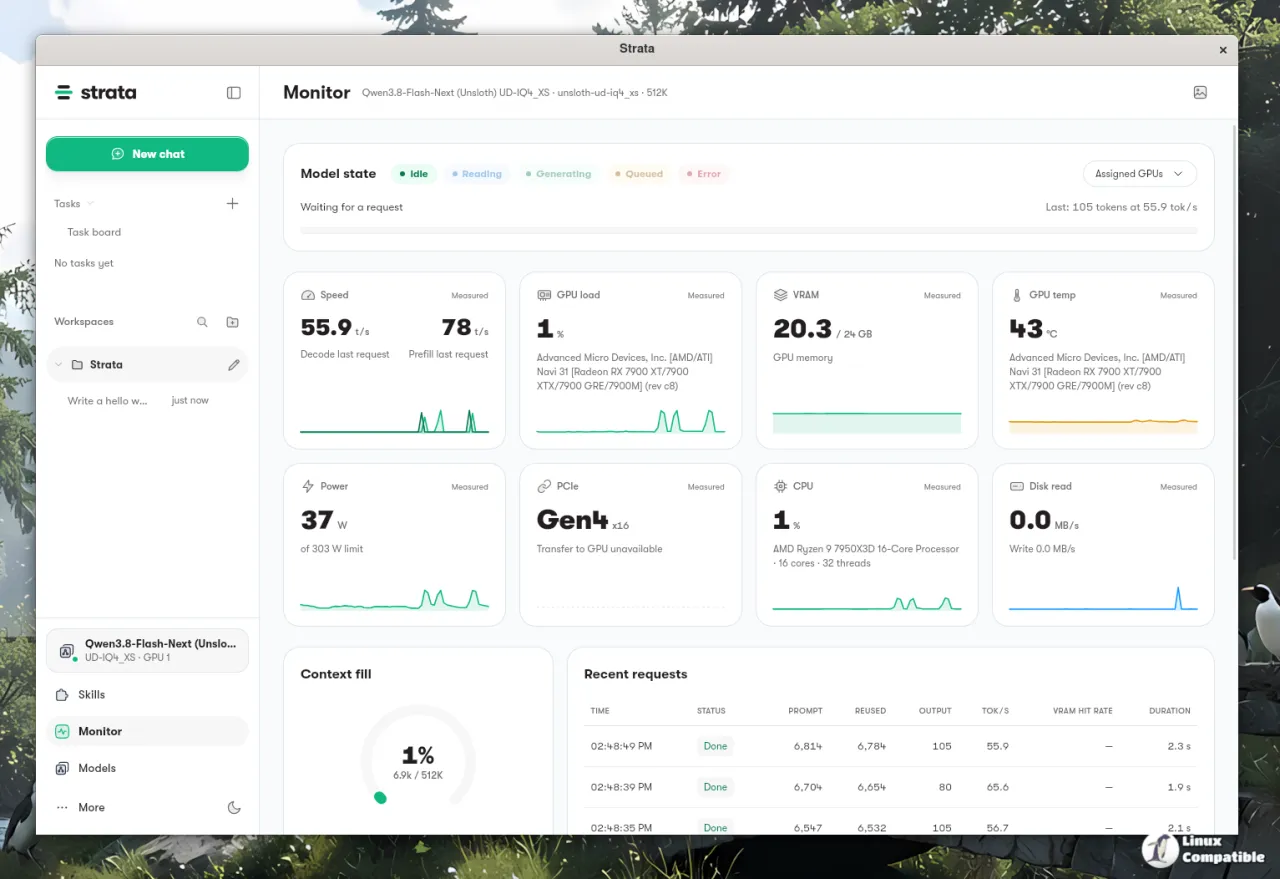
On the AMD side, a Radeon RX 9000 or AI PRO R9700 gets faster Qwen decoding. Veit tested a single R9700 with 32 GB of VRAM and 125 GB of RAM on Linux, where a 32K prompt decode rose from 64.9 to 85.1 tok/s, a 31 percent jump. DeepSeek now also runs on Ryzen AI Max (Strix Halo) Windows PCs through a new engine package for the gfx1151 chip, measured on a GMKtec EVO-X2 with 128 GB of shared memory.
Two NVIDIA cards now read long prompts dramatically faster through layer-major prefill, and it's on by default. On two RTX A4000 cards the first word after a 32K prompt came after 27.7 seconds instead of 141.8. If you've ever watched a local model chew through a long document, that kind of number is a big deal.
A set of release notes that's almost too honest
What actually sets this release apart isn't any single benchmark. It's how Veit presents the numbers. The notes publish raw tokens-per-second deltas, quality-test pass rates, and even the small quality trade-offs each change introduces. Two switches roll every 0.2.7 default back to what 0.2.6 did.
That level of transparency is unusual for software of any size. A one-step rollback via DS4_DEFAULTS=026 for DeepSeek or STRATA_DEFAULTS=026 for Qwen restores staging rings, attention buffers, drafter cuts, and a dozen other knobs at once. It also quietly admits that "faster" isn't free. The vision tower, for instance, turns on by default for DeepSeek but pulls VRAM from the expert cache, so total usage doesn't grow.
The honesty runs both ways, however. Veit lists exactly what he did NOT test: prompts past a few thousand tokens at 512K or 1M, RTX 40 and A100-class cards, RX 6000 on Windows, and DeepSeek picture input on anything but Linux. Read that section before you assume your setup is covered.
"Every extra GB holds roughly 700 more experts," he wrote, echoing the earlier principle. "And every expert on the GPU is one the CPU does not have to compute."
Can you actually run this?
The short answer depends on RAM and disk more than your GPU. Strata wants at least 32 GB of combined RAM and VRAM to start, 64 GB recommended, and disk use begins near 80 GB, sometimes exceeding 150 with larger quantizations. An 8 GB card runs, just slowly.
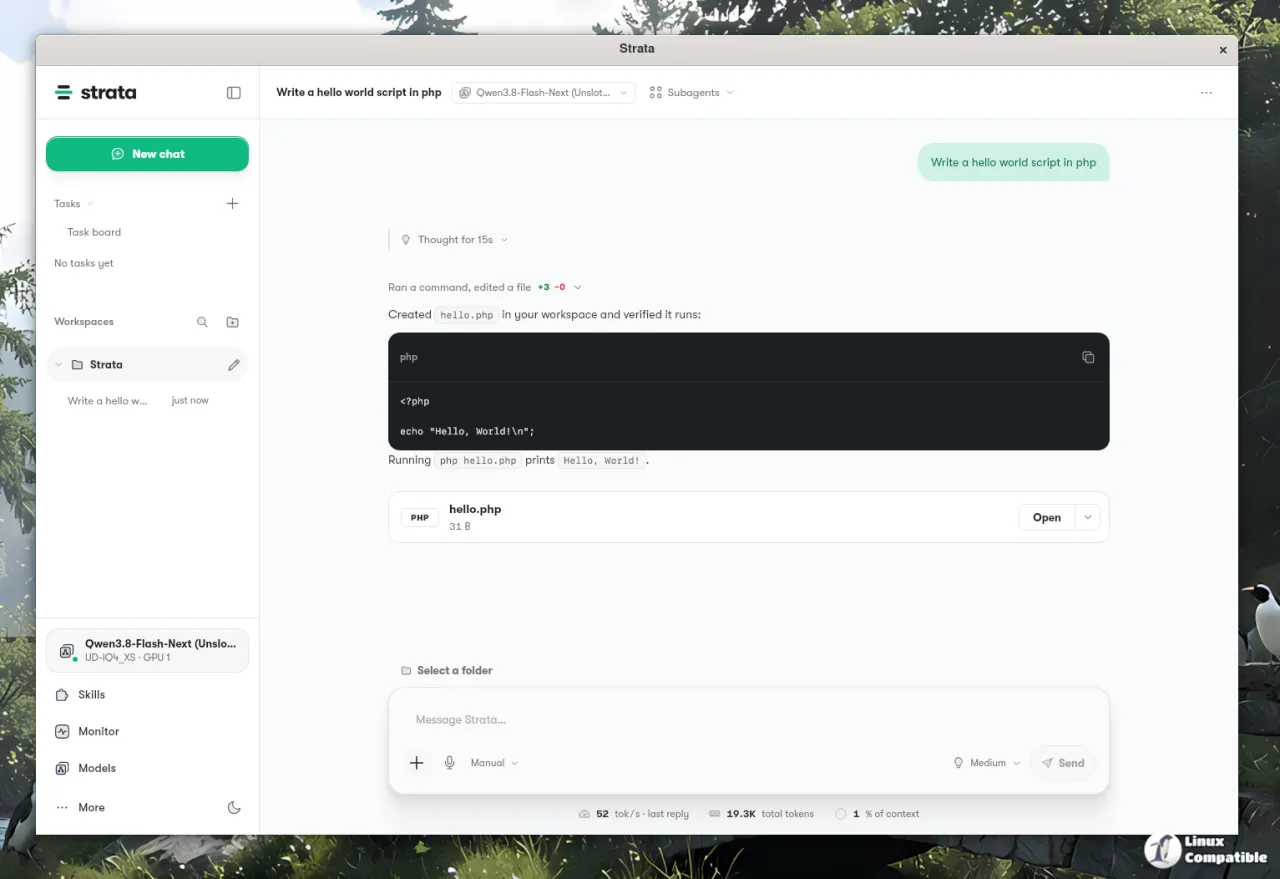
Because Strata serves OpenAI- and Anthropic-compatible APIs on localhost, tools like Claude Code, Codex CLI, Cursor, and Open WebUI can drive it unchanged. There's an MCP setup in both directions, and the README's recommended path is a nice touch: drop a single line into your coding assistant asking it to "Set up Strata on this PC for me" from the repo and follow docs/AI_SETUP.md, and the assistant reads the setup doc and does it for you.
Keep in mind that the release cadence alone is a story. Between October 20 and October 27, Strata put out more than a dozen tags, some within the same day. That's 4,563 commits in a repo barely five weeks old, and it moves fast enough that you'll likely see 0.2.8 before the dust settles.
The verdict
The headline feature, a 125B model on a 12 GB card, free, and offline, is genuinely one of the more impressive things a solo developer has done this year. The radical transparency in the notes is a real trust signal, and the local API surface makes it instantly useful for anyone who values privacy or wants to run models on sensitive code without shipping prompts to the cloud.
It's not without costs, though. The disk footprint is large, the first run can freeze your PC for a minute or two while it downloads, and several of those tidy benchmark numbers come from the developer's own hardware or community reports rather than independent testing. You'll also want plenty of RAM before expecting 100 tokens per second.
Strata 0.2.7 ships as three installers, Linux AppImage, Windows, and macOS dmg, plus separate engine packages for CUDA and AMD.
Head here to the GitHub release page.


