Strata 0.2.5 runs with DeepSeek in the desktop app and comes with cleaner installer
The viral open-source inference engine ships a single installer per OS and brings DeepSeek V4.1-Flash into the desktop app.
Strata runs Qwen3.8-Flash-Next, a 125-billion-parameter model, on ordinary gaming hardware. No server rack. No cloud subscription. The trick isn't so much raw power as stubbornness: rather than forcing the entire model inside your graphics card's memory, the engine spreads the load across your GPU, CPU, system RAM and SSD at the same time.
That means a PC with a modest RTX card and some spare RAM can do something that used to require data-center gear.
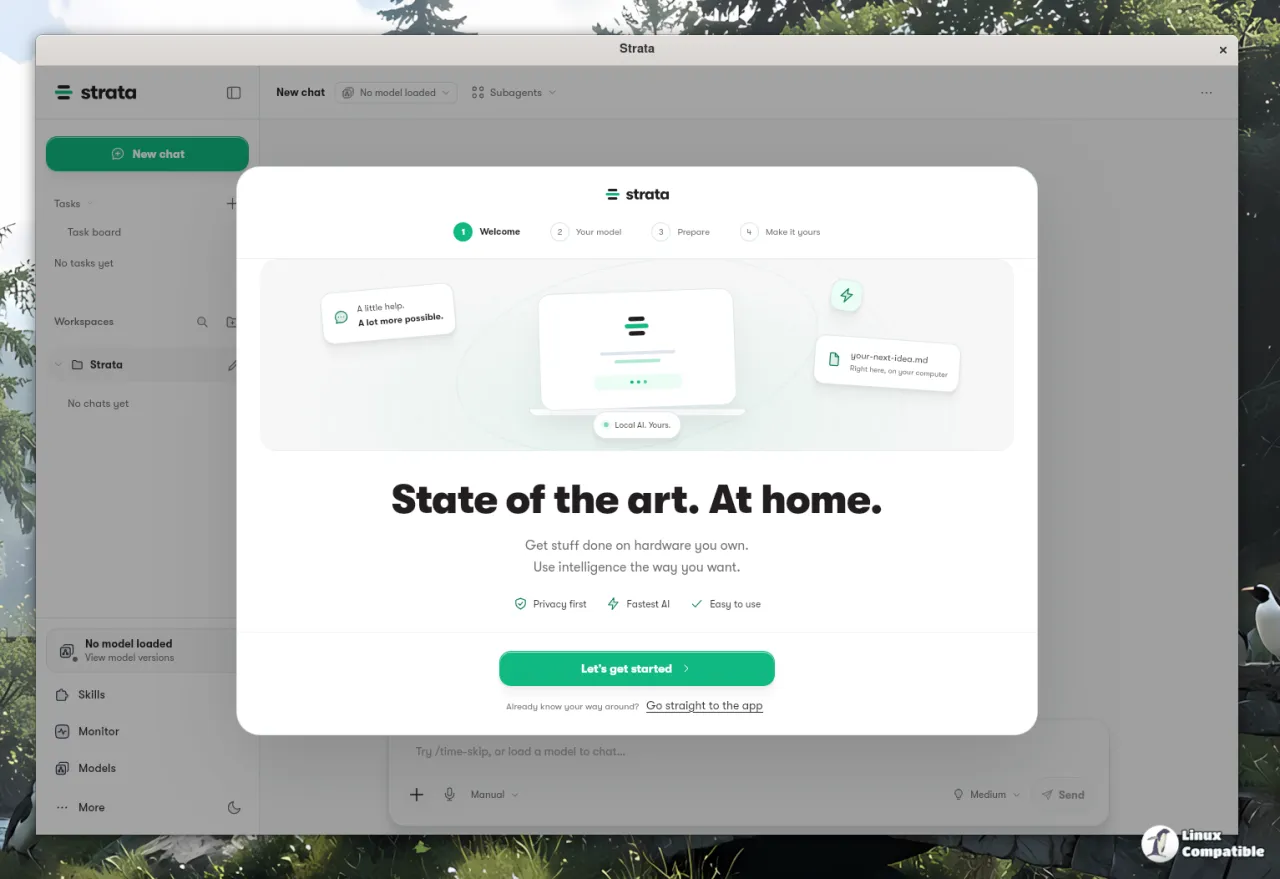
Released today as version 0.2.5, this update is really about making a complicated thing feel simple. The headline change is a single installer per operating system. The Windows and Linux files no longer bundle a GPU-specific engine. On first launch, the app shows you the right engine for your card, along with its size and one Download button with progress and resume support.
Keep in mind that Mac users still get a small Metal engine baked into the installer. It's a sensible exception.
How it actually works
The project leans on a kitchen metaphor in its documentation. Your graphics card is the counter — small but fast, and it keeps a few thousand of the most-used experts within reach. System RAM is the pantry, holding all 24,576 "experts" that make up this mixture-of-experts model. When a word needs an expert that isn't on the counter, your CPU pulls and computes it from RAM immediately, in parallel with the GPU, so neither waits on the other.
Your SSD is the archive. It stores roughly a 29 GB n-gram lookup table that the model only reads a few rows of per token, so it doesn't need to live in memory.
There's another speed trick underneath that. A small draft layer guesses the next few tokens, and the big model verifies them all in one pass, keeping the ones it agrees with. The result is roughly a 1.6 to 1.8x speed boost without changing output quality. You get the same answer, just sooner.
For what it's worth, the model isn't locked to Strata. llama.cpp already runs Qwen3.8-Flash-Next. The trade here is peak performance on a specific configuration, and you give up the ability to run the long tail of other models without fuss.
What's new in 0.2.5
DeepSeek V4.1-Flash now shows up inside the desktop app's model picker. It was previously Terminal-only, having arrived in the 0.2.4 update. Context is fixed at 8K with no calibration step.
The DeepSeek sets are enormous. They don't fit in memory and instead stream from the SSD. The download ranges from 239 GB at 1.75 bits per word to 274 GB at 2.25. Free disk space needs to run a little higher still, up to roughly 280 GB for the largest variant.
Strata introduces a "Speed" choice for DeepSeek. Choose "Faster" and the model uses five of its six experts per word instead of all six. The quality loss is usually unnoticeable. That's why "Faster" is the default on PCs with 16 GB of GPU memory or less, and on cards whose memory is shared with system RAM.
On an RTX 5070, Strata says Faster mode decoded code and agent runs 16% faster. On a Strix Halo machine it measured 11 to 13% faster on decoding and 5 to 7% on prompts. An MI325X showed no quality difference at all from Full quality. That last one is the interesting number: the speed gain was real, not just a compression artifact.
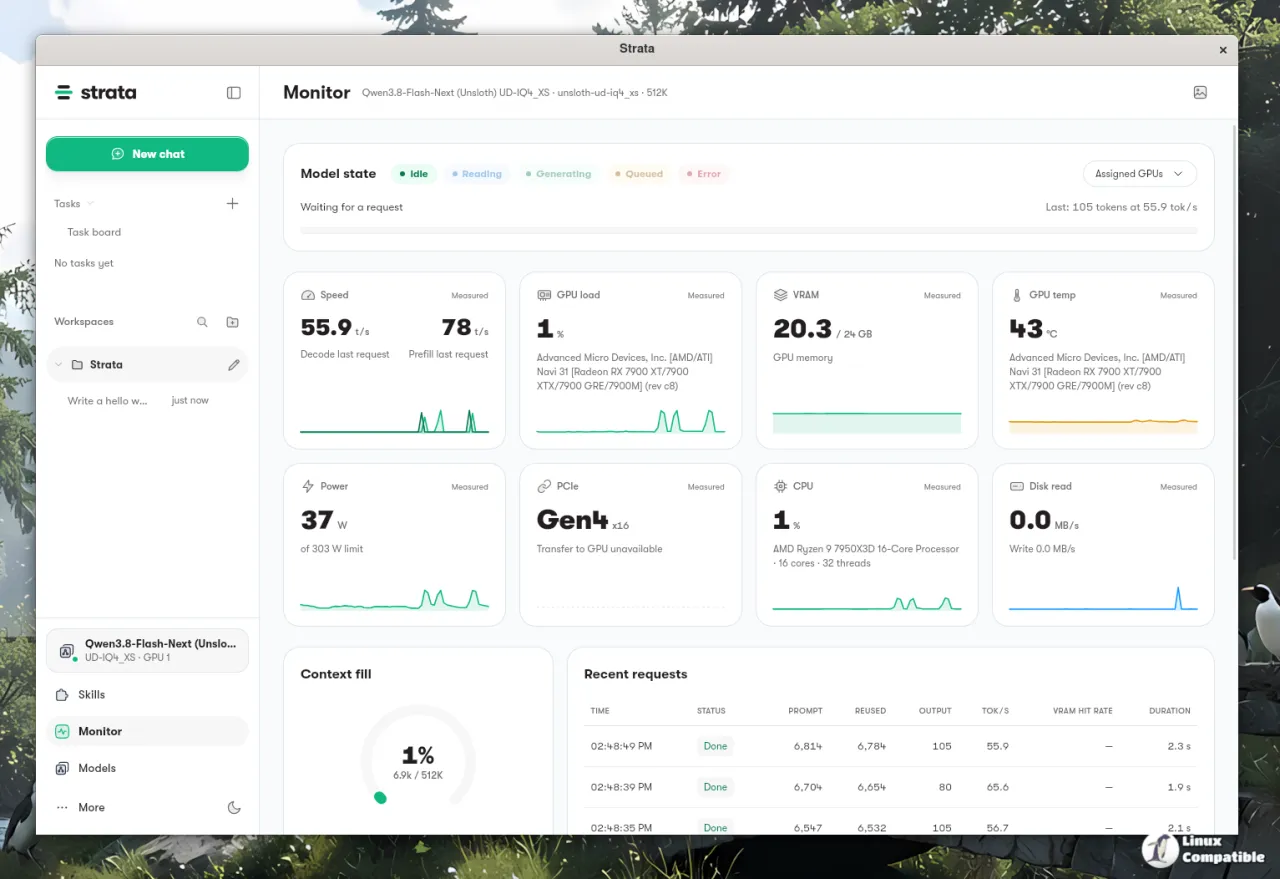
The biggest chunk of this release is a pile of performance tweaks. Most notably, the RAM store previously capped at 48 GB and would stop loading experts once it hit that ceiling. Now, where free RAM exists, it holds every routed expert. Strata cites one R9700 with 251 GB of RAM holding everything and still keeping 12 GB free, hitting 12.6 to 21.4 tokens per second on the 2.00 bpw set.
Prompt handling gets a few fixes too. NVIDIA cards under 16 GB now read prompts in chunks of 4096 instead of 8192. A multi-GPU bug that made long prompts up to twice as slow is addressed, with one R9700 reportedly jumping from 205 to 431 tokens per second on an 8K prompt.
The reception is as noisy as the install
Strata's popularity has been matched by a wave of pushback, which makes for a more interesting story than a clean victory lap.
On r/LocalLLaMA, the loudest reaction wasn't to the tool itself but to the volume of promotion. A meme post titled "Yes bots we get it, Strata is good now please stop" drew around 555 points and 359 comments. Some commenters suspected coordinated or bot-driven promotion. No evidence of paid accounts was published, though, and the star count and commit history still look consistent with organic enthusiasm.
An essay on the same subreddit, "The Rise of Overfit Inference Engines," frames Strata as part of a split in local AI between general-purpose runtimes like llama.cpp and vLLM, and narrow engines tuned to a single model-and-hardware pair. That's the core tension: you can get better numbers by ignoring everything else.
Here's the part that's easy to overlook. Many of Strata's recent commits carry a "Co-Authored-By: Claude" trailer and Claude-Session links. The developer was directing an AI assistant rather than typing every line. It's stated matter-of-factly, and maybe it should be: an engine people are being told about was substantially drafted by a model, reviewed by a human, and then measured by volunteers on their own hardware.
The numbers people are quoting also come with a caveat worth repeating. Those headline speeds come from high-end rigs with lots of RAM, not the 12 GB floor the project advertises. They prove the engine works well in practice but say less about minimum-spec performance. What's still missing is an independent benchmark on a 12 GB card.
It's a rather impressive feat for the internals it's touting, though you're paying for it with a one-time download of roughly 70 GB and a minimum of 32 GB of RAM. The small form factor and one-click install do help, at the same time.
How to try it
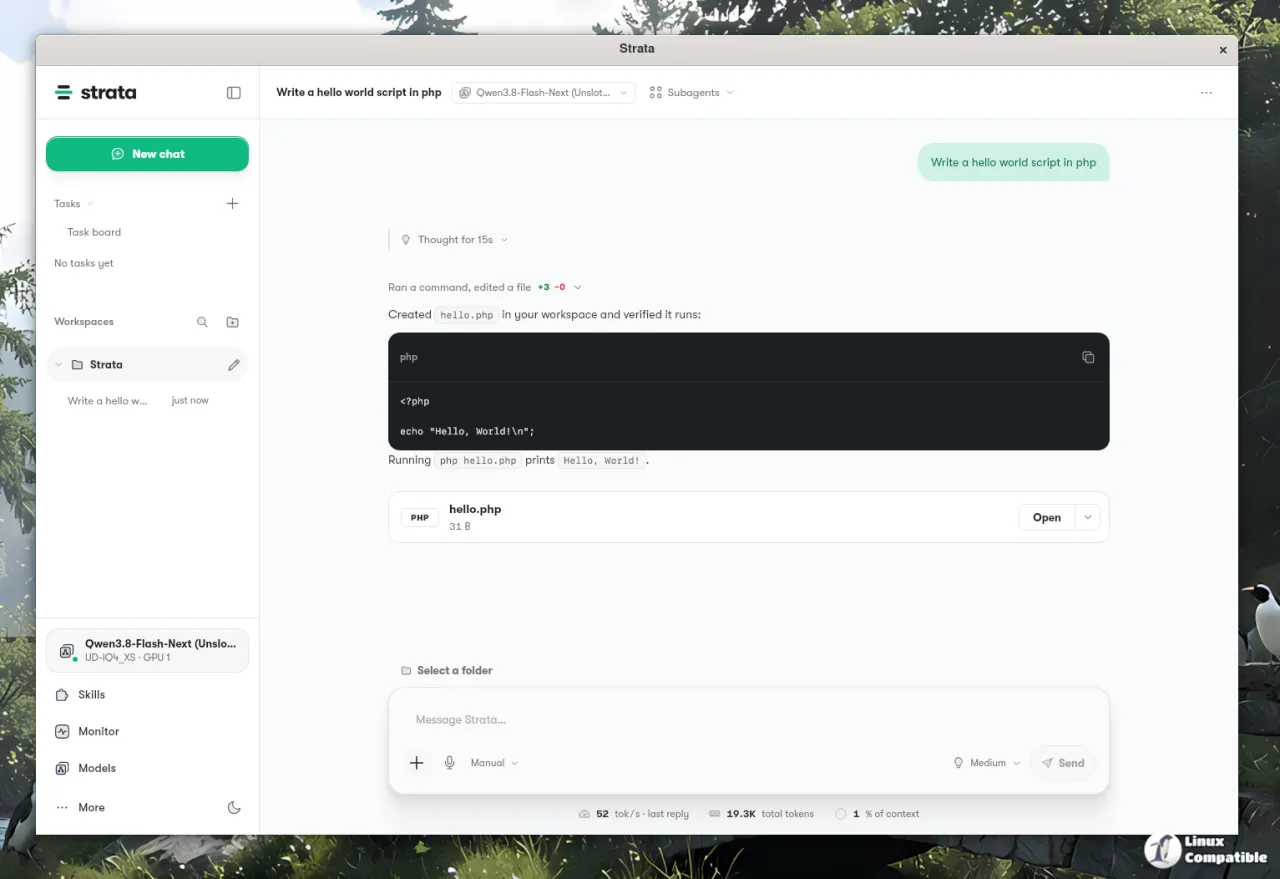
The desktop app runs fully offline once installed, with no account, no cloud and no telemetry. Strata serves a localhost server that speaks both OpenAI-compatible and Anthropic-compatible APIs, so existing agents like Cursor, GitHub Copilot, Claude Code and OpenCode can point at it as if it were a remote model.
You can grab the installer for your OS from the project's releases page, or run the one-liner from a terminal.
For Linux or Mac:
curl -fsSL https://github.com/Niko1221/Strata/releases/latest/download/install.sh -o install.sh && sh install.sh
For Windows:
irm https://github.com/Niko1221/Strata/releases/latest/download/install.ps1 | iex
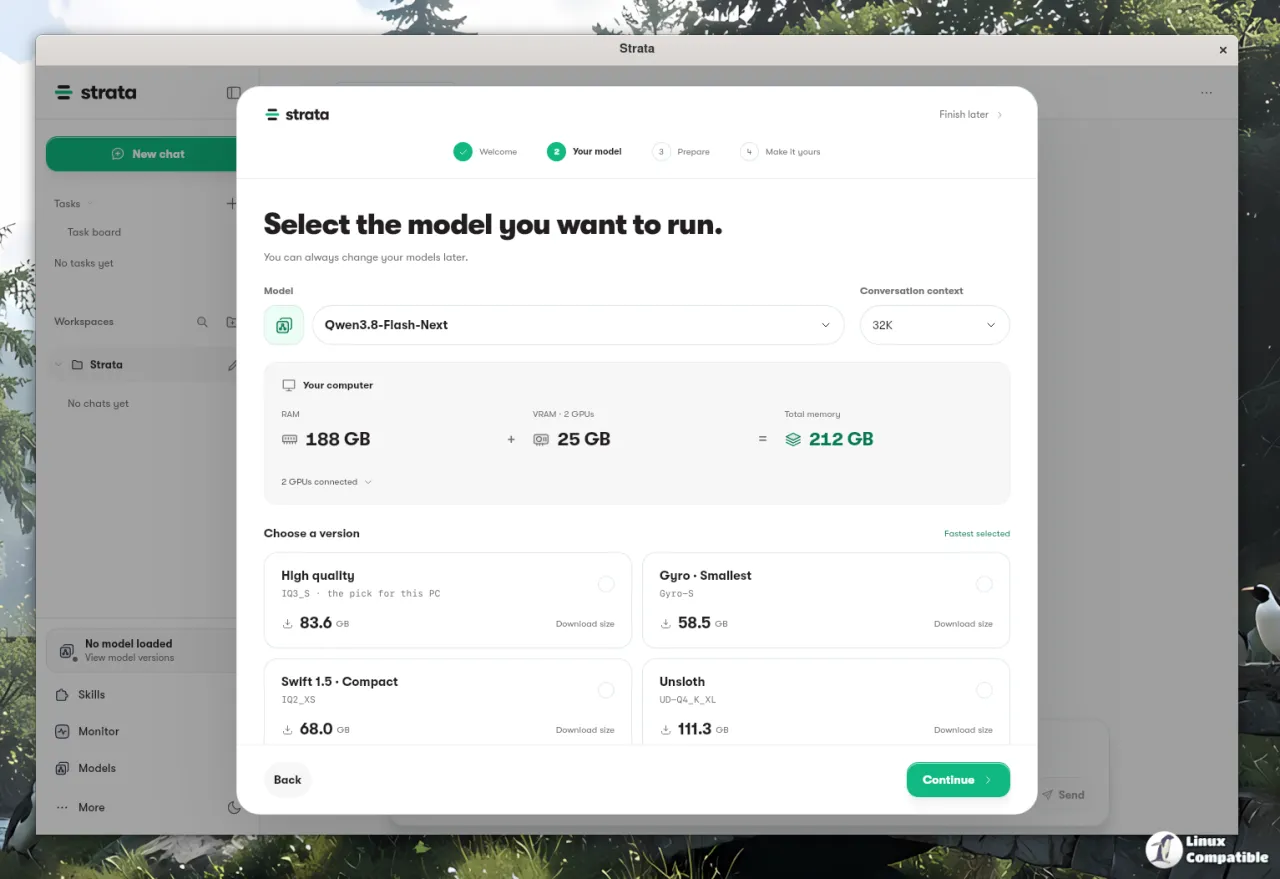
Then run strata launch. Model selection roughly tracks your RAM: 32 GB heads toward the Coder variant, 48 GB toward IQ2_XS or Q2_0, 64 GB toward IQ2_XS, and 96 GB or more toward the larger IQ3_S or Unsloth UD-IQ4_XS.
Expect one thing on first launch. The app loads 35 to 55 GB into RAM and locks part of it, which can freeze your PC for one to three minutes. It's expected behavior, not a bug.
The project is developed largely by one person, Niko Veit, based in Ljubljana, Slovenia, and funded partly through Buy Me A Coffee. It's MIT-licensed, free, and quietly one of the fastest-growing open-source AI projects on GitHub, with roughly 32,000 stars and 3,500 forks.
Head here to see the full 0.2.5 release notes and download the installers.


