Strata 0.2.21 Shipped with Speed Gains Running from 3x to 17x
The November 24 update to the open-source engine that runs a 125-billion-parameter model on a gaming PC is almost entirely about speed.
Another Strata update has been released, updating the desktop app, the terminal, all three engine families, and the Control server to version 0.1.67 across every supported platform. But if you read the release notes, the single biggest theme is unambiguous. The whole thing is a speed push.
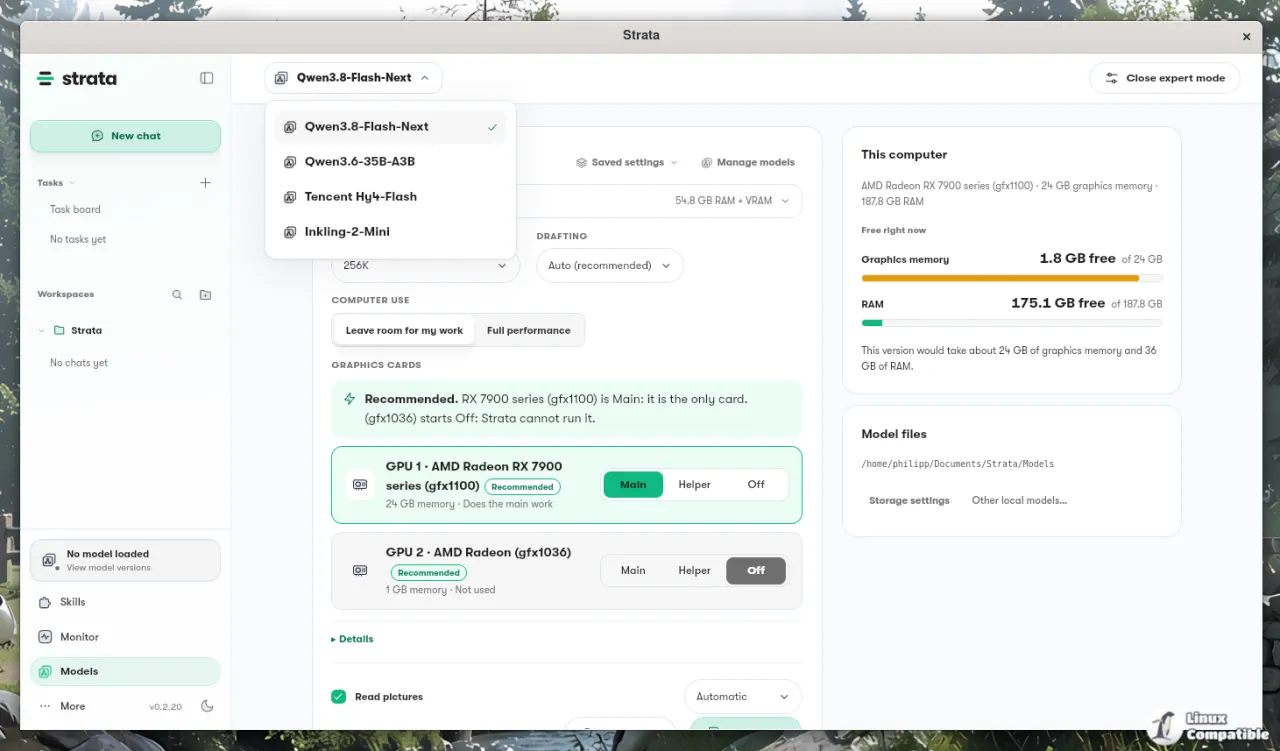
Strata says Inkling 2 Mini, its "thinking" model variant, got dramatically faster on most cards, and the biggest jumps show up on the weakest hardware. In some cases the gain is a 3- to 17-fold increase in token throughput versus the previous release. That kind of spread usually means the last version was leaving a lot on the table for certain cards, and this one is cleaning it up.
The head-to-head numbers Strata published on identical machines are the compelling part. An RTX 3060 Ti with 8 GB of VRAM climbed from 11 tokens per second to 43, a 3.9-fold improvement. The AMD RX 7900 XT is the standout: it went from 4.9 to 66 tokens per second, a 13.5-fold jump. An RTX 5070 with 12 GB moved from 12.5 to 68, and even a top-end RTX 4090 running a 32K prompt settled at 92 tokens per second once the compression was tightened.
Those are generation speeds. Prompt reading grew more modestly but still meaningfully. The RTX 5090 pushed 6,967 tokens per second reading long documents on the standard quant, up from 3,923, and nearly 9,019 on the tighter quant. Apple M5 Max users saw a 62% bump. Intel's DGX Spark ranged from 12% to 58% depending on setup.
What else changed
Beyond raw tokens per second, the update quietly fixes several things that have annoyed people for weeks.
The one Mac users will feel the most: long agent conversations no longer re-read the entire prompt on each turn. That re-reading previously hit Apple Silicon hardest, and it now works across every backend, M-series chips included. On an RTX 5090 Laptop with two or three slots, agent sessions jumped from 85 to 142 to 152 tokens per second as a related side effect.
A drifter that used to break whenever Unsloth re-hosted its files now works. In 0.2.20, Unsloth re-uploaded its model files in a way that made Strata unable to start the UD models with speculative decoding turned on. A single request now gets routed to the slot running the drifter, so it picks up the drifter's speed even with just two or four slots. At startup, a short three-minute test decides whether the drifter should be on for your particular card.
There are bug fixes too, and a few are old wounds. Strata fixed a crash that used to trigger on long conversations, and a Qwen error that said "layer 0 never rang" on RTX 30-series and newer cards. Repeated engine crashes now stop after three attempts with a clear message instead of restarting forever. Downloads are pinned so that future Unsloth re-uploads don't blow away your setup, and both GGUF layouts are accepted.
The model lineup got minor tweaks rather than new entries. Qwen3.8-Flash-Next picked up one accuracy fix in prompt reading that reorders a single sum; Strata says the first-token choice was unchanged on every prompt checked, so quality is effectively identical while speed holds. HY-4 Flash gives the same output as the previous version on Strix Halo and CPU.
The honest limits
Strata is upfront about where this release still stumbles. On 24 GB RTX 40 and 50 cards, the app now boots with just one slot by default, which is the best speed for a single user or long documents, but you can raise it. The 32-slot mode is only for short requests: with long prompts each one can wait several minutes for its first token, and on cards up to 24 GB, or on the RTX 5090 at 64K context, a 32-slot start can fail to load at all. For long documents, use eight slots or fewer.
The AMD RX 7900 XT and XTX with the SQ-20 quantization runs about 7% below the previous release, fixable with the flags --vram-experts-gb 13.2 --ram-experts-gb 2.5. Same story for 12 GB AMD cards running Inkling, which sit roughly 13% behind and need --vram-experts-gb 8.5. And with 16 or more slots on NVIDIA, the first reply after a long prompt is slightly less exact, a behavior that's been present since 0.2.20.
That last point ties into a recurring theme across the independent tests: the cost in this workflow isn't the speed of the answer, it's the wait for the first token. A 98K-token prompt can take about 38 seconds to produce its first word. Follow-up turns start in under a second once the context is cached.
To get the update, use the in-app updater or download an installer from the release page.


