Strata 0.2.2 lets you run a 125-billion-parameter AI model on a gaming PC, and it now supports Intel Arc and Macs
Developer Niko Veit ports the memory-light "Gyro" variant onto new hardware, adds per-GPU roles, and keeps the project's blunt honesty about what still doesn't work.
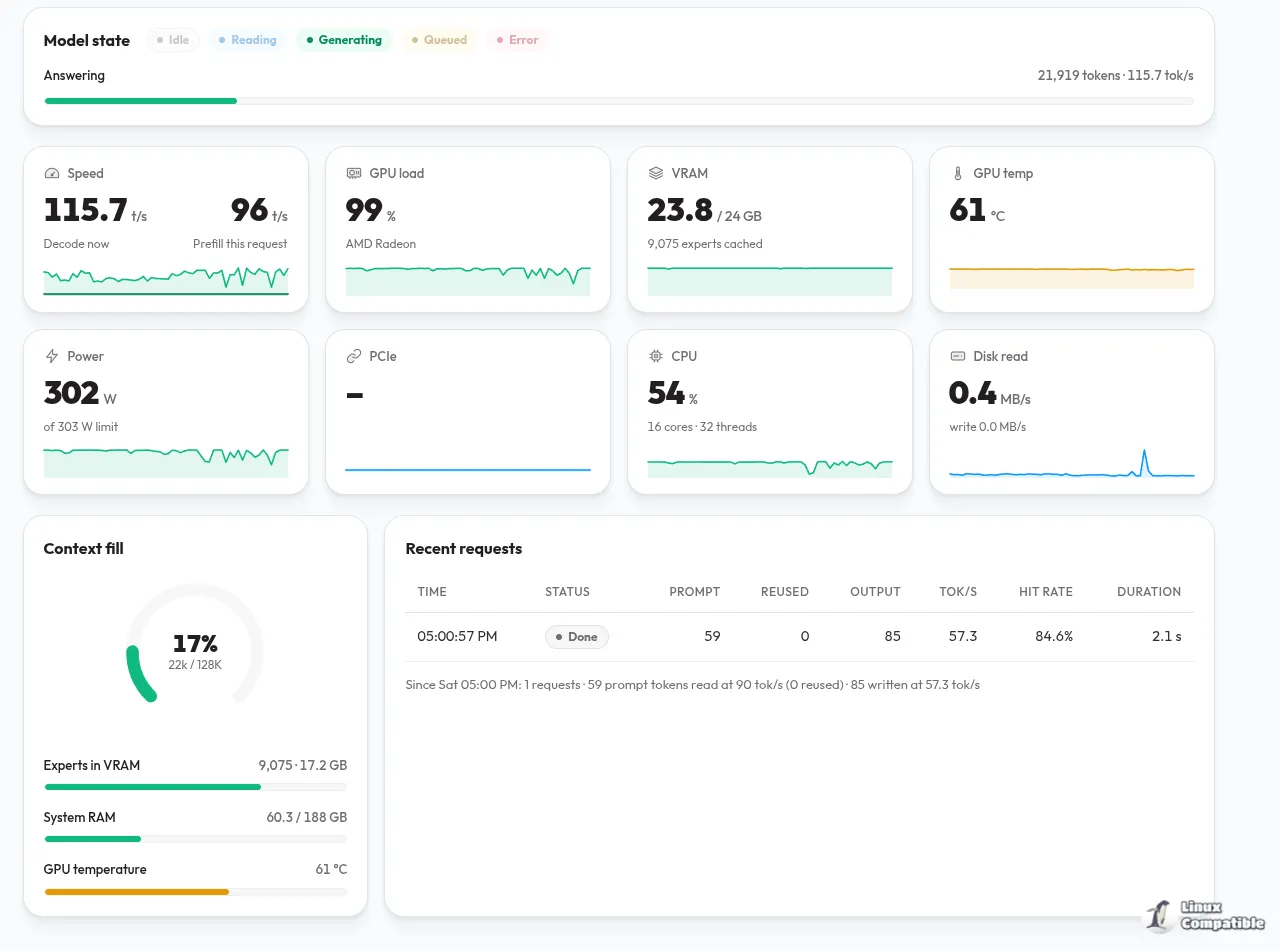
Niko Veit says he leans on AI coding assistants to ship three versions a day. That speed shows up in Strata 0.2.2, the latest update from the solo developer based in Ljubljana, Slovenia, released October 21. Strata's stated goal is to run a 125-billion-parameter model on a gaming PC with a one-click installer for Linux and Windows. No account, no cloud, and no telemetry by default. This build's headline move is getting the memory-light "Gyro" model variant to run on Intel Arc and Apple Silicon, where it could not before.
It's a big deal for a project that started under 1,000 GitHub stars a few weeks before its September 24 launch. GitHub discovery data shows it crossing 18,000 stars by October 8, and reaching roughly 29,600 by the 0.2.2 release. Forks sit at 3,100.
The model in question, Qwen3.8-Flash-Next from Alibaba's Qwen team, is a mixture-of-experts design with a total of 176.94 billion parameters, though only about 6 billion activate per token. Most of the weights can therefore live on your SSD or system RAM and get pulled in only when needed, which is exactly the trick Strata uses to keep something this size usable on consumer hardware.
The "library" analogy in Strata's own docs puts it plainly. Imagine 24,576 specialist reference books, and your GPU as a desk that only holds the few thousand most-used ones. The rest sit on RAM shelves or an SSD archive, read on demand. A tiny draft model guesses the next few words while the big model checks them, buying roughly 1.6 to 1.8 times faster answers for the same result.
Gyro finds new homes on Arc and Mac
The bottleneck with a model this size is memory, and Gyro is agentionai's answer to it. It uses rotor quantization to cram the routed experts into a smaller footprint. Gyro-S fits on a 32 GB card, and Gyro-M targets the 35 to 36 GB range. In agentionai's own benchmarks Gyro-M scored 80.0 on MMLU-Pro against 81.4 for its own larger Q4 build, which the developer pitches as 98 percent of the accuracy at about half the memory.
Strata was never the only front-end able to run Gyro. llama.cpp, vLLM, Ollama, and LM Studio all can. What sets it apart is that it's a desktop app, not a command-line tool, and now it can do this on two hardware families that were previously stuck on NVIDIA.
On an Arc A750 paired with a Ryzen 5 5600X and 62 GB of RAM, the new SYCL engine read a 1,406-token prompt at 82 tokens per second, compared to 40 before the trellis kernels took over. A 20,000-token prompt decoded at 195 tok/s.
On a Mac mini M4 with 32 GB, the Metal engine hit 9.1 tok/s on decode and 109 tok/s on a 4K prompt. The read happens from published GGUF files unchanged, which matters because it means no separate Mac build is required.
Keep in mind that Gyro is listed next to other model sizes on a Mac but never set as the default, and a 32 GB Mac streams experts from the SSD rather than holding them all. The kernels were verified bit-for-bit against the format definition, with divergence sitting at roughly the same noise floor as two separate runs of the CUDA engine itself.
The NVIDIA gains are smaller but real. On an RTX 3060, Gyro-S jumped from about 54 to 62-63 tok/s, and an older Tesla P100 decoded roughly 30 percent faster. Strata also quietly restores code for old Pascal and Volta cards in its Linux CUDA 12 package, after that code was accidentally dropped in the previous release.
Roles, fixes, and a confession of limits
The other headline feature is a per-GPU role system. For the first time each graphics card can be flagged as Main, Helper, or Off, controlling which layers it holds and whether it gets a process at all. By default the recommended card runs as Main, most others as Helpers, and any card with 8 GB or less starts Off. Point every card to Off and the server stops within a few seconds with a single plain message.
On top of that, the release does a lot of maintenance work that rarely makes news. Sharing without an API key is now allowed via --no-api-key, your own GGUF files load again, and the app and Terminal share a single models folder so you stop downloading the same thing twice. There's also a cleaner in-place move for relocating that folder, NUMA-aware expert pooling for dual-socket machines, and a standardized definition of what "answer speed" actually means.
Then there's the honesty, and the release notes are unusually explicit about what was and wasn't tested. The RX 6000 series engine was built but never run on real hardware. The Windows rdna2 package wasn't even built. A Strix Halo and discrete Radeon combo, the end-to-end Gyro-on-Mac runs, and the whole family of GPU roles went untested.
That last bit is worth sitting with. Most software launches by declaring everything works. Strata publishes a known-limits section, interleaves A/B test pairs with noise margins, and credits fixes by username. It's essentially a one-person team, and it's being candid about the tradeoffs.
It's arguably the strongest example yet of the "local AI" movement: frontier-scale models on $500 to $1,500 gaming PCs, governed by clever memory tiering rather than data-center GPUs. The privacy pitch is real too, though this release makes local sharing easier, which is why it pairs that convenience with a clear warning that anyone who can reach the port can use your model.
How to run it
Strata is free and MIT-licensed. Requirements are modest by frontier standards: at least 32 GB of combined RAM and VRAM, roughly 80 GB of free disk, and a current graphics driver. Supported hardware spans NVIDIA RTX 20 through 50 series, AMD RX 6000 through 9000 plus the R9700, Intel Arc on Linux, Apple Silicon, and AMD's Strix Halo.
You can install it three ways. The desktop app is a one-click installer for Windows, Linux, or macOS. Terminal users can run a single curl command against the releases page, or point an AI coding assistant at the setup docs. Once running, the OpenAI-compatible API lives at http://127.0.0.1:8080/v1, with an Anthropic-compatible endpoint alongside it.
Strata 0.2.2 is available now from the GitHub releases page.


