Fedora 45's Make-or-Break Release Candidate Hits Testing
The second release candidate for Fedora Linux 45 landed today after the first candidate fell through. It has a single shot to pass before an October 27 ship date.
The Fedora Project just published the second release candidate for Fedora 45, and unlike most pre-release builds, this one carries real weight. RC-1.2 (compose Fedora-45-20261021.0, image stamp 45-1.2) went out today, in every edition from Workstation to Cloud to Spins, across x86_64, aarch64, ppc64le, and s390x. And it's exactly the media QA needs to unblock a launch date the team already had to slip.
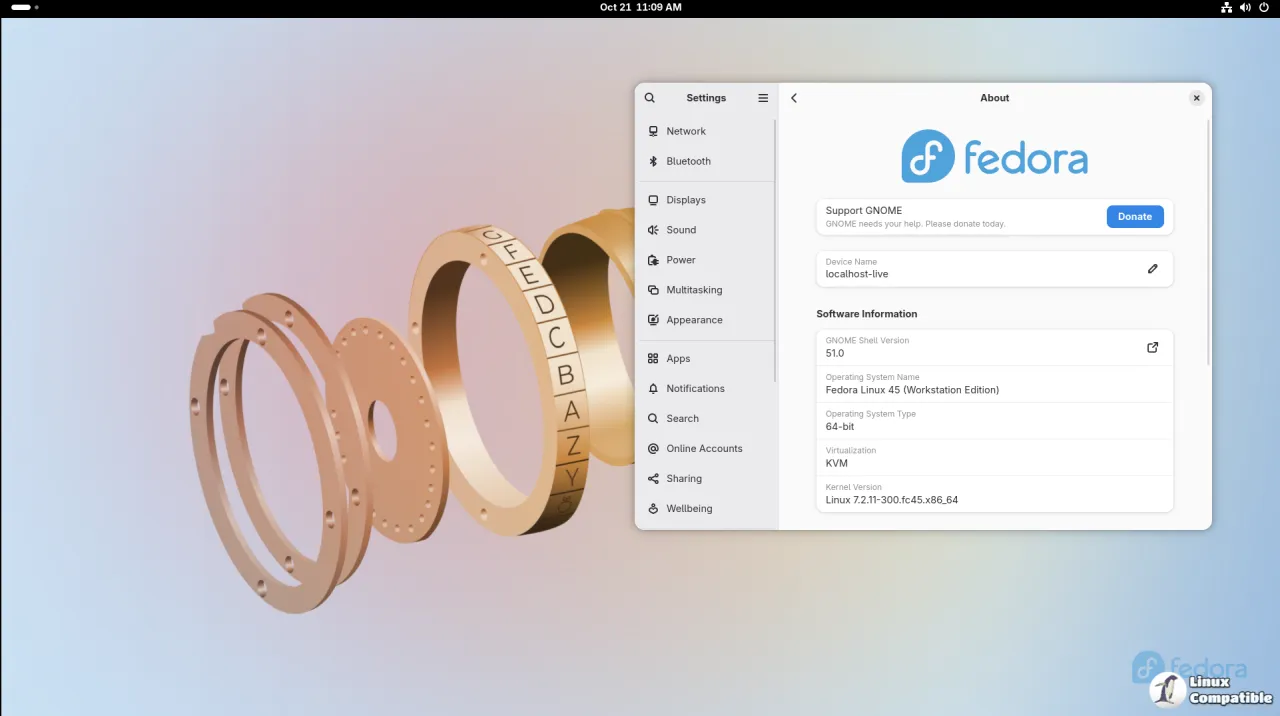
Here's the situation. Fedora 45's original ship date of October 20 got declared NO-GO on October 15 at the project's Final Go/No-Go meeting, mainly because no suitable RC media existed to validate yet. FedOps architect Aoife Moloney broke the news on the fedora-devel mailing list. A new target of October 27 was set, with November 3 parked as the built-in fallback.
So Thursday's Go/No-Go is the whole ballgame. If RC-1.2 passes release validation with no blocker bugs left over, Fedora 45 ships Tuesday. If it doesn't, the November 3 date is where this ends up.
Not just another RC
For a build that's nominally a QA checkpoint, Fedora 45 is quietly hiding a chunk of interesting changes. The one that stands out to me is kmscon replacing the legacy in-kernel VT console. Fedora Magazine calls it "surprisingly different," and honestly the label fits. You're trading the old conserver for something with smoother rendering, better Unicode support, and fewer reasons to worry about console stability during long installs.
Then there's the stuff you'd expect. GNOME 51 ("A Coruña") ships on Workstation, KDE Plasma 6.7 on the KDE edition, and the kernel is 7.2 with btrfs scheduler work and networking tweaks. Fedora's reportedly tuning things up for Snapdragon X1 laptops too, which would be a nice change for a platform that's had its share of driver headaches.
Two changes deserve a second glance. First, Fedora 45 moves to fully reproducible builds, meaning identical source should produce byte-identical binaries. That's a supply-chain trust win, even if most users will never actually run the verification. Second, the installer now requires valid RPM package signatures by default. Unsigned packages get blocked out of the box. It's a genuine security win, and yes, you'll now have to deal with signing on your custom repos.
The Atomic desktop installer picks up a WebUI flow, Web-based remote installation, and Stratis partitioning support. Fedora CoreOS gets systemd-oomd and zram swap turned on by default. And the toolchain list is practically every developer's holiday: GCC 16.2, glibc 2.44, LLVM 23, Python 3.15, OpenSSL 4.0. It's a rather generous list for the internals it's touting, though the immutable-desktop focus means a lot of it stays out of reach for casual users.
All of which brings us to why RC-1.2 exists at all.
The QA team tracks everything on result pages fed by automated openQA runs plus manual bare-metal, virtual, and cloud testing. The consolidated view is the Test Results:Fedora 45 RC 1.2 Summary page. As of now, the picture is mostly green. Installation checks pass across Workstation, Everything netinst, Server, KDE, and i3 on both UEFI and BIOS and over both VM and USB. Base tests clear on x86_64 and aarch64 for Workstation, KDE, Server, and Minimal, with Silverblue passing rpm-ostree rebase and package layering. Server, Cloud, and Desktop release-blocking tests all pass too.
There's one wart. The automated mediakit ISO Size sanity test flagged several large images for blowing past their configured size caps. The Everything boot aarch64 image runs about 1.43 GB against a 1.3 GB ceiling, and a batch of Spins and Labs trips the same gate. Functional installation tests passed, so this is fluff rather than function. QA typically reconciles these at the Go/No-Go by hand rather than treating them as a hard failure. The Security Lab results aren't in yet, but that's normal this early in the cycle.
Head here to the live openQA testcase-stats page if you want to watch the numbers move.
Want to help break it?
Every edition is available now as ISOs, disk images, cloud images, Vagrant boxes, container images, and torrents. Compose artifacts live on the Koji image server under Fedora-45-20261021.0. Workstation, Server, and Cloud each have their own download pages, with Spins and Atomic desktops linked off the main Fedora site.
If you're on Fedora 44 already, you don't need a clean install. A DNF system upgrade with the dnf-system-upgrade plugin gets you there. To submit results, either edit the result pages directly or run the relval tool:
dnf install relval
relval report-results
The hard deadline is Thursday, October 22, when the Final Go/No-Go decides whether October 27 survives. A Virtual Release Party is lined up for October 30, though that only happens if the date actually holds.
Head here to download the release.


