Strata 0.2.1 lets you run a 125-billion-parameter model on a gaming PC
The MIT-licensed inference engine runs Qwen3.8-Flash-Next on modest hardware. It also ships a fixed benchmark suite aimed squarely at a community tired of author-only numbers.
Strata, the C++ inference engine from developer Niko1221, posted version 0.2.1 on GitHub today. It is the project's first non-beta stable release. The engine inside is 0.1.46, up from 0.1.45.3, and the headline point is that this line is supposed to stop breaking. The release notes patch the crashes, stuck downloads, GPU-selection bugs, and the settings-overwriting problem that haunted the last beta. A same-day hotfix, 0.2.1.1, fixed a Windows Terminal long-path issue for AMD installs.
If you are keeping score, the project is also one of the fastest-growing open-source repos in its niche. The star counter sits around 28,800 with roughly 3,000 forks. That much traction usually comes with kindling.
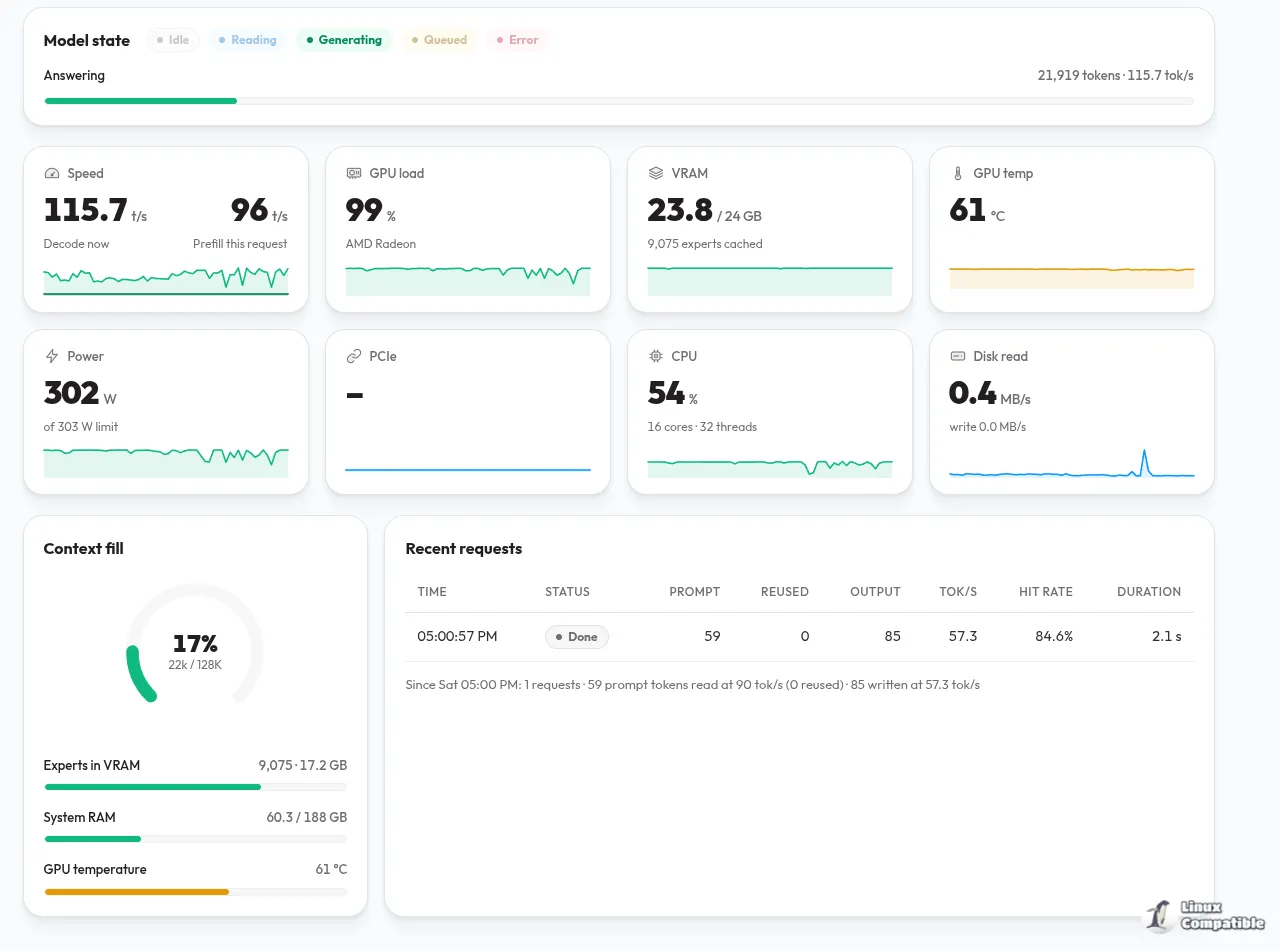
What Strata actually runs
Strata is deliberately single-model. Its whole engine wraps around Qwen3.8-Flash-Next, released by Alibaba's Qwen team on August 26 under the Qwen Community License 1.0. It is a 125-billion-parameter model, though only about 6 billion of those parameters activate per token. That gap is the entire trick.
The full count includes a 51-billion-entry n-gram lookup table and a 4-billion Multi-Token Prediction head. On benchmarks the model reportedly beats its 397-billion predecessor on agentic and coding tasks, scoring 62.5 on SWE-bench Pro and 73.9 on CoWorkBench, while training at roughly one-ninth the compute. Those are vendor numbers for the full-precision build. Strata runs quantizations far smaller than that, a point worth circling back to later.
The minimum bar is deliberately low. Strata wants 32 GB of RAM plus VRAM combined, with a 12-to-16 GB graphics card as the floor. The app also exposes an OpenAI-compatible and Anthropic-compatible API on localhost at port 8080, so agents like Claude Code, Codex CLI, and OpenCode can point at it as if it were a cloud service, with everything staying on your machine.
Here's the part that makes consumer hardware feasible. Strata describes its memory system with a library metaphor. The GPU is the desk. RAM is the reading room holding all 24,576 experts. The SSD is the archive holding that 29 GB lookup table. When a word needs an expert not already open on the desk, the CPU pulls it from RAM while the GPU keeps working. Strata calls this Dynamic Expert Caching and claims speculative decoding buys it 1.6 to 1.8 times faster generation.
This release in detail
Beyond the fixes, 0.2.1 lands a few things worth knowing about.
The Tasks screen gained a Schedule and Board switch that turns scheduled work into a kanban view. You get a running column, a waiting column for tasks needing approval, and a failed list. Each run collapses to a single line showing only the newest problem per task, and the sidebar counts what needs attention. All eight app languages got translated as well.
Vision is the other headline. The macOS app and Terminal now read images through a Metal GPU reader by default, signed with the app. On an M4 Strata measured a 260-token picture at 0.45 seconds on the GPU versus 50.7 seconds on CPU. A 972-token picture came in at 2.4 seconds versus 194. The GPU reader uses about 1.2 GB of memory, and on that big picture 8 of 972 tokens differ from the CPU reader, though the answers stayed correct.
Intel Arc got its own reader too. Alchemist cards read images by default through the CPU, while Battlemage stays opt-in after a card-reset concern. Strata reports a SYCL GPU reader hitting 0.16 seconds per picture on an A750 versus 1.73 on CPU.
Downloads run faster now, using 16 connections with multiple pieces per request instead of the eight from the beta. On a test box, main model files improved roughly 9 percent to around 74 MB/s, and the draft-layer fetch dropped from 28 seconds to 4.6. Files are still checked against pinned SHA-256 sums.
Ready-made Docker images are here for cuda, rocm, and Strix Halo builds, though there is no Intel image yet, and two of the images were built but never run on actual hardware.
The numbers debate, finally being measured
What actually sets 0.2.1 apart is its obsession with defaults, and not just hand-waving. Each new default comes with interleaved A/B measurements on real hardware, a note on whether the output is bit-identical to the prior build, and an off-switch via environment variable.
The Radeon 780M iGPU got a prompt-speed bump measured on a Ryzen 7 8745HS, pushing a 1K prompt from 98.5 to 157.3 tokens per second with identical token IDs. The Strix Halo tuning rests on a community A/B that claimed 250.9 to 528.9 tokens per second, but the maintainers openly admit they have no Strix Halo hardware of their own. Two NVIDIA cards switched to a serial batch group for a 12 to 16 percent throughput gain, with a caveat that a card with a tiny expert cache can actually lose.
Where this lands
The quantization caveat deserves its own mention. Strata's speed numbers target models compressed to roughly 2 to 3 bits, things like IQ2_XS or IQ3_XXS, not the full-precision model Qwen benchmarks against rivals. For real work, one PromptHackers roundup reportedly advised nothing below 4-bit, at which point a cloud GPU may actually be cheaper. The README is upfront about the tradeoff: smaller means faster, larger means a bit smarter, and the Coder variant keeps only half the experts for code-focused use.
Independent hands-on accounts are mostly positive. blog.martin.ae ran an RX 6800 with 64 GB of RAM, starting around 30 to 40 tokens per second and reaching 50 to 60 after moving the card to a proper PCIe x16 slot. Hokuto Engineering's teardown confirmed the three-tier caching plus speculative decoding could reach 50 to 90-plus tokens per second on a 12 GB card, while flagging several-minute cold starts and task-dependent accuracy trade-offs.
Strata is a genuine proof of concept that a 125-billion-parameter model can fit on a gaming rig, even if it doesn't always run well enough to matter. The move toward a fixed, checksummed benchmark suite documented in COMMUNITY_BENCHMARKS is the most promising signal yet that this debate might eventually settle on data instead of hype.
Head here to the full release notes.


