QEMU 11.1.0 Ships with NVMe Hotplug and a Host of Security Patches
The August 2026 release brings dynamic storage management, specific purpose memory emulation, and over a dozen CVE fixes.
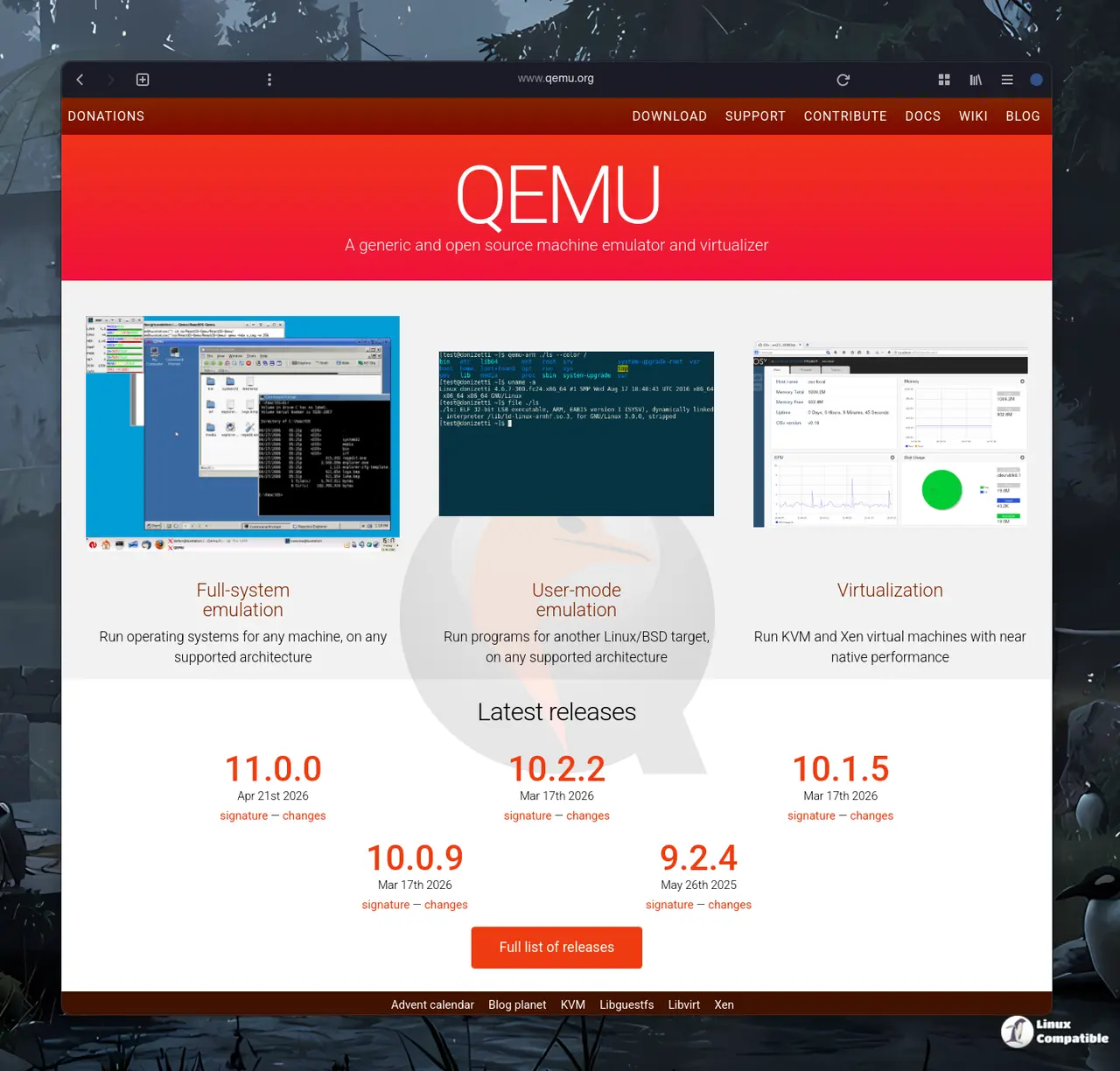
QEMU 11.1.0 has officially landed. Tagged by Stefan Hajnoczi on August 11, 2026, this release wraps up roughly 3,500 commits from the last quarter. It's a security-focused maintenance drop that brings some meaningful feature additions alongside the patches.
The numbers behind this release are substantial. 285 contributors touched the codebase, resulting in over 111,000 lines added and nearly 46,000 deleted across 2,431 files. Philippe Mathieu-Daudé leads the pack with 313 commits, followed by Richard Henderson with 270 and Peter Maydell with 253. That's a lot of churn for a ~3.5-month window between this and the v11.0.0 release in April.
Security: Patches for a Dozen Vulnerabilities
If you're running QEMU in production, this update is non-negotiable. The release addresses at least 12 assigned CVEs, targeting guest-triggerable vulnerabilities in host-mode QEMU. The fixes span multiple subsystems, including virtio, 9pfs, the dmg image parser, and NVMe.
Notable among the fixes are an infinite loop in virtio_queue_empty() (CVE-2026-16457) that could lead to denial of service, and a memory exhaustion issue in 9pfs where Treaddir allocation wasn't capped (CVE-2026-9238). There are also out-of-bounds access issues in the dmg parser and missing size checks in virtio-blk. Beyond the assigned CVEs, the team applied hardening patches for USB, VNC, VFIO-user, and CXL subsystems.
Dynamic NVMe and Specific Purpose Memory
Beyond the security work, there are a few features worth noting. The most practical for cloud deployments is NVMe namespace hotplug. You can now add and remove NVMe namespaces dynamically via QMP commands without rebooting the guest. This should simplify dynamic storage scaling in workload scenarios.
For servers with discrete GPUs or AI accelerators, the new sp-mem device type is relevant. It enables emulation of Intel Specific Purpose Memory regions with proper ACPI SRAT table generation. The integration handles SOFT_RESERVED e820 memory map entries and QMP/HMP introspection, which helps if you're trying to model modern server hardware more accurately.
The QEMU monitor subsystem has also seen modernization. Monitors can now be created and removed at runtime using -object monitor-qmp or monitor-hmp. There's a new option for auto-deletion on client disconnect, which is handy for multi-VM orchestration and container-based deployments.
Architecture and UI Updates
RISC-V emulation gets a major boost with the implementation of the RISC-V IOMMU, including S-stage translation and MSI PTE checks. This brings the platform closer to full emulation parity. ARM developers will appreciate the implementation of FEAT_FPRCVT for vector FP conversion instructions as part of the SME2 extension.
On the UI side, a full VT100 terminal emulator has been added to the display layer. It's useful for embedded or serial console scenarios where you don't want to rely on external tools. GTK display backend now supports console hotplug events, and the Hexagon TCG subsystem has established functional test infrastructure.
Build system improvements include better Meson and Rust integration, with qemu_ldflags now propagating to the Rust link step. There's also a fix for the Parallels format regarding header size and bat_entries overflow.
What's Next
With 12+ CVEs addressed, the immediate action item is upgrading your production instances. The feature additions like NVMe hotplug and dynamic QMP monitors are significant for orchestration but won't matter if your instances are vulnerable to guest-triggered exploits.
Keep in mind that the RISC-V IOMMU and sp-mem features require specific machine configurations to be useful. If you're just running generic x86 VMs, the security patches and block layer fixes are your primary targets.
For the full list of changes, check the official release notes.. The release can be downloaded from here.


