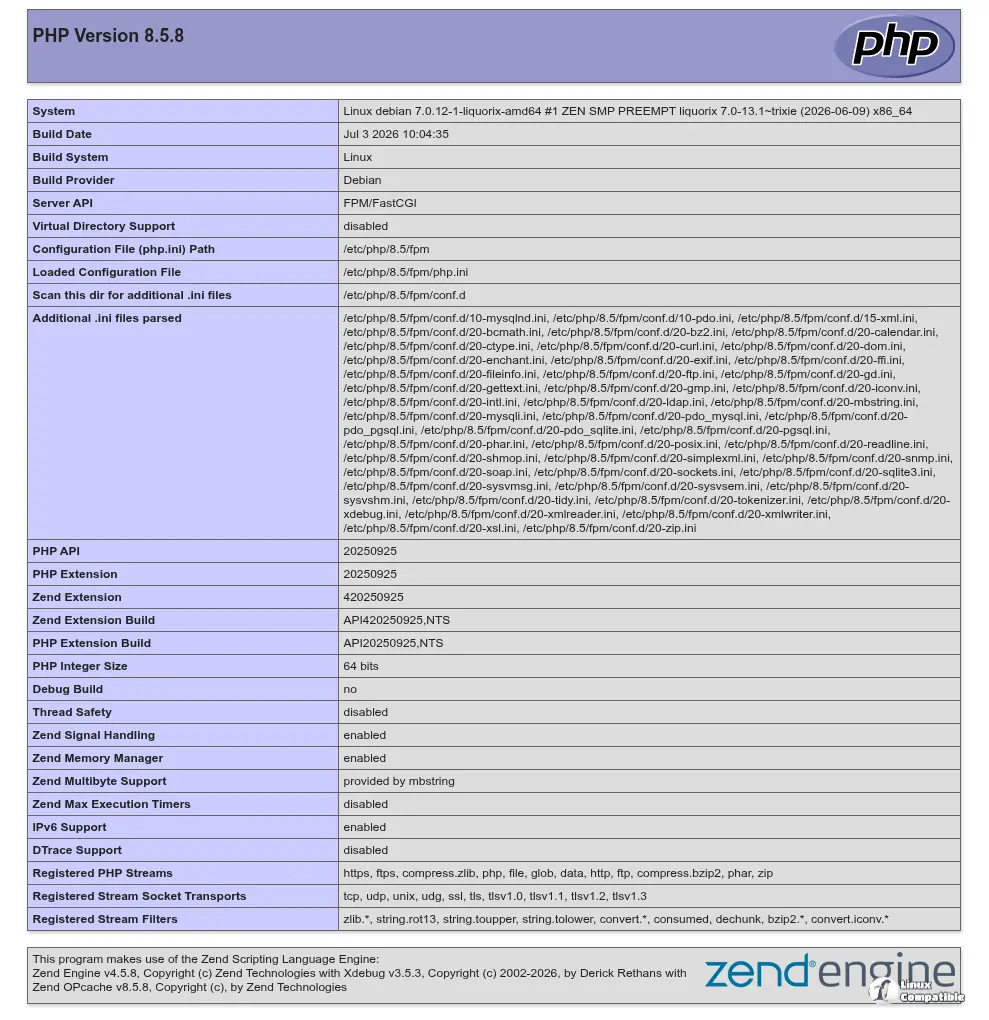
Ondřej Surý has released fresh PHP packages spanning from 5.6 up to 8.5, with the newest builds landing at 8.4.22 and 8.5.8 for Debian 11, 12, 13 and Ubuntu 24.04 and 26.04 LTS. The debsury.org repository continues to support coinstalling multiple PHP versions simultaneously, allowing administrators to run specific builds alongside legacy branches without library conflicts.
New PHP packages drop across Debian and Ubuntu, including fresh 8.4 and 8.5 builds
If you manage PHP on a Debian or Ubuntu server, your package manager just pulled in a massive round of updates. Ondřej Surý has pushed refreshed builds for eleven version branches, ranging from PHP 5.6.40 all the way up to 8.5.8. The packages are already available for Debian 11, 12, and 13, alongside Ubuntu 24.04 LTS and 26.04 LTS.
That's a lot of ground to cover in a single repository snapshot. You'll get 5.6.40-103, 7.0.33-91, 7.2.34-65, 7.3.33-34, 7.4.33-30, 8.0.30-24, 8.1.34-8, 8.2.32, 8.3.32, and 8.4.22 sitting right next to the bleeding edge 8.5 release. The older branches that upstream has marked end of life are getting security-only patches rather than feature updates. Don't assume those legacy builds will live forever in the free repository, but Surý keeps them around as long as the maintenance burden stays reasonable.
Running multiple PHP versions without the dependency hell
The deb.sury.org repository has never been about chasing the latest feature release. It's about giving sysadmins the ability to keep five or six PHP versions on the same box without fighting over shared libraries. Install php8.2-cli, php8.2-fpm, and php8.2 and they'll all coexist cleanly with their 8.4 or 8.5 counterparts. Native extensions like php8.2-sqlite3 lock to that specific release, while PECL modules such as php-memcached share one package name across the entire tree. You can swap the default interpreter with a quick update-alternatives call or execute a specific build inline without touching anything else.
As of the Bookworm rebuild, Surý is compiling for amd64, arm64, and armhf. If you're running an ARM VPS or a Raspberry Pi cluster, you're covered. Ubuntu non-LTS releases aren't officially supported, and anything past EOL gets funneled toward Freexian's paid PHP LTS program. That means your Stretch or Bionic server isn't completely abandoned. It just requires a commercial contract to keep getting security patches.
One maintainer, a mountain of packages, and no patience for hand-holding
Surý has been packaging PHP for Debian since 5.0. He's been a Debian Developer since 2000, and his PPA sources match upstream releases exactly. That consistency is why most server admins skip the distribution defaults and point straight to his repo. The project runs entirely on his spare time, funded by Patreon, GitHub Sponsors, and Freexian's commercial tier. He's transparent about the boundaries: no guarantees on EOL version longevity, no basic sysadmin support, and his inbox is effectively a dead drop. The Codeberg issue tracker is where bugs actually get seen.
The repository is built for people who already know how to manage their own systems. You install it, you pin your versions, you handle the extensions. If you're migrating a legacy app off PHP 7.4, the coinstallable architecture makes the transition painless. You just point your web server to the new FPM socket, test, and switch the symlink when you're done.
Head here to add the repository to your system. The install script pulls a signed README and sets up the GPG key in one shot. Keep in mind that switching between builds is just a symlink away, and upgrading to 8.4 or 8.5 is straightforward if your current stack plays nice.


