Nobara Linux 44 has arrived as the latest release from GloriousEggroll, the developer behind Proton-GE, launching on August 28, 2026 with five distinct editions tailored for gaming and creative workflows. The Fedora-based distribution continues its transition to a rolling release model and now features a unified ISO that supports both AMD/Intel and NVIDIA installations, though users must disable Secure Boot to proceed. The system ships with a preconfigured gaming stack including WINE, Lutris, and custom kernel patches, alongside Brave as the new default browser replacing Firefox. Community-funded by approximately 1,577 Patreon supporters, the project remains a hobby-level effort intended for personal use rather than mission-critical environments.
Nobara Linux 44 lands with five editions and a rolling release model
Thomas Crider, known as GloriousEggroll, ships the latest iteration of his Fedora-based gaming distro, complete with a unified NVIDIA ISO and Brave as the new default browser.
Nobara Linux 44 is finally here. If you've been following the Linux gaming ecosystem, the name GloriousEggroll should be familiar. That's Thomas Crider, a Denver-based engineer and the developer behind Proton-GE, the community fork of Valve's Proton that has become necessary for running Windows games on Linux with minimal friction.
Crider is back with Nobara Linux 44, released August 28, 2026. It's a Fedora-based distribution purpose-built for gaming, streaming, and content creation. The latest release ships in five editions and continues the rolling release model Crider adopted in May 2025.
The project has exploded in popularity since its July 2022 debut. According to Boiling Steam and ProtonDB data, Nobara climbed to roughly 4% market share among ProtonDB users within its first year. That growth rate beats both EndeavourOS and Garuda Linux at similar checkpoints. The rapid adoption is largely attributed to Crider's existing reputation in the community.
Not exactly a household name. But for anyone trying to play Baldur's Gate 3 on Linux without a headache, GloriousEggroll is basically a household hero. The name "Nobara" itself comes from Nobara Kugisaki, a character in Jujutsu Kaisen. It's the anime that inspired Crider to start the project, which is a colorful origin story for a system tool.
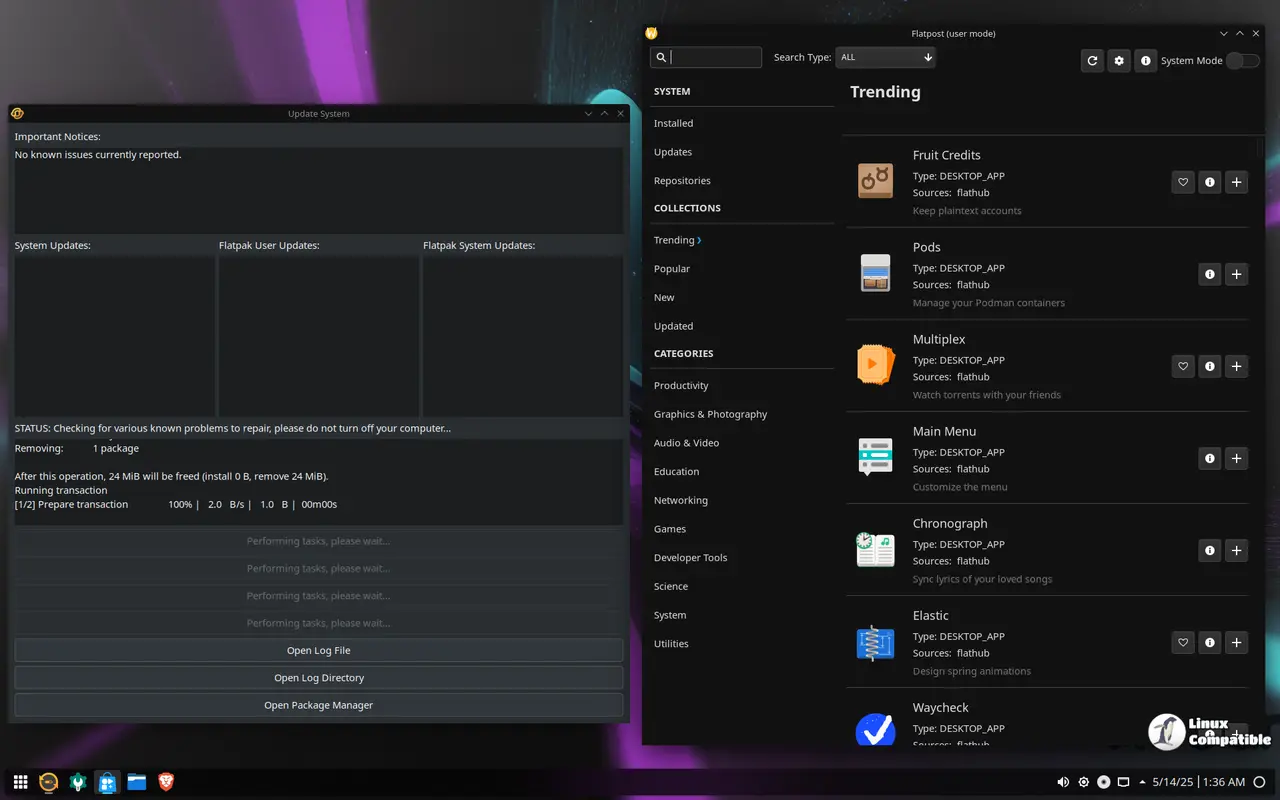
Five editions for every setup
You can grab Nobara 44 in five distinct flavors. The Official edition offers a reference experience with a custom KDE look, balanced for games and creative work. If you prefer a cleaner interface, the GNOME edition is optimized for laptops and touch devices. There's also a traditional KDE build for power users, a Steam-HTPC edition for living room gaming with a console-like interface, and a Steam-Handheld edition scaled for Steam Deck-style hardware.
All editions share the same base packages and repositories. The difference is purely in the desktop environment and UI layout.
Rolling release and a custom stack
The switch to a rolling release happened six months ago with version 42. Since then, you get continuous updates without waiting for major Fedora version bumps. That update also brought a change to the default browser: Brave replaced Firefox starting with v42.
One notable improvement in Nobara 44 is the unified ISO. The image handles both AMD/Intel and NVIDIA installations, so you no longer need to hunt for a separate NVIDIA variant. However, keep in mind that Secure Boot is not supported. You'll need to disable it in your UEFI settings to get Nobara running. This is a common limitation for gaming-focused distros due to the headaches of signing proprietary drivers.
The software stack is where Nobara really differentiates itself. Proton-GE is preinstalled alongside WINE, Steam, and Lutris. For content creators, OBS Studio, Blender, and Kdenlive are ready to go. You also get custom kernel patches for latency and video playback, plus tuned Mesa and Vulkan drivers.
It's a rather aggressive stack to maintain. Crider is doing it as a solo hobby project, funded by about 1,577 Patreon members contributing roughly €1,160 a month. There's no corporate backing or venture capital here. Crider is explicit that Nobara is intended for personal use, not mission-critical production environments. While the funding model is sustainable for a labor of love, the project does carry the inherent risk of relying on one person's continued interest.
Head here to download Nobara Linux 44. The ISOs are available at nobaraproject.org and support x86-64, armhf, and aarch64 architectures. For installation, Crider recommends Ventoy for multi-ISO workflows, or Fedora Media Writer and Rufus in DD mode with GPT. The project also maintains a wiki at wiki.nobaraproject.org for documentation, and there's an official Discord server if you run into issues.
Six months after the rolling release announcement, Nobara 44 is the latest proof that the model is holding up. If you're looking for a Linux distro that skips the manual configuration and just works for games, this is one worth checking out.


