Mesa 26.2.7 ships: 142 bug-fix commits, zero new features
Mesa's latest maintenance update delivers crashes, corruption, and leak fixes, and nothing new at all.
Mesa 26.2.7 landed today, and per Mesa's own convention it ships with one declared feature. That feature is "none." Release manager Eric Engestrom spelled it out plainly on the mesa-announce mailing list: this is a straight bug-fix release, the kind that's supposed to keep your existing drivers from crashing, leaking memory, or corrupting frames. And it looks like one of the more work-heavy point releases in a while.
The numbers back him up. There are 142 commits from 55 unique contributors, placing 26.2.7 ahead of both 26.2.6 (October 28th) and 26.2.5. A typical point release runs somewhere in the 80-to-130 range, so 142 sits toward the top. Two weeks out, 26.2.8 is already on the calendar for November 25th.
Engestrom's announcement reads about as exciting as a bus timetable, which is arguably the whole point. You don't want Mesa to be interesting.
The fixes themselves
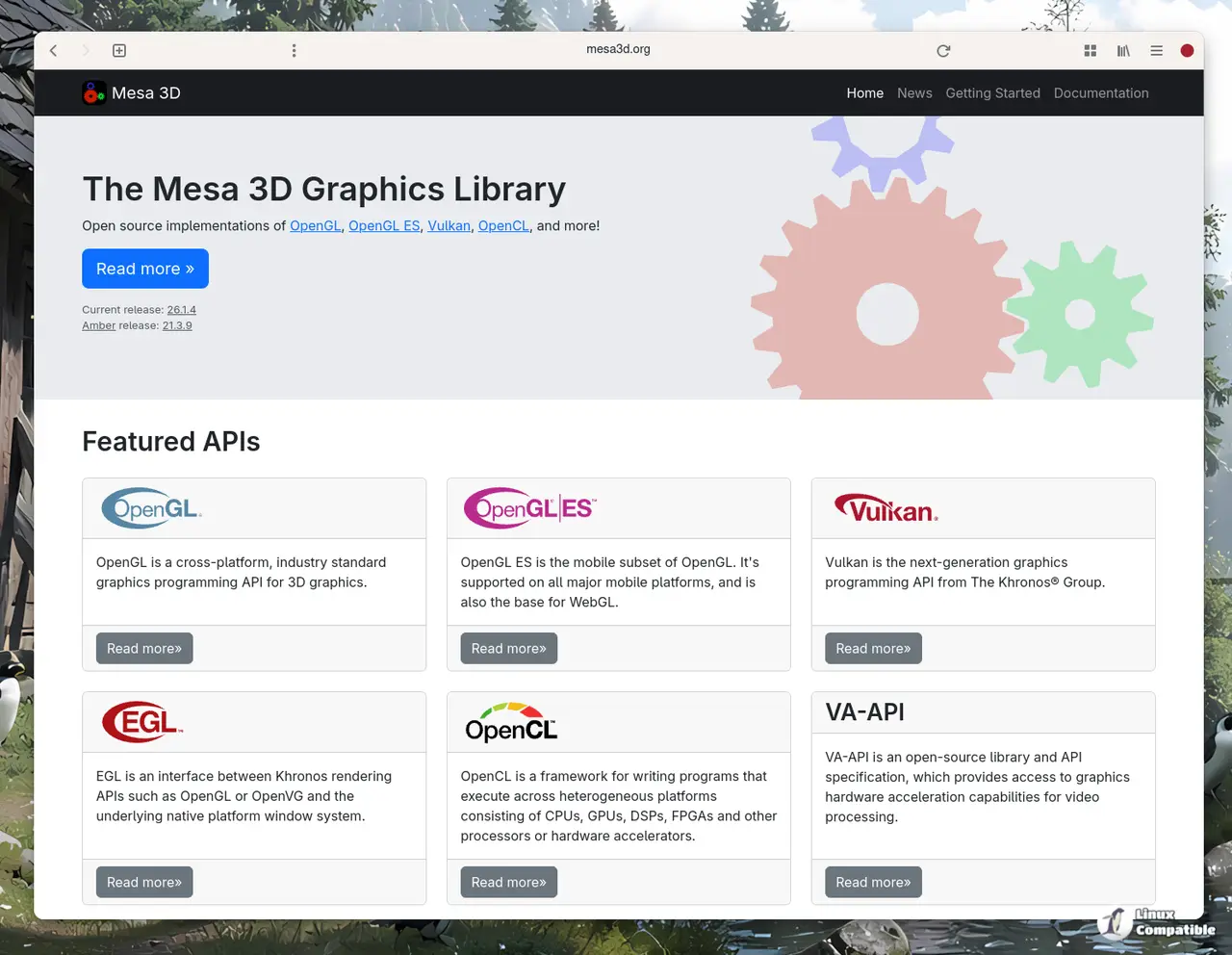
Mesa is the open-source graphics stack quietly rendering whatever's on your Linux screen. It implements OpenGL, Vulkan, OpenCL, and the rest, sandwiched between your games and your GPU. AMD and Intel lean on it hard, NVIDIA's free NVK driver rides on it too, and you've almost certainly never heard its name. Millions of machines depend on it daily anyway.
AMD's stack took the largest share, since Linux gaming leans on it. Timothy Arceri pushed a cluster of DCC and HTILE compression fixes aimed directly at texture corruption and hangs. Marek Olšák repaired conditional-rendering state that could corrupt occlusion queries, while David Rosca's AV1 video-decode crash, a division-by-zero in film-grain handling, finally got the guards it was missing.
Intel picked up two things: a PIPE_CONTROL barrier fix on Xe2+ hardware and a handful of game-specific drirc workarounds. An assume_full_subgroups hook is now enabled for The Last of Us Part II, and an fma tweak landed for Project Wingman. These are exactly the quiet per-game patches that smooth rendering without a full driver rewrite.
NVIDIA isn't forgotten either. NVK picked up fixes alongside a push on the Apple AGX driver, which Mary Guillemard took over this cycle after running NVIDIA/Nouveau compute work last round.
Yiwei Zhang contributed 14 patches, the single largest batch, and almost all of them targeted Venus, Mesa's layer for exposing descriptor handling under virtio-gpu and similar virtualized setups. It's not the flashiest work in the tree, but reference-counting and cache-correctness fixes like these are precisely what stop GPU-accelerated VMs from hanging or leaking after hours of use.
Mike Blumenkrantz led overall with 18 commits, spending most of them on OpenGL's pixel-map handling and the Zink translation layer. He advanced driver state before the first draw and resolved geometry before enqueueing, among a dozen or so related hardening patches.
None of that is visible to end users unless something was about to break. It's a rather impressive patch count for a release that promises nothing, though most of it stays invisible until it matters. That's fine, and it's the deal Mesa makes with you every two months.
Where this cycle heads
26.2.7 sits near the tail of the 26.2 feature cycle, which opened August 5th. The bi-weekly bugfix cadence has held firm, and the next bugfix release, 26.2.8, is due November 25th.
The bigger move is just around the corner. The 26.3 feature release is expected later this November, and that's where the ambitious work lands. Already in flight upstream: Intel's "Jay" shader compiler, a common Vulkan layer for carrying cross-driver workarounds, and "Shiva," a new Vulkan framework modeled on Gallium3D. The 26.2.x stable line soaks up all that experimentation before it reaches your desktop, which is exactly why a release like 26.2.7 matters. It's the quality gate between bleeding-edge development and your actual screen.
Getting it is the easy part. The tarball lives under the Git tag mesa-26.2.7, and it's signed and checksummed, so source-builders can pull it from Mesa's GitLab while distribution users will usually catch it through their package manager. That timing depends on each distro's schedule and backporting policy, so don't expect it everywhere at once.
Head here to download the tarball.


