Tails 7.17 shipped today as a routine maintenance release bundling three component updates: Tor Browser 16.0.1, Tor client 0.4.9.16, and Linux kernel 6.12.116. Notably, the Tor client jump to 0.4.9.16 is an emergency release aimed at relieving overload on the network's directory authorities. The browser upgrade pulls in Firefox ESR 153.7's large batch of remote code execution fixes, including ones backported from Firefox 160. There are no new features, and anyone on Tails 7.0 or later gets an automatic upgrade while older installs must go fresh, erasing Persistent Storage.
Tails 7.17 Ships as a Routine Security Update With an Emergency Tor Client Patch
The latest Tails release bundles Tor Browser 16.0.1, Tor client 0.4.9.16, and kernel 6.12.116. Only one of those changes is really worth your attention.
Tails 7.17 went out today, and it's exactly what you'd expect from a point release. Three component updates, no new features, no interface changes. The team isn't adding anything shiny this time. It's just keeping the anonymity stack patched, which is honestly the whole job.
Except one of those updates is an emergency release, and that's the part worth a second look.
Keep in mind the three moving parts. Tor Browser 16.0.1, built on Firefox ESR 153.7. The Tor client, bumped to 0.4.9.16. The Linux kernel, at 6.12.116. All routine versions on paper. None of them introduce anything you'd notice from one day to the next.
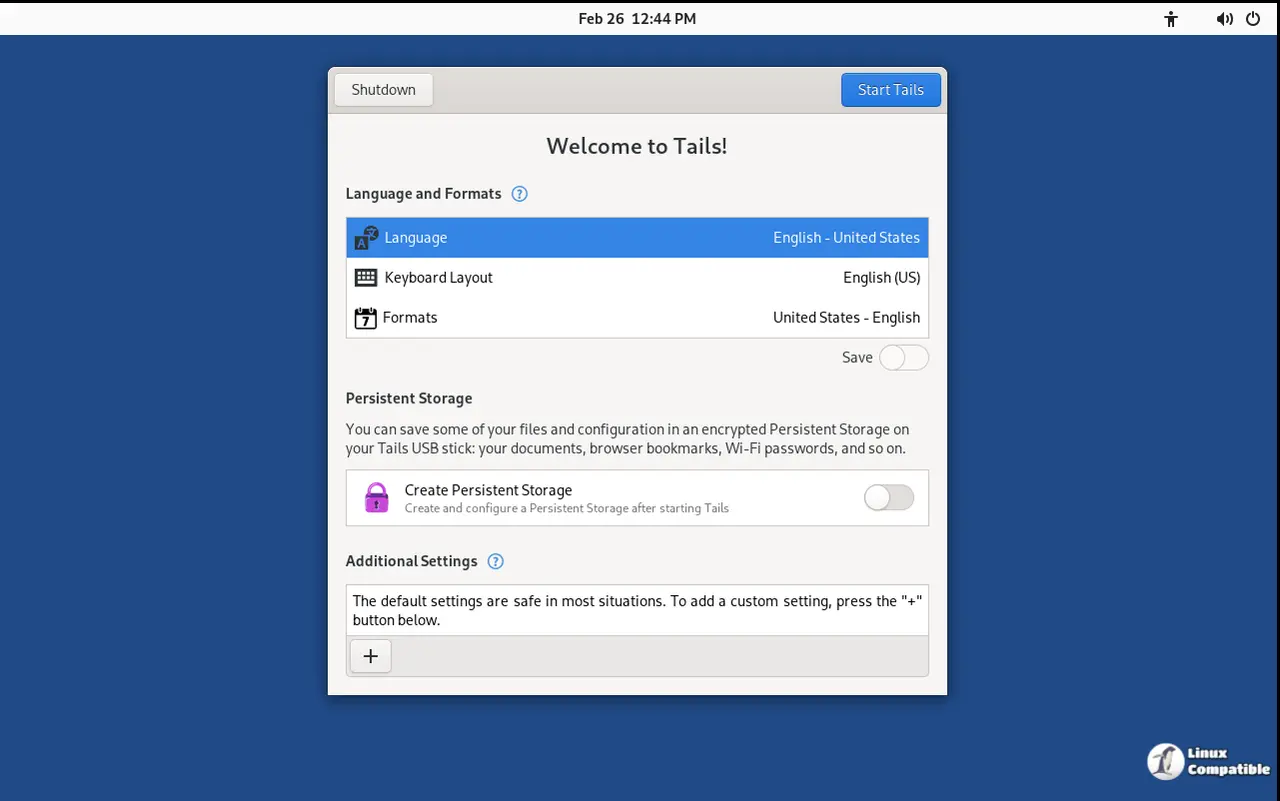
But the Tor client change cuts differently. 0.4.9.16 is an emergency release. The Tor Project says it "contains only a handful of fixes for directory authorities." Those are the trusted servers that maintain the relay list and agree on the network's consensus, the ones clients like Tails read to figure out where to connect. Apparently something pushed an unusual wave of directory-request traffic at them, the announcement quietly calls it a "thunderstorm," and the Tor team needed to stabilize load fast. They'll let some older clients rejoin temporarily to spread things out until a longer-term fix lands.
For a typical Tails user, that's a non-issue. "If you're not running a directory authority, there's no urgency," the Tor Project says plainly. Still, it recommends the upgrade, and you'll receive it automatically if you're on Tails 7.0 or later. You've just handed the network a healthier client whether you wanted to or not.
The browser update does the heavy lifting
Tor Browser is where most Tails users actually meet the internet, so a hole in it is a real hole in your safety. 16.0.1 arrived November 10, a day before Tails itself, and it inherits Firefox ESR 153.7, shipped under advisory MFSA 2026-127.
The advisory fixes a wide batch of flaws, mostly rated "high," many capable of remote code execution with little input from you. Use-after-free bugs across Graphics, WebRTC, DOM, and more. Sandbox escapes. Privilege escalation. Same-origin-policy bypasses. Mozilla notes many came through its bounty program from outside researchers, including teams at OpenAI and Tencent KeenLab, so these are real, discovered flaws rather than theoretical ones.
That's a substantial haul for a release that, on the surface, is just a point bump.
This version sits on top of Tor Browser 16.0, which launched October 29 on the new Firefox ESR 153 base. That major transition cost the Tor Project a review of more than 270 Firefox Bugzilla issues, and it disabled a few conveniences, like search suggestions, split view, profile backup, that could have made users stand out to trackers. It added native Linux ARM64 support and dropped 32-bit x86. You don't see that kind of housekeeping in a routine update, even though 7.17 doesn't carry those specific changes itself.
The kernel change is quieter still. Linux 6.12.116 brings two use-after-free fixes for Xen virtualization drivers, xen-netback and xen-blkback, for reading statistics and I/O stats. Not Tor-specific, but memory-safety is memory-safety. The 6.12 LTS line is backed through 2035, and kernel maintainers were unusually blunt about it: "All users of the 6.12 kernel series must upgrade." Tails runs in RAM across a grab-bag of hardware, so staying current here matters more than it would for a fixed desktop.
You could write this whole thing off as maintenance churn, and it sort of is. But for a tool whose entire pitch is anonymity and safety, staying patched is the feature. 7.16 already moved people onto Tor Browser 16.0, so 7.17's jump to 16.0.1 is mostly the security layer, including backported fixes from the newer Firefox 160. The emergency Tor client also tells you the network was under unusual load at that exact moment. And the upgrade path is frictionless for recent users.
It quietly proves out the 2024 merger with the Tor Project too. When the Tor team updates, Tails rides along fast. Seven-point-sixteen shipped one day after Tor Browser 16.0. Seven-point-seventeen follows the same rhythm. That tight integration is why you end up with all three fixes in a single, automatic step.
Tails itself has been around since June 2009 and now runs on Debian with a GNOME desktop. It boots from a USB stick, wipes most of its RAM on shutdown, and forces every connection through Tor. The EFF calls it "one of the most robust ways of using the Tor network," and it's the tool Snowden and Laura Poitras have publicly endorsed. The bar for a security release isn't just "does it work" but "does it keep people safe."
Upgrading in practice
If you're on Tails 7.0 or later, the Tails Upgrader should prompt you automatically. An older install has to go the fresh-install route, which erases Persistent Storage, so back that up first. Manual upgrades and plain ISO downloads sit on the Tails site if the automatic path misbehaves.
Head here to tails.net for the announcement, the upgrade docs, and the install instructions.


