LACT 0.9.1 Lands for Linux GPU Tinkerers, Fixes AMD Kernel Crashes and Expands Nvidia VF Curve Support
The open-source GPU configuration tool adds display reporting, supports Turing cards, and smooths over rough edges in the latest AMD drivers.
LACT (Linux GPU Configuration and Monitoring Tool) version 0.9.1 has officially dropped. This update tackles a nasty AMD driver regression, extends the voltage-frequency curve editor to older Nvidia cards, and finally stops forcing you to wait for the UI to load.
The project has quietly built a serious following over the past year. You can see the momentum in its GitHub statistics: over 5,000 stars, 129 forks, and nearly 70 open issues. Since shifting its entire frontend to libadwaita in the v0.9.0 release back in April, LACT has been iterating at a rapid pace. This latest patch is less about flashy new features and more about cleaning up the friction that pops up when you start poking under the hood of modern graphics hardware.
AMD Kernel & Power Cap Fixes
Previous versions of LACT would crash on RDNA3 hardware running kernel 7.0.13 or 7.1. The culprit? A driver regression that started reporting the power limit as exactly zero.
The developers did not just patch the crash. They implemented graceful clamping to keep your existing power configurations alive while kernel maintainers sort out the regression. They also fixed a related issue where lowered maximum power limits were being ignored on certain RDNA3 cards. If you run an RX 7000 series card, updating to 0.9.1 should prevent a sudden application failure the next time you tweak power limits.
Nvidia VF Curve & Display Info
The voltage-frequency curve editor has been one of LACT’s standout features, offering Windows-level undervolting control on Linux. This release extends that support to Turing graphics cards, which includes the RTX 2000 and GTX 1600 series. You can now grab a block of points on the curve, move them together, or flatten the selection entirely.
Keep in mind that the feature still relies on entirely undocumented Nvidia driver functionality. It works well for now, but don’t expect stability guarantees if Nvidia decides to change their internal APIs in a future driver update.
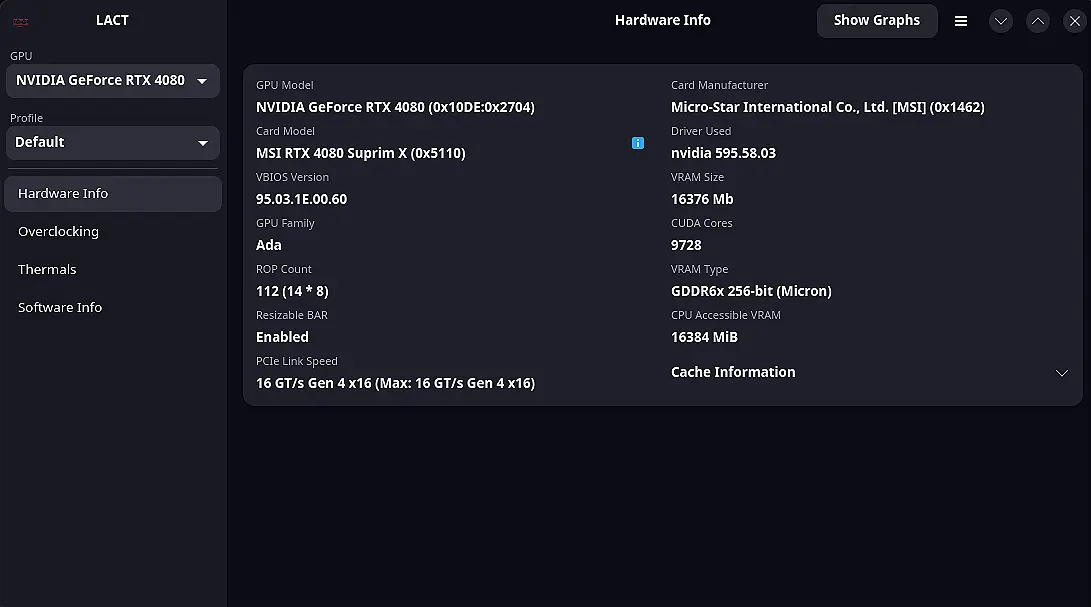
On the display front, LACT now reports connected monitor information directly in the GUI. It shows active DisplayPort connection details. It is basic right now, but it is exactly what power users have been requesting for system reporting. Startup time also got a noticeable kick by fetching Vulkan and OpenCL information asynchronously in the background. The interface now remembers its window size, supports keyboard shortcuts for navigation, and finally stops throwing empty-name processes into the profile search.
Architecture & Installation
LACT runs on a client-server model. You get a GTK4/libadwaita frontend (lact), a system daemon (lactd), and a CLI (lact-cli). The daemon handles the actual GPU communication through SysFS and kernel interfaces, which means it works fine on headless systems or remote servers.
You can grab native packages for Arch Linux, Debian, Ubuntu, Fedora, OpenSUSE, Gentoo, NixOS, and Solus. Flatpak and Docker builds are also available for those who prefer sandboxing or pure headless deployments. Newer builds require GTK 4.14+, which means Debian 12 and Ubuntu 22.04 users will need to wait for newer base dependencies or stick to the Flatpak version.
The Trade-offs
It is a rather ambitious tool for its size, especially considering the Nvidia VF curve editor bypasses official APIs. However, at the same time, the trade-off is worth it for enthusiasts who want granular control over power limits, fan curves, and undervolting without leaving Linux. The project is MIT-licensed and actively funded through GitHub Sponsors and Patreon, which is the lifeblood of open-source driver work.
If you need more control over your GPU thermals or are trying to push an older AMD or Nvidia card past its factory limits, LACT is worth a look. Head to the official GitHub repository for the full changelog, installation guides, and remote configuration documentation.


