KDE's Nate Graham published a permissive draft policy titled "Don't be lazy," asking AI-assisted contributors to use judgment rather than outsource their thinking. The thread drew nearly 50 contributors over a week, splitting developers over quality concerns, mandatory disclosure labels, and the environmental toll of training data centers. A grassroots group called KDE for People then demanded an outright ban on generative AI across Plasma, arguing the draft ignores ethics and bypasses wider community input. As of September 23, KDE has adopted neither the draft nor the ban, with a revised policy still expected.
KDE's "Don't Be Lazy" AI draft splits its community and sparks a call for a full ban
A permissive draft policy over AI-assisted contributions has triggered the most heated debate in KDE's recent history, and a new advocacy group is now demanding an outright ban.
Nearly 50 contributors weighed in over about a week on KDE Invent, the project's tracking system, and the result was less consensus and more shouting. At the far end of the spectrum sits a newly formed campaign called KDE for People, pushing for a full ban on generative AI across Plasma and its components.
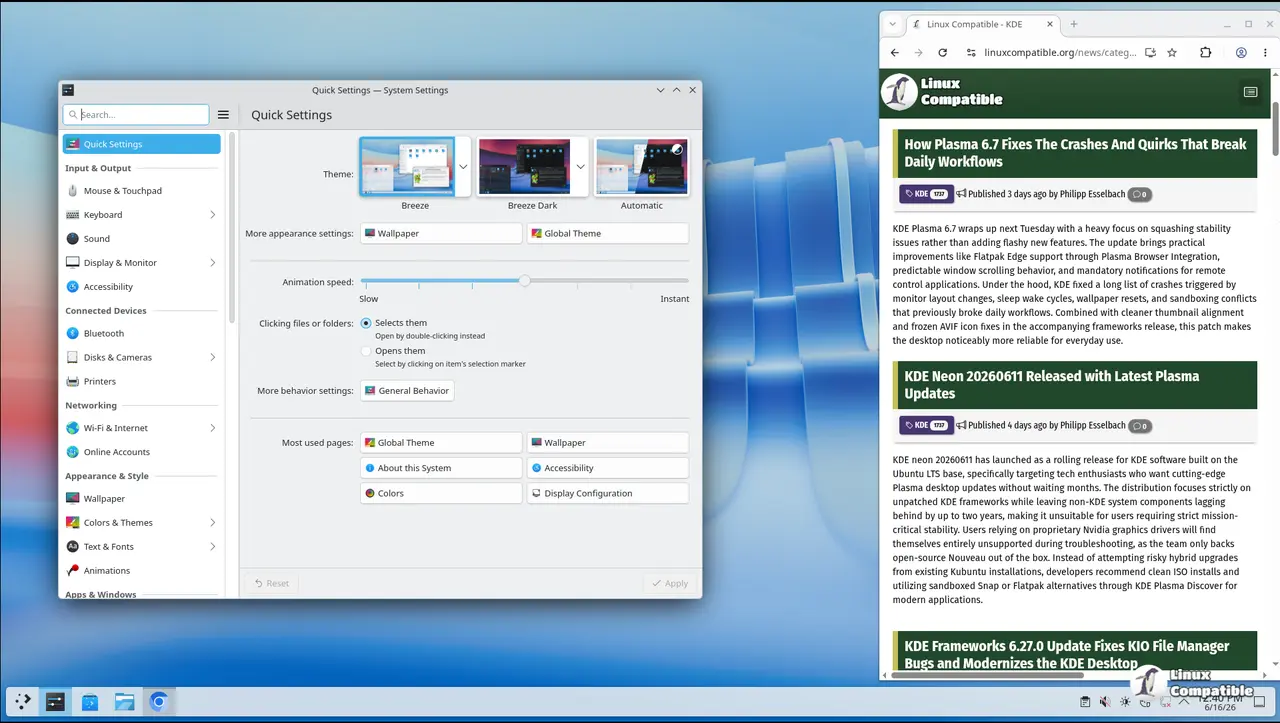
It's a fight that's bigger than a desktop environment. Every major software project is now wrestling with how to handle AI-assisted contributions, and KDE is doing it in public, in real time.
For those who don't track Linux, Plasma is the desktop you'd recognize at a glance: windows, panels, settings, and the visual identity of the screen. It's built almost entirely by volunteers, and for over two decades its direction has been set by peer review and community consensus rather than any single company.
The thread, in the open
Nate Graham, a KDE Plasma developer and CEO of Techpaladin Software, opened the discussion. His draft assumed people would use LLMs and put the responsibility squarely on each individual. The guiding principle was blunt.
The golden rule reads simply: don't use a tool to replace your own judgment, communication, or learning. Don't take unsustainable shortcuts. Don't avoid growing as a person. Break all three and the draft warns you'll ship poor-quality work that becomes someone else's problem.
Graham got specific about what he didn't want. No "vibe-coded" changes you can't explain. No LLM output passed off as a rough draft for maintainers to clean up. And no "Assisted-by: [LLM]" tags in commits, which he dismissed as "just free advertising for the LLM's provider."
The ideal, by his account, was that nobody should be able to tell you used an LLM. Not because you were hiding it, but because your output would look like what you'd produce on your own.
Reviewers mostly cared about practical problems, not ideology. Aleix Pol Gonzalez noted that maintainers already can reject any code, but flagged a fresh threat. "If anything, the specific thing here is that we won't accept being DoS by LLM-generated MRs which now can become a thing."
That's a real concern. One person could flood the maintainers with a wave of machine-generated merge requests.
Eike Hein praised the core but disliked the tone. He said the strong part was the "don't submit things you don't understand" principle, and worried the revised draft had weakened it. "The AI-shaming stuff (it's implicitly lazy, it's low-effort, etc.) takes precedence," he wrote.
Then came the sharpest exchange, and it turned on the environment.
Sune Vuorela went hard. "I think that the current suggested policy is basically a giant insult to KDE Eco, the earth, copyright, code reviewers," he said, citing datacenter energy demand competing with national grids.
Moritz Mundhenke declared it a "red-line for me," threatening to leave the community if AI output were explicitly allowed.
Jakob Petsovits offered what may have been the most-cited pushback, and it leaned on consistency. "If we reject contributions not for quality and maintainability reasons, but for how they were created, then we might as well reject contributions for all other kinds of reasons," he wrote. Air travel, banned. Carnivore, banned. Heating your house with fossil fuels, banned.
He then got at the actual tension. "I want to live in a world where we recognize our divisions, and we come together as friends and collaborators anyway."
Hadi Chokr leaned into pragmatism. "The genie is out of the bottle. We aren't getting it back in no matter what you believe," he said, adding that a ban nobody can enforce only punishes people honest enough to admit what they used. Refusing locally-run open models, he argued, is handing the field to the corporations.
The disclosure debate deserves its own moment. Should contributors be required to label AI-assisted work? linear cannon argued for a mandatory "Assisted-by" line, worried about output "regurgitated verbatim by the LLM from another project" that later turns out to be uncopyrightable. Akseli Lahtinen fired back: "If that information is required for the commit to make sense, then the commit is useless!"
It's a fair point on both sides. A tag only helps if people actually read it.
The thread eventually blew up. David Edmundson warned it would be locked if comments stopped being constructive, and after a user named svin posted personal information about another commenter, sweetluna, Tobias Fella shut it down. "This is a policy discussion and not a place for trolling," he wrote.
Graham had separately asked everyone to take 24 hours to cool off and promised a revised draft. The thread stayed open as a live debate, with developers now arguing whether the next round should be limited to registered KDE developers. Justin Zobel opposed that, arguing a contribution policy shouldn't only bind people with accounts. Christoph Cullmann agreed with the restriction, saying it would keep "loud random people" who aren't stakeholders from hijacking the process.
Separately, on September 23, the KDE for People campaign made its move, demanding an outright ban. It picked up steam when a Reddit user, DownHatter, posted about it in the r/kde subreddit under the headline "KDE for People: KDE's mission is to be for everyone."
The campaign's website frames its stance as a "pro-people outlook to community, ethics and with respect for the work that has gone into KDE software and projects for decades."
Its demands are broad. It wants generative AI output banned in code and assets. It wants AI blocked from merge-request descriptions, bug reports, and translations, including the .po gettext files that localizers actually edit. It wants vibe-coding barred and AI topics kept out of community spaces like Akademy and Planet KDE.
The strongest argument is about process, not technology. The campaign argues the draft sidesteps human-rights concerns and pushes responsibility onto individual contributors. Deciding on it "without wider community involvement," it contends, works against the public interest.
The campaign knows a ban can't be perfectly enforced. "Things will slip through," it acknowledges, but frames the rule as a signal of the kind of community KDE wants to be, and suggests a ban need not be permanent.
It points to Zig, elementaryOS, and OBS Studio as projects that have already banned LLM submissions, linking to an external "No-AI list." It also claims KDE Eco has declared AI use incompatible with its goals, though that claim comes only from the campaign and hasn't been independently verified.
The petition has gathered signatures, but it's drawn plenty of criticism too. The original Reddit thread leaned neutral-to-negative, and the debate has spilled onto the fediverse, where positions are locked in. Some argue a nuanced policy that bans mindless vibe-coding while permitting responsible use is being thrown away. Others say accepting any generated output is itself an ethical stance KDE shouldn't make.
KDE has adopted neither the petition nor the original draft.
The wider battle over AI in open source
KDE isn't the only one grappling with this, and projects have landed all over the map.
The Linux kernel walks a middle path: it accepts AI-assisted code, but every submission still needs human review and a write-up proving the contributor actually understands it. Debian permits high-quality LLM output under existing review standards. GIMP, Zig, elementaryOS, OBS Studio, Gentoo, and Void Linux have banned AI outright, while Nobara Linux and Omarchy are openly permissive.
Godot recently became a flashpoint when maintainers complained about an influx of "AI slop." Keep in mind that the KDE thread even referenced "AI canaries," hidden text traps that reveal whether code was machine-generated, as tooling already in use elsewhere. Even permissive projects are building detection.
KDE's draft tracks closest to the Linux kernel model: permissive in principle, conditioned on review and personal accountability. It also echoes recommendations from the Software Freedom Conservancy on LLM use in free software.
It's a rather tricky situation. The draft answers the quality question nicely: can you explain and maintain what you submit?. However, that says nothing about the environmental or ethical concerns driving the ban campaign. The campaign answers the ethics question yet offers no way to enforce its rule beyond vibes.
A rule that separates the two concerns, firm review plus disclosure without moralizing, is probably the best shot. Whether the community can actually agree on that is another matter.
As of September 23, nothing is decided. No project-wide ban has been adopted, and the "Don't be lazy" guidelines haven't been ratified either. Disclosure remains fully unsettled, and Graham promised a revised draft, possibly starting in a thread limited to registered developers, a scope that's itself contested.
The rules currently in force are KDE's existing ones on licensing, code review, and communication. If you contribute, expect scrutiny and be ready to explain every line you submit.
Head here to read the original thread on KDE Invent and follow the debate as it unfolds. One of the largest free-software projects is setting a public precedent, and the rest of open source is watching closely to see how it ends.


