Goverlay 2.0 major release launches, aiming to be the one panel for Linux gaming's graphics mess
The open-source MangoHud front-end now folds DLSS-on-AMD, HelixSR, and a dozen other community tools into a freshly redesigned interface.
Goverlay 2.0 is finally here. Independent developer Benjamim Gois shipped the biggest update to the popular open-source Linux gaming configurator today.
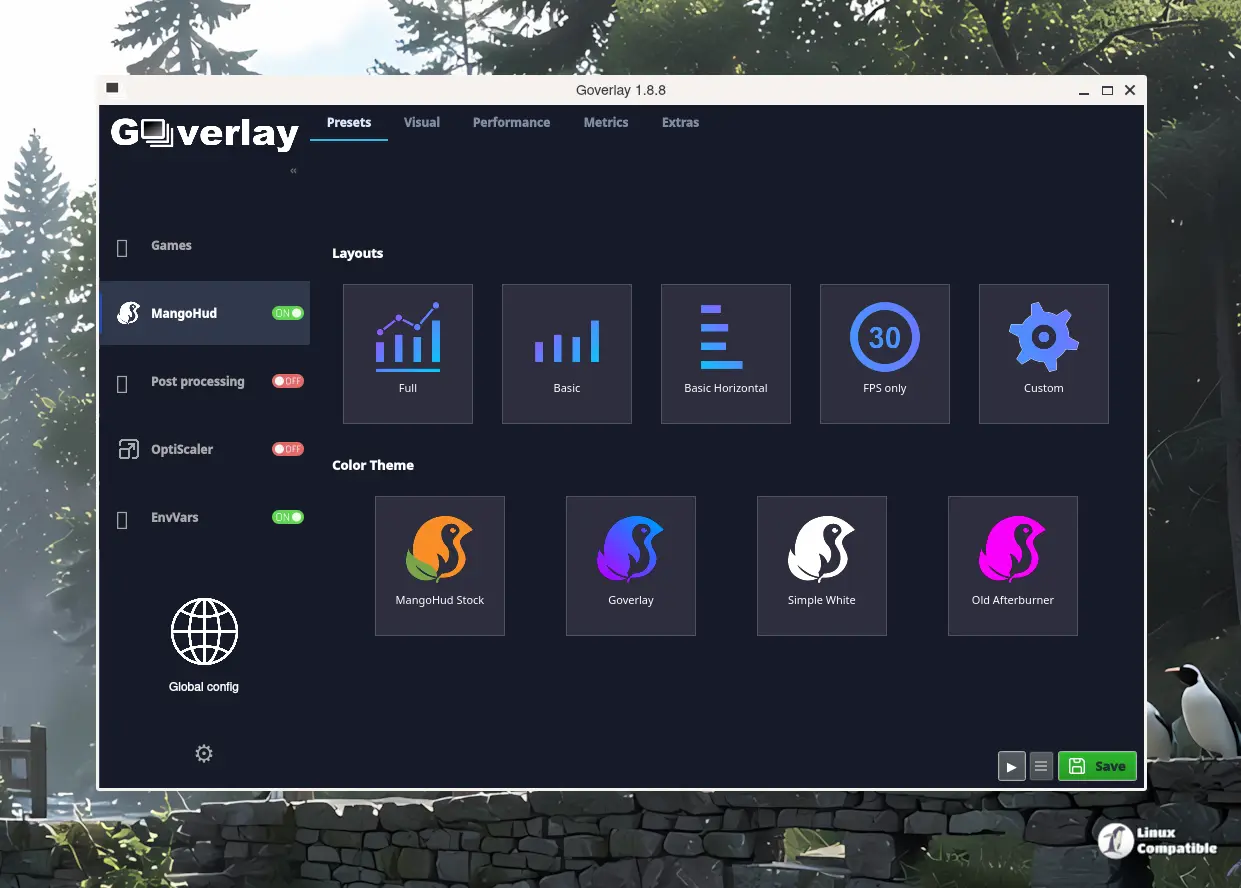
If you've ever dug through Steam's launch options to wrangle a performance overlay into a Windows game running through Proton, you already understand why this matters. Goverlay is a Qt6 graphical front-end that lets PC gamers configure the behind-the-scenes tools without hand-editing config files. You toggle a switch, it writes the config and launch command, and you paste that into Steam, Lutris, or a Decky Loader plugin.
That's the basic deal. Under the hood, it's built in Free Pascal using the Lazarus IDE, and it manages a growing pile of tools: MangoHud for real-time overlays, vkBasalt for post-processing, OptiScaler for upscaling and frame generation, plus per-game Proton tweaks.
Version 2.0 leans on three pillars. There's a full UI redesign across every tab. A modular first-run component installer lets you download only the modules you actually use, instead of pulling in everything. And there are integrations for the newest graphics tech, which is where the story gets interesting.
In the release notes, Gois writes straight at his users: "Hello Linux Gamers!" He frames the thing as a genuine milestone. "I still can't believe that there's already 6 years since the original goverlay release," he says.
The rollout cadence said the same thing. This wasn't a rushed ship. RC1 dropped on 11 November, RC2 on 18 November, RC3 on 21 November, then the final 2.0 three days later. A big, risky change set earns stress-testing, apparently.
A control panel for the magic-graphics jungle
Here's the context. In 2026, the Linux "magic graphics" scene is a wild west of overlapping tools. lsfg-vk, MAKO, HelixSR, OptiScaler, FSR4 Injector, d4r, AMDNR. Each one brings its own plugin, its own launch options, its own way of patching a game into submission.
Goverlay 2.0 folds several of those into a single pane of glass. The showpiece is DLSS-Neural Rendering support, now with detection for both RDNA4 and RDNA3 GPUs.
NVIDIA's DLSS 5 Neural Rendering was originally NVIDIA-exclusive, a machine-learning model that reconstructs image detail. Community projects have reimplemented it as Vulkan compute shaders so it runs on AMD RX 9000 (RDNA4) and RX 7000 (RDNA3) cards. Goverlay bundles the whole thing, with neural model weights sourced from @mochizuki0323 and @mauri870. In practice, an AMD user can now toggle a DLSS-5-class look in games that otherwise ship FSR or nothing at all.
The rest of the integrations arrive as well. HelixSR gets an in-app compilation flow, which kills a major manual-setup headache. OptiScaler and FSR 4 support land alongside a fix that stops upscaler profiles from leaking between games. MAKO 5.0 and AMD Fluid Motion Frames (AFMF) find their way in, as does vkNemu, an open-source reimplementation of AMD's Radeon Chill.
And yes, vkSumi has been renamed "Color Grading," now with automatic download and update handling baked in.
Keep in mind that none of this is Goverlay's own code. DLSS-NR, HelixSR, OptiScaler, MAKO, and AFMF are all separate community projects. Goverlay integrates them, but doesn't control them, so a downstream break in any of those can temporarily regress your overlay. That's the trade-off of being a unifying panel.
PasCube ships as a full Vulkan demo compiled from the PasVulkan engine, letting you preview MangoHud and post-processing settings in real time. It got fresh visuals in 2.0. PasPlot, a new native MangoHud CSV benchmark viewer, turns raw frame-time logs into shareable, organized benchmarks instead of leaving them in some log folder to rot.
Head here to the release announcement.


