XanMod Ships 7.3.6 and 6.18.65 in a Fully Synchronized Release
Three coordinated kernel builds landed on today, and this time the real-time variant didn't fall behind. The MAIN branch rides Linux 7.3.6, while LTS and RT both sit on 6.18.65. That synchronization is honestly the whole point of the story.
Normally the RT build trails the LTS drop by about a week. This cycle it caught up and shares the exact same base code. Both MAIN and LTS track Greg Kroah-Hartman's upstream stable tree, with MAIN on the fresh 7.3.x line and LTS on the maintained 6.18 track.
The changelogs show how much got folded in. The 7.3.6 build carries roughly 2,661 commit entries relative to its previous point release. LTS and RT picked up about 2,148. That cadence reflects just how fast the 7.3 mainline is moving right now.
What these builds actually are
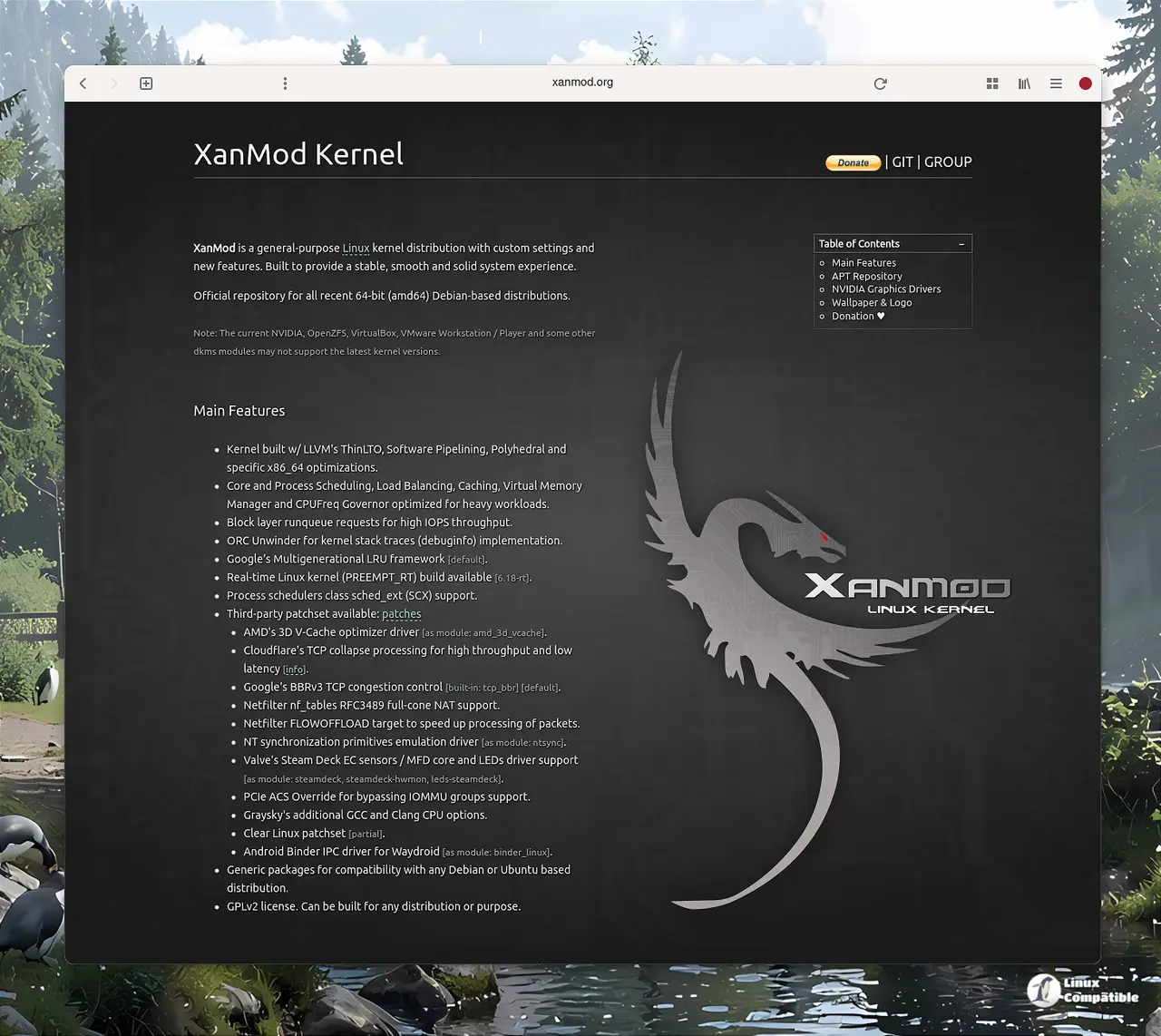
XanMod isn't a separate kernel. It's been maintained largely since 2015 by Brazilian developer Alexandre Frade, and it's mostly donation-funded. What it does is take upstream stable code, rebuild it for x86-64, and bolt on a pile of performance tweaks plus third-party patches. The stated goal is simply to make desktop and gaming machines feel stable and smooth.
It's GPLv2, ships as .deb files, and targets Debian and Ubuntu. So in essence it's the same kernel you could compile yourself, just with optimizations layered on and someone else doing the tedious part.
As stable point releases, these are about hardening, not new features. Scan the changelogs and the theme is immediate: use-after-free fixes, buffer overflows, and reference-count bugs spanning networking, storage, crypto, and drivers.
The SMB server ksmbd shows up again. It's a frequent fix target for upstream too. This round it gets a CREATE response buffer overflow fix, an iface_list use-after-free during server reset, and a batch of access-control corrections.
The networking stack gets a big one, covering rnbd-srv, octeontx2-pf, tipc refcount panics, netfilter conntrack workers, and netlink bitmap access. BPF gets out-of-bounds write fixes and stack-argument validation. Storage work lands across mpi3mr, ntfs3, btrfs, and ocfs2.
There's a fair amount of CXL memory-safety work as well, alongside refcount races in audio and a double-free in nvmet. Mainline and LTS share nearly all of this because they're anchored to the same recent upstream window. Mainline adds more BPF work and a bigger AMD acceleration batch, which tracks the busier 7.3 line.
What XanMod adds on top
This is where the project actually distinguishes itself. It builds with LLVM software pipelining, polyhedral optimizations, and extra x86_64 tweaks. Scheduling, load balancing, virtual memory, and CPUFreq governors get tuned for heavy workloads. Multigenerational LRU is on by default, and it ships a PREEMPT_RT build this cycle.
It also pulls in community patchsets: Google's BBRv3 TCP control, Cloudflare's TCP collapse handling, Netfilter nftables features, and, oddly enough, a Steam Deck EC sensor driver from Valve.
Independent benchmarks suggest the compiler tweaks net roughly a 2% gain without bloating the image. The difference is most noticeable under heavy desktop load, audio production, and gaming. Modest result, but consistent.
One thing to get right before you install is the psABI tier. XanMod splits its builds by x86-64 psABI level, so picking the wrong one means a failed boot, not a wasted afternoon.
Legacy x86-64 covers roughly 2003-era CPUs. v2 handles about 2009 and up. v3 is your 2015-and-newer territory, which means Haswell through Arrow Lake plus Zen and newer. The v4 AVX-512 tier exists too, though XanMod explicitly says it offers no kernel benefit. Skip it unless you're on Zen 4 or a newer Xeon.
Install it with APT. You register the PGP key, add the repo, and install linux-xanmod-x64v3 for modern hardware. There's a compatibility checker script at dl.xanmod.org if you'd rather verify before committing.
If you're on NVIDIA, keep in mind the companion driver repo currently sits at 620.73.04 on the production branch. But XanMod warns that NVIDIA, OpenZFS, VirtualBox, and VMware modules may not yet support the latest kernels. Check compatibility before you reboot, especially if you run out-of-tree DKMS modules. The EDGE branch is even more bleeding-edge and shouldn't land on a production box.
For anything important, the 6.18.65 LTS line is the sane bet. Linux 6.18 shipped as this year's LTS on November 30th, 2025, with support projected through December 2027 and possibly extending to 2028. The 7.3.x mainline is for enthusiasts who want the freshest code, and it's moving fast, carrying nearly 19,000 commits from around 3,000 developers.
The release cadence here is worth a mention. In late November XanMod shipped near-continuous point releases: 7.3.3 and 6.18.62 in the first week, then 63, 64, and now 65. That tracks upstream stable drops that earlier in the month carried Greg Kroah-Hartman's rare "all users must upgrade" advisory. It's been a security-heavy month, with Xen virtualization fixes and a wave of ksmbd corrections.
Running all three branches off one person's automated pipeline within minutes of each other is genuinely notable for a project maintained largely solo. It says something about the maturity of the build system.
Head here to the XanMod website for more information.


