Godot 4.8 Dev 4 lands 224 fixes and a native 3D trail node
The fourth development snapshot for the upcoming 4.8 engine packs rendering upgrades and editor polish from a massive community effort, countering rumors of a stability-only release.
Godot 4.8 development snapshot 4 is out, and the team admits it's the toughest one to summarize. The release ships 224 fixes from 86 contributors since dev 3, along with features that suggest the 4.8 roadmap is packed tighter than expected. 86 contributors. 224 fixes. That's a heavy punch for a development snapshot.
The dev log notes this was "easily the hardest to narrow down what features to highlight out of every blog post" since the author joined the foundation. That's a strong signal that this snapshot pushes past the "stability-focused" narrative some have floated for the 4.8 cycle. The build, based on commit b56a91878, touches rendering, shaders, editor UX, export tooling, and platform support all at once.
The long wait for a native trail node is over. QbieShay built the first-class Trail3D node using foundational work from Zi Ye, removing the need to wrestle with linear algebra or manual UV assignment. Line3D exists in the enum but isn't implemented yet. Everything just works.
Rendering and Shaders
Shaders get their own treat with VisualShader Node Groups. Hendrik Brucker added the ability to encapsulate frequently used shader sections into reusable sub-graphs, which should tame complex setups.
Rendering sees a meaningful boost. KenzieMac130, a first-time contributor, added multi-bounce ambient occlusion approximation based on a 2016 Siggraph paper from Activision. This addresses the previously over-darkened look in Godot scenes with low-cost interreflections.
Juan Manuel and Hugo Locurcio brought specular information to directional lightmaps. Baked results now compare closer to real-time directional lighting. The technique references a 2018 GDC presentation for the technical details.
Keep in mind that decal support arrived on the compatibility renderer, ported by Bastiaan Olij from the mobile approach. You're capped at 64 decals per frame, with a hard limit of 8 per surface. It's a limitation, though one that makes sense for the OpenGL path.
Editor and Core Updates
Tomasz Chabora converted the main screen system to EditorDock. Tabs are now configurable, and most screens can be closed or floated. The old workflow still works but is deprecated. Michael Alexsander replaced the flat script method outline with a hierarchical tree view. Selection state is preserved across saves, which should save you a few clicks. Ismail Ivanov added auto_font_size and related properties to Label and RichTextLabel. You can now prevent text overflow by auto-scaling text down to a minimum threshold. Property access is roughly 1.6× faster after moving maps from ClassDB to GDType. It's a solid engine-level win.
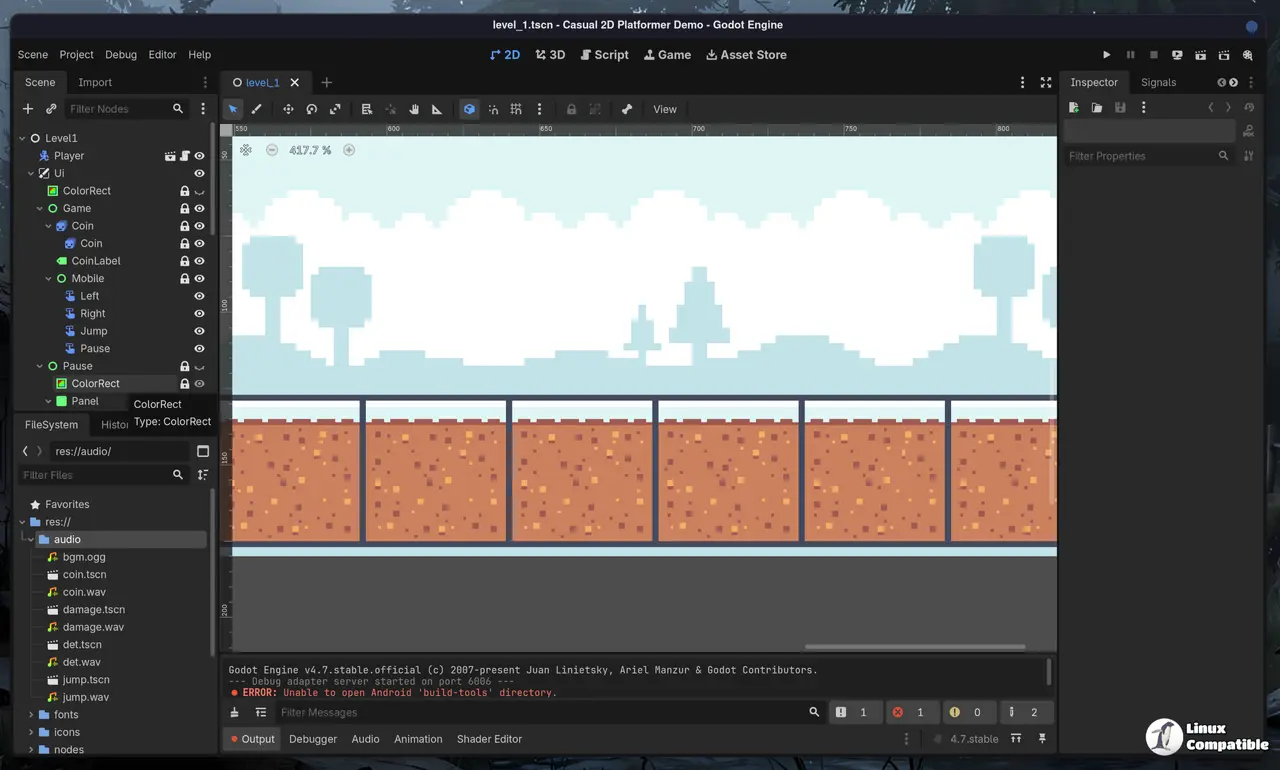
Fredia Huya-Kouadio introduced AndroidSDKManager, which auto-downloads and configures the Android and Java SDKs. You'll see the option in the Export Presets dialog or the reworked "Setup Android Build..." menu item. visionOS support is expanding. The download manager now includes visionOS templates, and XR support adds hand tracking plus PSVR2 controllers for the Apple Vision Pro. Windows toast notifications now use custom COM+ code instead of WinRT/C++ dependencies.
You'll find BoneSpreader3D, AnimationNodeObservers for signaling events, CoreAudio idle sleep on macOS, and Emscripten updated to 6.0.1 in the changelog. GDScript now flags strings used as comments.
Head here to download the snapshot for Linux, macOS, and Windows. The web editor and Meta Quest XR editor are also available. Android editor access requires a request to the testing group. The interactive changelog lists all 224 fixes.


