GNOME 49.10 Released: The Final Bugfix Update for the GNOME 49 Series
GNOME has shipped 49.10, the last bugfix release for the 49 "Brescia" series, and the project isn't pretending it's thrilling.
GNOME calls this one "a boring bugfix update." The Release Team says that plainly, then tells every distribution still running GNOME 49 to upgrade anyway. There is no 49.11 in the cards. This is the final set of fixes for the branch before it goes fully stale.
Keep in mind the timing, since that's the real story here. GNOME 51 launched on September 16, 2026, just days before this release. The instant 51 shipped, the 49 branch was quietly pushed into end-of-life status. So 49.10 reads more like a bookend than a milestone.
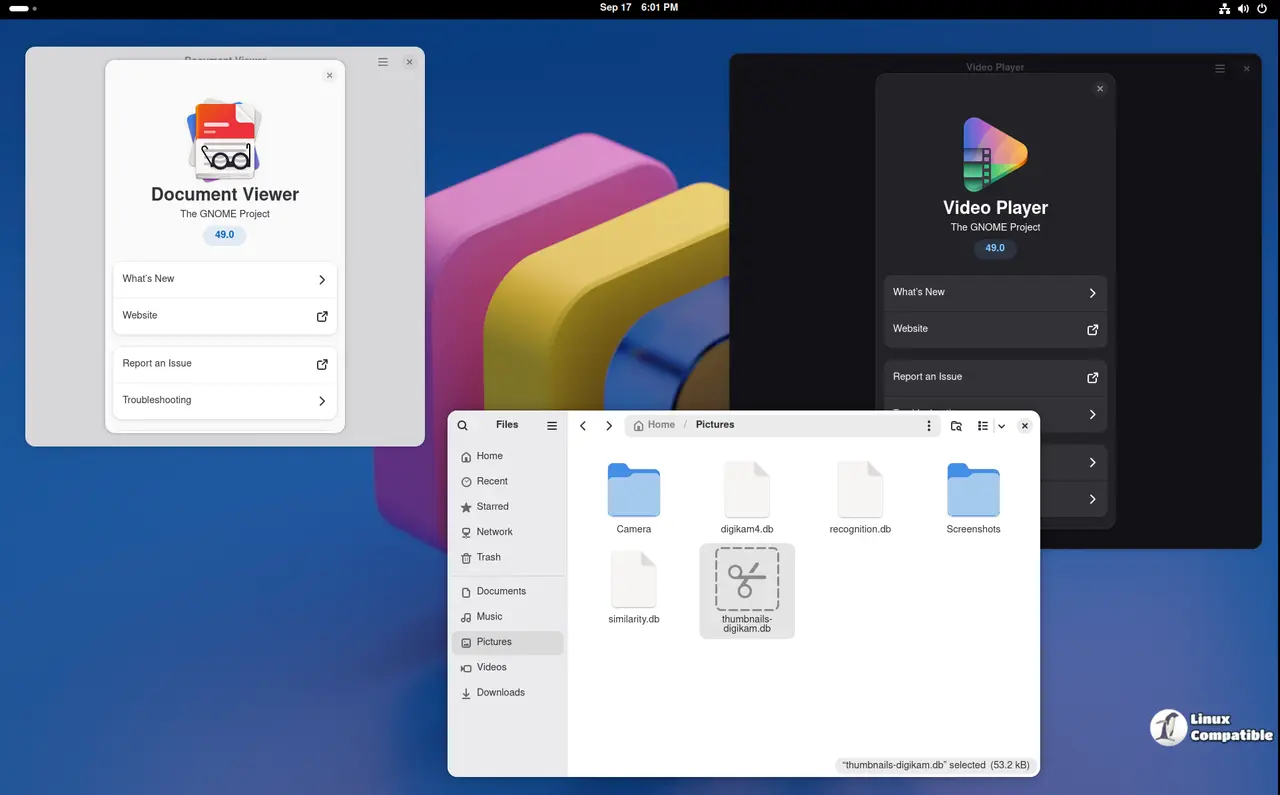
For the record, "Brescia" comes from the Italian city that hosted this year's GUADEC, GNOME's annual conference. Naming releases after the venue is a long-standing GNOME habit, and it's a tidy way to keep a little history alive even once the code goes old. When 49 first landed in September 2025 it was a genuinely big update: it retired Toem in favor of Showtime as the default video player, swapped Evince out for Papers as the document viewer, and rebuilt Calendar with full keyboard and assistive-tech support. HDR wallpapers, a beefed-up remote-desktop stack, and a pile of smaller touches rounded things out. None of that appears in 49.10. The release adds nothing new. It just polishes and secures what's already there. Boring by design.
What changed in 49.10
The release bumps about a dozen modules. Here's where things actually moved.
GNOME Shell went from 49.9 to 49.10. Fixes cover Thunderbolt authorization, which could previously block device pairing, and workspace-switching glitches that turned up with direct scanout. There's also a lock-screen bug tied to the Esc key, automatic cancellation of mount-password dialogs on lock, and a screen magnifier that now tracks the mouse without polling. The build got a stability pass too, with libical4 support, validated image data, a crash fix, and a handful of memory leaks plugged.
Mutter jumped from 49.7 to 49.8 and went heavy on multi-display correctness. That's the area people actually complain about. It fixes blurred rendering on non-pixel-aligned monitors, redraw glitches on rotated screens, and cases where multiple displays were reported as the primary one. It also handles cross-GPU buffer scanout, which matters if you game, watch HDR video, or share your desktop across several GPUs.
On the security front, most of Shell's changes are housekeeping. The real weight sits elsewhere.
GVFS (1.58.4 to 1.58.5) ships one security patch, CVE-2026-88924. The admin backend didn't set socket ownership before creating it, a race a local attacker could exploit. Fix the ordering and you close the hole.
Epiphany (GNOME's browser, now just called Web) picked up two security fixes that were actually held back from the earlier 49.9 release. Bug #2921 patched an Autofill code injection reachable through CSS selectors. Bug #2922 closed a WebExtension path-traversal hole (ZIPSLIP) that let a malicious .xpi archive write files outside its own directory.
A raft of smaller modules moved too. libsecret picked up individually encrypted items and file-based locking to stop concurrent-write races. gcr added zero-mtime support. libadwaita, at-spi2-core, gnome-maps, msgraph, yelp, and gnome-user-docs got smaller cleanups, including a typo fix and some compiler-warning tidy-ups in yelp.
Keep in mind that a lot of core modules didn't touch. Nautilus, gnome-control-center, gnome-software, glib, gtk, gnome-session, gnome-settings-daemon, gdm, and the evince family all sat at their 49.9 versions. That's deliberate for a bugfix release, though if you were hoping for a file-manager tweak, this isn't it.
A swan song
The thing worth remembering about 49.10 isn't what it does, but when it arrives. GNOME 50 is now the "stable" branch and will keep getting point releases, with 50.6 penciled in for October 10, 2026. GNOME 51 is the newest major release and will define the desktop for the next year and a half or so.
So the practical path is straightforward. If your distro still ships GNOME 49, apply 49.10 as your final set of fixes, then plan to move on to 50 or 51. Flatpak runtimes get a short grace period through this transition, after which the old runtime gets flagged as end-of-life.
To grab 49.10, wait for your vendor to package it and update normally. That's the recommended route for nearly everyone. Developers and tinkerers can instead compile from source using the BuildStream snapshot.
The Release Team's advice hasn't changed: install the official vendor packages unless you have a good reason not to. Head here to the announcement if you want the complete rundown.


