Garuda Linux has officially shipped Temeraire (260819), an Arch-based rolling update landing on August 19, 2026. The ISO swaps the stock kernel for a CachyOS-derived linux-garuda image featuring the EEVDF scheduler and automatic Nvidia DKMS builds, while FireDragon 13 ships a complete privacy-focused rewrite and the new toolbox consolidates every legacy system management script. Eleven desktop editions are available, ranging from KDE Plasma and GNOME to a brand new Rust-based COSMIC variant, with default software jumping to Plasma 6.7.4, FFmpeg 9, and GCC 16. You can download any of the official ISOs directly from the Garuda build servers or verify the full changelog on the community forum thread.
Garuda Linux Temeraire Drops: New CachyOS Kernel, FireDragon 13, and a Leaner Installer
The August release brings a fully consolidated toolbox, eleven desktop editions, and a serious bump in default software versions across the board.
Garuda Linux has officially shipped its 260819 ISO, codenamed Temeraire, and it represents one of the distribution's most substantial annual releases yet. Built on Arch Linux and developed entirely out of Germany, the rolling release lands on August 19, 2026. It follows last November's Broadwing ISO and brings a fresh default kernel, a complete FireDragon rewrite, and a fully consolidated system management tool across a dozen desktop flavors.
The Temeraire announcement hit the Garuda forums on August 20, pinned globally by DevOps lead Nico (dr460nf1r3). Early adopters have already reported smooth installs, and the usual round of benchmark requests is circulating in the threads. Keep in mind that this is a rolling release, so pacman updates will catch you up to the stock Arch baseline without forcing a full reinstall.
Kernel and Core Changes
The headline technical shift is the new linux-garuda kernel, which defaults to version 7.2. Instead of maintaining a custom kernel from the ground up, the team built the stock image on top of CachyOS's existing work. That means you get the EEVDF scheduler out of the box, along with automatic DKMS Nvidia driver compilation before any package updates. It's a smart move. Maintaining a kernel from scratch rarely scales well for a community distro, and borrowing a proven foundation lets the team focus on Garuda-specific tuning instead.
FireDragon hit version 13 with a complete rewrite. The privacy-focused browser now runs on Firefox Latest via the Floorp codebase, drops in-house features like workspaces and a notes panel, and ships in four distinct variants. On top of that, the Garuda Toolbox has finally absorbed every legacy system administration script. You can now handle boot configs, kernel selection, networking, gaming presets, and diagnostic tools from a single interface built on Angular 22. Performance watchers will also notice the "better blur" effect is gone, which matches what the community had been asking for ahead of time.
Software Stack and Editions
The rest of the ISO is noticeably newer across the board. You're looking at Plasma 6.7.4, GNOME Shell 50.4, Cinnamon 6.6.9, Hyprland 0.56.2, and Python 3.14.7. GCC moved to 16.2.1, OpenSSL to 4.0.1, and FFmpeg crossed into version 9. Even better, GIMP 3.2.4, Krita 6.0.3, and Inkscape 1.4.4 now ship by default. Not bad for a desktop-focused distro.
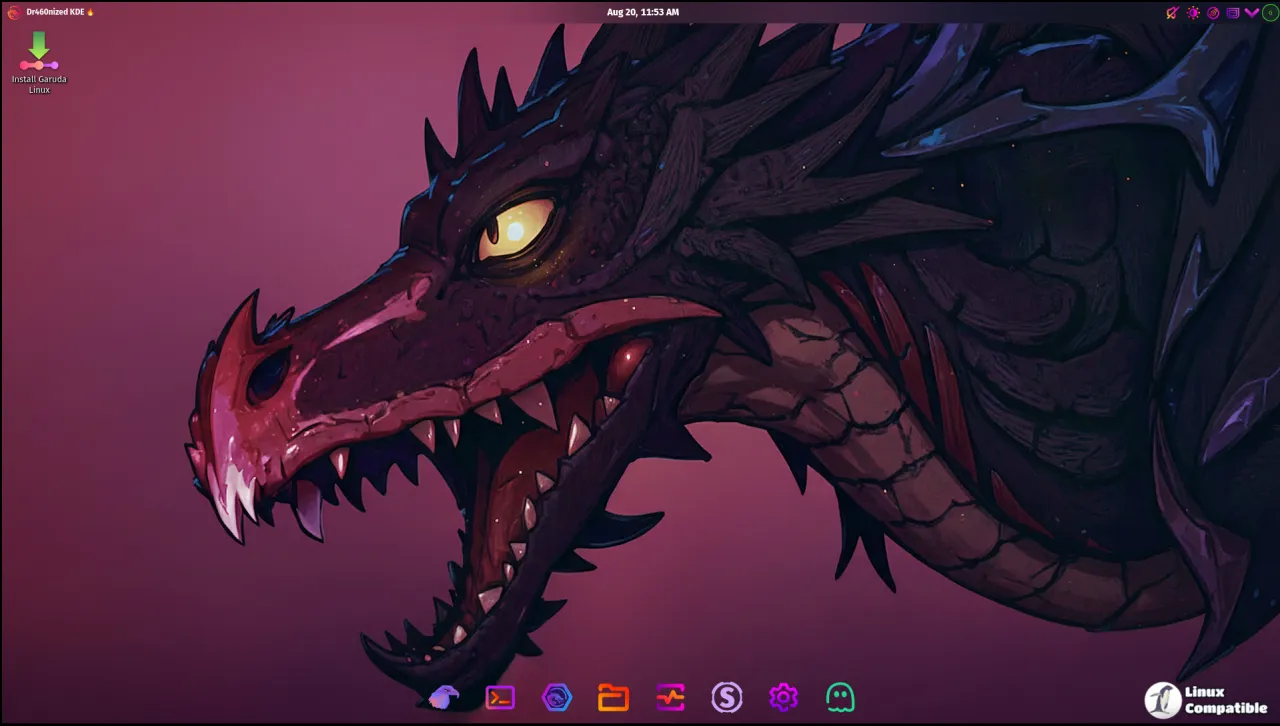
Temeraire ships in eleven desktop flavors, ranging from the familiar Dr460nized gaming edition to a brand new COSMIC variant built in Rust. The leaner profiles mean the gaming ISO no longer bundles the entire kde-games meta package, focusing instead on launchers and performance tweaks. Infrastructure-wise, Garuda now hosts its own Arch mirror at arch.garudalinux.org, pulled globally via Cloudflare and R2. The Chaotic-AUR website also got a facelift with estimated build times and live pipeline logs, which should help anyone tracking AUR package availability.
It's a polished release, though the shift to a CachyOS-derived kernel will require a few weeks of real-world feedback before we can fully judge the scheduler claims. The toolbox consolidation is genuinely overdue, and stripping out legacy packages keeps the installer sizes between 2.1 and 4.8 gigabytes depending on your flavor of choice. Head here to the official forum thread for the full changelog and ISO verification hashes.
If you're ready to jump in, the ISOs are already live on the official servers. The team has also pushed the NixOS-based build infrastructure to production, so future ISOs should build faster and ship with fewer hiccups. Keep an eye on the wiki for migration notes if you're switching desktops mid-stream.


