Fedora Linux 45 Beta Hits the Road on September 15
The third candidate release ships Tuesday after a record-fast go/no-go meeting clears the final testing hurdle.
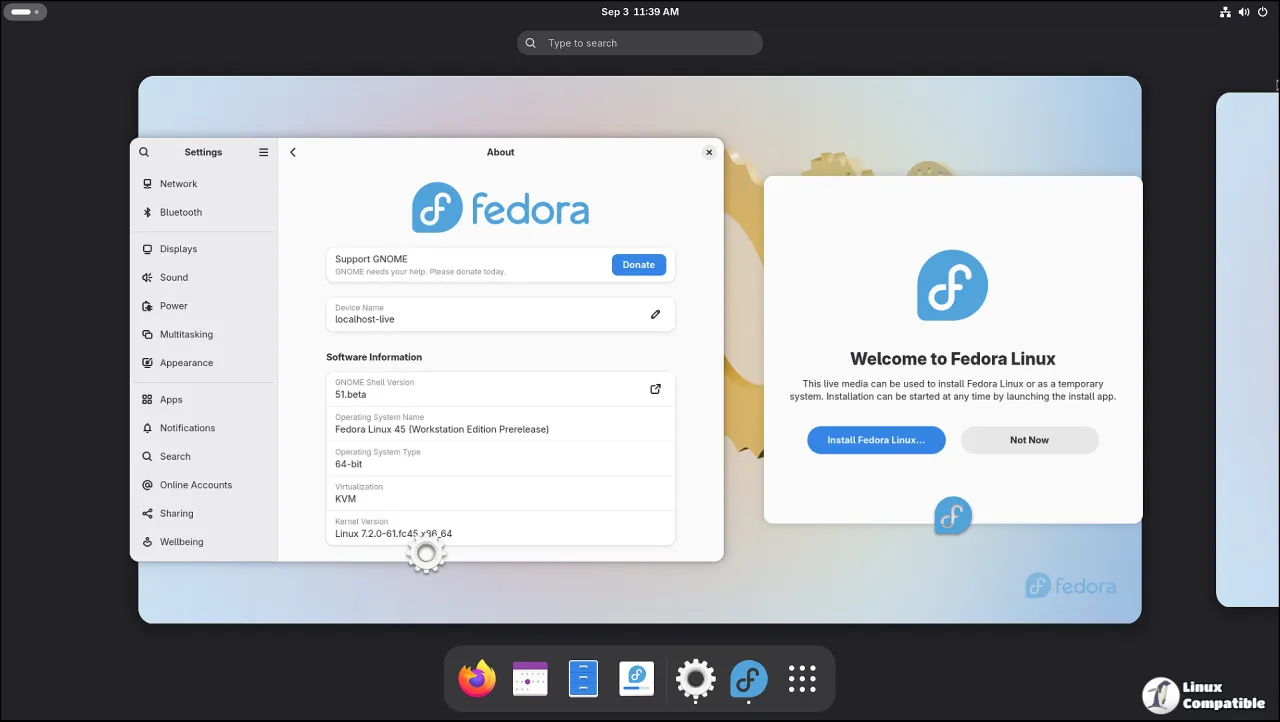
Fedora Linux 45 Beta is officially on deck. The project confirmed Tuesday morning that the third and final candidate release (RC 1.3, built from the September 5 compose Fedora-45-20260905.0) will ship live on Tuesday, September 15. The three governing bodies, FESCo, Release Engineering, and QA, voted go during a roughly 40-minute meeting on September 10. No proposed blockers. One accepted blocker already verified as fixed. It's a remarkably clean slate for a beta that carries as much technical weight as this one does.
This lands right in the middle of Fedora's fall cycle. Alpha wrapped back in February, Beta RC 1.1 and RC 1.2 rolled out in early September, and RC 1.3 is now crossing the finish line before the October 6 final freeze. The Beta is the last widely coordinated test window before the code goes completely cold for Final, which is still tracking for November 2026.
The Toolchain and Security Stack
What makes this build worth flashing is the toolchain. Fedora 45 is shipping with GCC 16.2, glibc 2.44, Python 3.15, and Golang 1.27. OpenSSL just got the major rebase to version 4.0, and if you've been waiting to try out post-quantum cryptography, Sequoia's %openpgpverify will be the default, swapping out GnuPG for PQC support. The security hardening stack is heavier this cycle, too. ptrace is restricted for unprivileged users by default, and RPM now enforces signature verification out of the box. It's a lot of bleeding-edge software crammed into one installable ISO.
The Atomic desktops got a long-requested facelift. The Silverblue and Kinoite installers are finally ditching the legacy GTK Anaconda in favor of a web-based installer with secure remote installation over HTTPS. Stratis storage support made it into the graphical installer as well, so you can natively set up your chosen filesystem without jumping through Kickstart files. KDE Plasma's work on this cycle is solid, though a black-screen login bug (#2524940) is still sitting in the tracker. It'll need a patch before Final ships.
What's Left Before Final
Let's be straight about the test coverage. Basic boot, install, and storage workflows passed cleanly across x86_64 and aarch64. But advanced storage, specifically SAS and hardware RAID, dropped off the radar, likely because the QA team lost the person who automated those tests. Cloud images and aarch64 WebUI storage coverage have a few holes, though the meeting deemed them sufficient to continue. FESCo is drafting a criteria adjustment to formally lower the bar for those specific areas rather than let them block the release. It's a pragmatic call, though it does leave a few edge-case users to test the hardware themselves.
The path from here to Final is straightforward. Fedora enters final freeze on October 6, meaning any new packages after that point need explicit approval. The QA team will be tracking a handful of non-blocker items, including Plasma login crashes, Anaconda's Bugzilla reporting failure, and ISO size limits that some boot images have exceeded. Aoife Moloney volunteered to drive a policy conversation around shipping spins that don't fully work out of the box, which is probably overdue.
Keep in mind that the final freeze lands October 6. If you want to help stabilize the release, head here to the Fedora QA test results category and start hammering on the new workstations and immutable variants.


