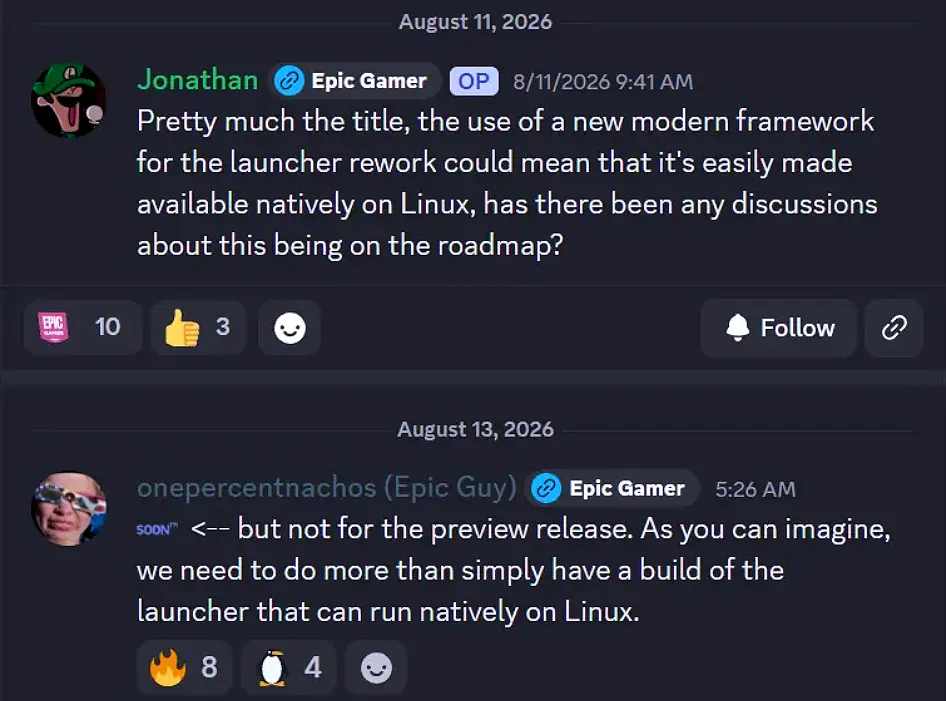
Epic Games confirmed via a Discord AMA that a native Linux client for the Epic Games Store is in development and coming "soon," though it will be excluded from the upcoming preview build due to necessary architectural changes. This move parallels GOG's own efforts to build a native Linux Galaxy client, signaling a broader industry shift toward official Linux support driven by the Steam Deck's success. While a native launcher will improve performance and simplify setup for Linux gamers, the availability of multiplayer titles like Fortnite hinges on whether Epic can successfully port its EOS anti-cheat system to the platform. Until that happens, users will continue relying on Heroic Games Launcher, the open-source tool that currently bridges the gap using Wine and Proton.
Epic Games Store Will Get a Native Linux Client "Soon," But the Anti-Cheat Problem Lurks
Epic confirms the work is underway via Discord AMA, though architectural changes and EOS anti-cheat porting complicate the timeline.
Epic Games is finally moving on Linux as reported by Steam Deck HQ. A native client for the Epic Games Store is in development and coming "soon," according to the company's official community Discord server. However, if you're hoping to test it in the upcoming preview build, you'll need to wait a bit longer. Epic staff member @onepercentnachos dropped the news during a recent AMA, clarifying that the effort extends beyond simply compiling a dedicated Linux binary. The work involves deeper architectural changes that need to happen first.
The confirmation marks the first official acknowledgment from Epic about building a Linux storefront. This mirrors a similar push from GOG, which is also developing a native Linux version of its Galaxy client. Together, these moves signal that major PC storefronts are taking Linux gaming seriously for the first time in years. The success of the Steam Deck and a growing Linux gaming community clearly played a role here.
The Technical Hurdles
Epic's comment about the preview build hints at the complexity involved. The Epic Games Store is an Electron-based application with deep Windows integrations for services like updates and DRM. Porting this to Linux requires restructuring the architecture, not just translating code.
Anti-cheat is another significant hurdle. Titles like Fortnite rely on Epic Online Services (EOS) anti-cheat, which has historically been Windows-only. A native launcher helps with single-player games, but online multiplayer on Linux depends entirely on whether EOS gets ported. That's a separate, substantial undertaking that Epic hasn't mentioned a timeline for.
The Heroic Games Launcher Factor
For now, Linux users are relying on Heroic Games Launcher. It's a free, open-source tool that wraps the Windows Epic client using Wine and Proton. The project has roughly 12,000 stars on GitHub and over 500,000 monthly users. It's functional, but it adds overhead. Users deal with Wine compatibility issues, potential performance drops, and DRM complications that a native client would solve.
Heroic will likely remain relevant for GOG and Amazon store integration, but its role as the primary Epic workaround may shrink. Keep in mind that Epic hasn't specified how users would migrate their libraries from Heroic to the official client. That's a detail you'd expect to see when the client actually ships.
A native client removes a layer of friction for Steam Deck and Linux handheld gamers. It validates Linux as a first-class gaming platform and could encourage more developers to support it from day one. However, the real win for multiplayer fans depends on anti-cheat. Until EOS runs on Linux, Fortnite and other online titles remain blocked regardless of the launcher situation.
Epic hasn't provided a specific release date. Keep an eye on the Epic Games Store Discord for updates. The long wait is over in terms of confirmation, but the actual launch timeline remains unclear.


