D7VK 2.0 Lands, Brought Direct3D 3 Through 7 to Modern Vulkan GPUs
The legacy translation layer gets a major performance overhaul and a full rebase on DXVK 3.0.2.
D7VK 2.0 shipped today, and retro gamers who have been struggling to run late-nineties Windows titles on Linux or modern Windows finally have a proper solution. Developer WinterSnowfall has delivered a major version bump that promises literal two times performance increases in CPU-bound scenarios. The Vulkan-based translation layer wraps Direct3D 3 through 7 calls and routes them through DXVK's D3D9 backend before handing them off to your graphics driver.
The project has been quietly bridging the gap between ancient DirectX APIs and contemporary hardware for a while now. It acts as a DDraw wrapper that proxies those older API calls through a modern translation stack. That approach makes sense, even if the original DDraw ecosystem is notoriously messy. Games back then loved mixing Direct3D with GDI, and modern drivers completely forgot how to handle those quirks.
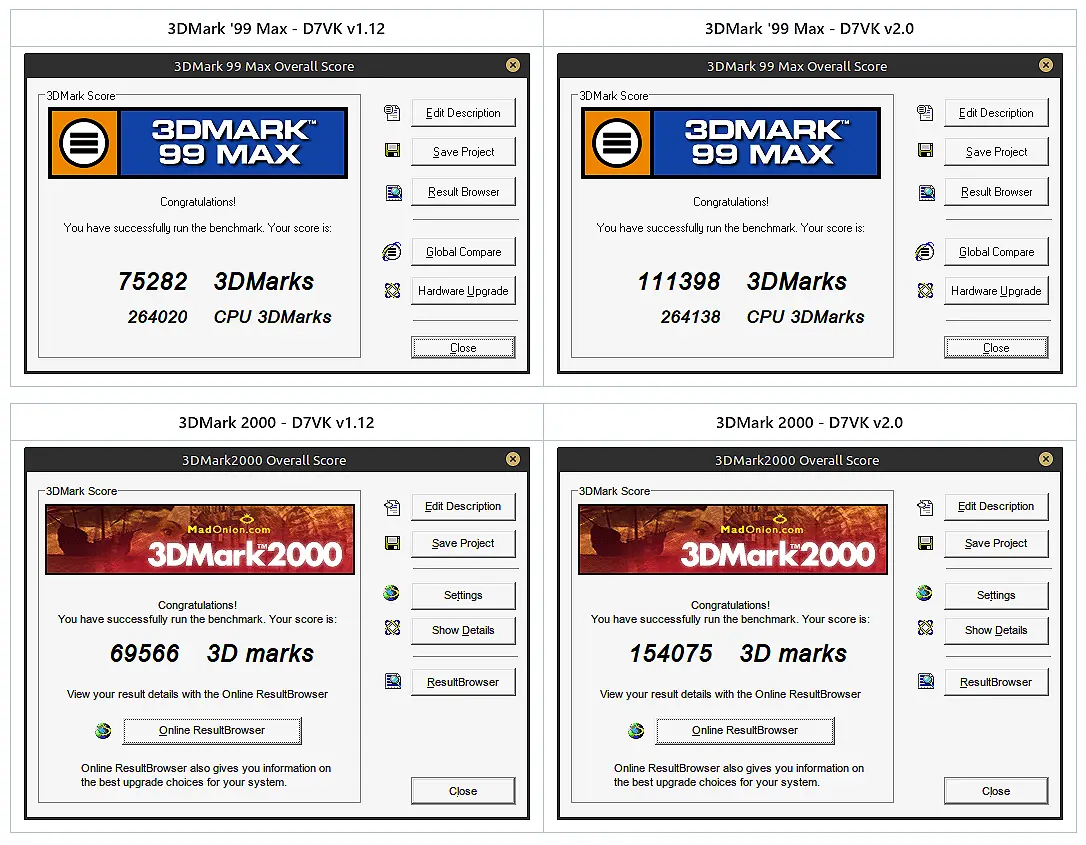
The v2.0 release justifies the major version jump. Contributor @CkNoSFeRaTU rewrote the CPU-heavy vertex processing routines with hand-rolled SSE helpers. The team also stripped debug loggers off the hot paths. Those loggers were running string operations even when nothing was actually being printed. That burned cycles. Removing them shifted several 3DMark benchmarks from CPU-limited to GPU-limited. Unreal Tournament now pushes dramatically higher framerates when VSync is off. Half-Life fans will notice a meaningful jump in uncapped sessions.
"Most of the 3DMark individual benchmarks are now entirely GPU limited, which is a very good sign indeed," WinterSnowfall wrote in the release notes.
Rebased on DXVK 3.0.2
D7VK 2.0 is built on top of DXVK 3.0.2, which means it inherits all the D3D9 refinements that trickle down to the older APIs. You get descriptor heaps via VK_EXT_descriptor_heap, improved memory management for MANAGED pool buffers, and working shared resources on upstream Wine without needing Proton-specific patches. Keep in mind that you'll need a Vulkan 1.4 capable driver to run it, which should cover basically everything released in the last five years.
The MANAGED pool buffer workaround also speeds up vertex uploads for titles like Toy Story 2 and SCP - Containment Breach. The project reports accurate dimension caps for both power-of-two and non-power-of-two surfaces after the team tested on actual Matrox G400, Nvidia Riva TNT2, and ATI Rage 128 hardware running Windows XP. That fixed clipping in Empire Earth and removed the need for workaround patches in Total Annihilation: Kingdoms and Revenant. Dungeon Keeper 2 gets frame limiting for its infamous water and flame animations. The Sims finally renders its white 3D models correctly, and NFS Porsche stops Z-fighting on night tracks.
The long road to running D3D3 on Linux
DDraw was originally built for multimedia apps, not games. The API got hijacked by developers who needed hardware acceleration without writing custom drivers, which explains why every Windows XP graphics driver had to patch DDraw endlessly. D7VK takes a minimal approach to that mess. It does not try to reimplement the entire API. It just intercepts DDraw calls and proxies them through DXVK.
If you are running Linux, you have two main deployment options. You can drop the ddraw.dll next to your game executable and set a native DLL override in winecfg, or you can rename the system ddraw.dll and place D7VK into your system32 or syswow64 folder for games that demand a system-wide hook like GTA 2 or StarLancer. Windows users just drop the DLL into the game folder. You will need to watch out for config variables since D7VK uses D7VK_LOG_LEVEL instead of DXVK's naming scheme. The project also supports DXVK's HUD and present interval options, so if you already use the translation layer for modern titles, the learning curve is basically nonexistent.
It is not exactly the most flashy piece of software, but it solves a genuine niche problem. The performance gains are real, and the shift to GPU-bound benchmarks in older 3DMark runs is exactly what you would want to see when you strip away CPU bottlenecks. However, at the same time, the Vulkan 1.4 requirement might leave some retro PC builders with older hardware behind. If you are stuck on an older GPU, @pythonlover02's DXVK-Sarek fork still ports D3D7 through D3D3 back to Vulkan 1.1 capable drivers.
The full release notes are up on GitHub, and the repository currently sits at 678 stars with over 8,200 commits across its development branch. You can grab D7VK 2.0 directly from the releases page.


