BlueOnyx Refreshes Installation Media for 5210R, 5211R and 5212R
A November 21 media roll-up bundles every update and kills a decade-old trick that forced first-time setups into a root shell.
BlueOnyx just published fresh installation media for all three of its currently supported lines. There are new ISOs, virtual appliance images and container images, rolled up to the state of the system as of November 21, 2026. But the change that actually matters isn't a big feature. It kills a decade-old ritual that forced anyone bringing a new box online into a root shell on first boot.
The update is a maintenance roll-up, not a feature release. It bundles every DNF package update across all three product trees and repackages them for USB deployment in a way BlueOnyx says is more resilient. Then there's the thing it spent the real effort on.
The one that counts
Two weeks before shipping the media, BlueOnyx posted a developer diary titled "Four Days of Chasing First-Boot Ghosts." The sprint zeroed in on the first five minutes after an install finishes. That's the narrow window where a box has technically booted but you still can't actually use it.
The numbers are staggering for what is basically polish. 27 SVN revisions. 45 added pages. 268 edited pages. Plus what the write-up calls a "small mountain of rebuilt RPMs." Michael Stauber and Greg Kuhnert did the work, with Kuhnert reportedly keeping cold boxes cycling through installs and restarts until the last edge case gave up.
Before this, the path to a running BlueOnyx was well worn. You install it. It grabs a DHCP address. You log in on the console and manually run network_settings.sh before the GUI would cooperate. The interface existed the whole time. Getting to it was just needlessly painful.
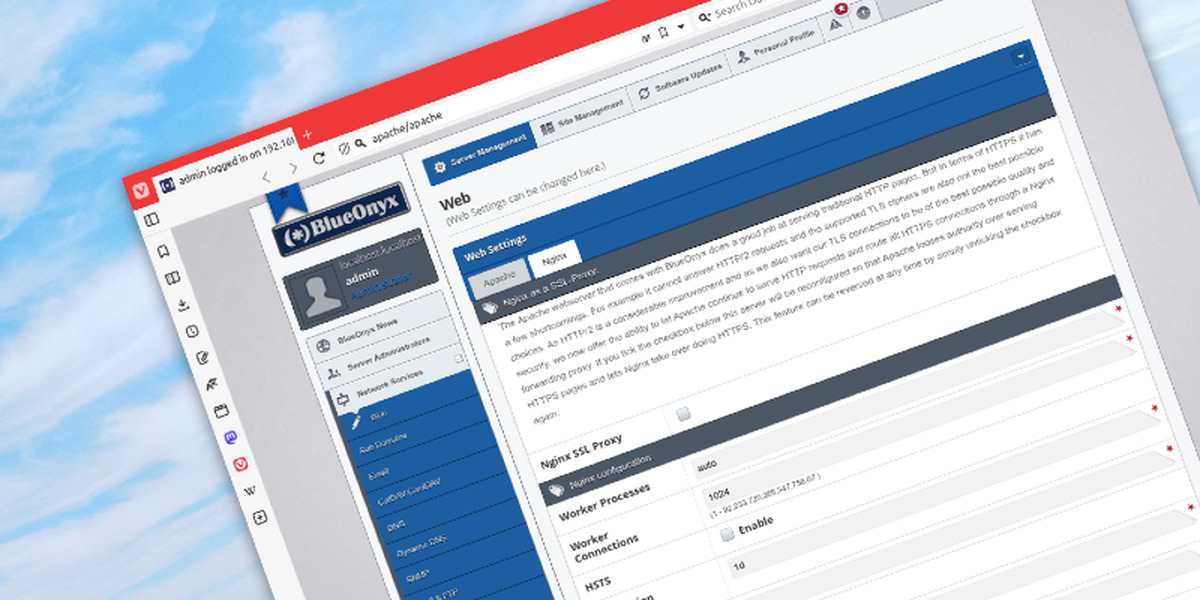
On the new media that's gone. A fresh DHCP install now browses straight to the box, shows a wait page while background constructors finish, and hands you the setup wizard directly. Fill it in, save, and you're in. No shell, no manual command, no "log in as root first."
The console command still works. It's just been demoted to what it should have been all along: an optional tool for people who want to wire up networking by hand.
What the ISOs actually are
If you're writing these to a stick, the format matters. The current BlueOnyx ISOs are hybrid BIOS + UEFI images that boot on legacy firmware and modern UEFI, including with Secure Boot. They use Anaconda's modern installer layout and expect a proper block-level write rather than a plain filesystem copy. That last part bites people.
BlueOnyx's guidance is explicit. If your tool offers it, choose "DD mode," "Raw mode" or "Image mode." The default ISO/filesystem write path is the one that produces a stick that boots but dies partway through.
The complete ISOs across all three trees now carry the 20261121 date. The netboot images keep their earlier builds — May for 5212R and 5211R, March for 5210R — because BlueOnyx only rebuilds the full media on each roll-up and leaves netboot alone unless a change forces it. Of the three active lines, 5211R is described as the most widely deployed.
A longer look at the ghosts
The thing worth pausing on is that most of the fixes describe bugs that never show up on a running system. They live entirely in that first-boot window, which means they're never reported and therefore rarely touched.
The wizard used to bounce users in circles while constructors ran, flinging "your login session has expired" errors at people who hadn't logged in yet. A capability cache would grab an incomplete permission set during that window and then trust it forever. A CCEd restart right when the wizard handed over to the GUI would kill the session and boot you back to the login form.
BlueOnyx versioned the cache so it validates against what CCE actually holds and refuses to store partial results. The GUI now rebuilds its connection and revalidates the session if a daemon restart sneaks in. There's a single writer for /etc/issue now, so the console banner finally shows the box's own IP. Dovecot and php-fpm now ship what they need instead of spilling red text across a perfectly healthy console.
Round out the mess and you've also got an empty /etc/fstab that could survive an install, PEAR modules pulled from pear.php.net during boot, kdump and GoAccess fighting the boot sequence, and EFI boot records written one disk off on /dev/sda. The last one failed silently every time because UEFI, GRUB and BIOS usually papered over it.
Getting it running
Downloads ship through BlueOnyx's seven-mirror network with SHA256 checksums. updates.blueonyx.it covers the USA, with mirrors in Berlin, Düren, the Netherlands and Tokyo rounding out the list.
For USB creation, Ventoy, Rufus and balenaEtcher are the tools the company calls out. Ventoy copies the ISO rather than extracting it, and may want a one-time MOK key enrollment under Secure Boot. Rufus needs the GPT + UEFI partition scheme with "Write in DD Image mode." balenaEtcher just works, defaulting to raw image mode with no manual options.
BlueOnyx also ships the media as VirtualBox (VDI) and VMware (VMDK) appliances over its OVA mirror network, plus Incus/LXC container images on a dedicated remote. The company actually runs its own web host on Incus, so it documents the exact commands to pull images the same way.
A year under security pressure
This isn't BlueOnyx's first roll-up of 2026. Complete-ISO refreshes landed in June, August, September (twice) and October before this November drop.
A fresh install now inherits a lot of security work by default. On November 19, 2026 BlueOnyx pushed a CRITICAL PHP cycle addressing CVE-2026-126714 ("phpAfterShell," a session-splicing remote code execution bug) plus several PHP-FPM use-after-free paths. Earlier in the year it hardened PHP-FPM isolation for virtual sites, enabled full PDO support across every PHP version, and pushed back against the October PHP2Shell vulnerabilities.
Because the November 21 media is a roll-up "as of today," you land with this entire security surface already patched. No post-install dnf update required just to reach a sane baseline.
The long view
BlueOnyx traces its lineage back to the Cobalt Networks RaQ servers of the 1990s, most famously the RaQ550. Sun bought Cobalt, the "Sausalito" GUI went open source, and the first BlueOnyx shipped on CentOS 5 in 2008. Three versions are active today, 5212R on AlmaLinux 10, 5211R on AlmaLinux 9 and 5210R on AlmaLinux 8, while older lines like 5209R have reached end of life.
The project is free to use but explicitly "not free to maintain," with tiered support contributions running from €25 at the community level up through corporate sponsorship and €50/month priority assistance.
Head here to grab the new media.


