Strata 0.2.18 brings a 220-billion-parameter model to your PC
Strata, the viral local-AI engine from Slovenian developer Niko Veit, shipped version 0.2.18 on 21 November 2026. The headline is native support for Tencent's Hy4-Flash, a 220-billion-parameter model that normally wants data-center hardware. Veit now says you can run it on a regular PC, using three new quantization packs for machines with 64, 96, or 128 GB of RAM.
Here's the thing. The project, launched on 24 September 2026, has ballooned to roughly 46,600 GitHub stars and 5,200 forks. That's nowhere near what you'd expect from a one-person repo, and it makes Strata one of the most-watched open-source AI efforts of the year.
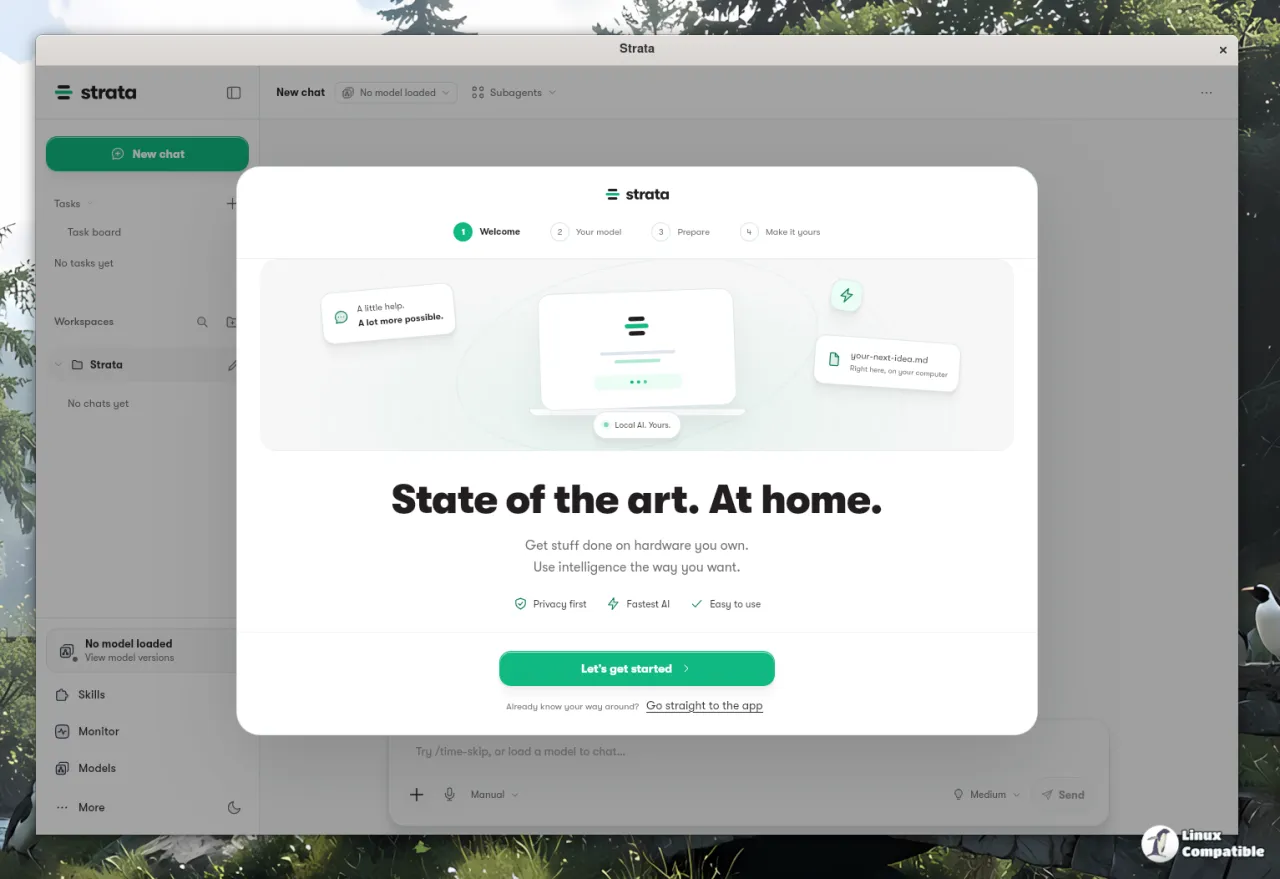
Fitting the unfillable. The core idea isn't compression. Strata doesn't shrink a model to fit your graphics card. It tries to shove a model far bigger than the hardware should handle across the whole machine, using tricks that would make a systems engineer wince.
A model of this kind has tens of thousands of tiny "experts." Any single word only calls on about ten of them. So Strata keeps the hot ones in VRAM, holds every expert in system RAM, computes the off-card ones on the CPU alongside the GPU, and backs a big lookup table on your SSD. The pitch is that this keeps "the GPU, the CPU, the RAM and the PCIe link all busy with the work each is best at."
Keep in mind the specs get wild fast. Hy4-Flash, released by Tencent on 16 November, lists 224B total parameters, a 1M-token context window, and text-plus-image input. Only about 12B are active per token, thanks to hybrid attention, a latent-space MoE design, and a 63.5B-parameter table Tencent calls Engram. There's also a built-in 0.85B drafter called DFly2 for speculative decoding. For what it's worth, Tencent's asking about $0.07 per million input tokens and $0.28 per output, a twentieth of Hy4's price.
Then there's the storage tax. The three "Strata Quantization" packs sit between 129 GB and 181 GB on disk. The pack targeting 128 GiB is closest to full precision, with a reasoning mean KL divergence of 0.0879. It's a lot of space for what is, after all, a research-grade toy. Though if you've got the RAM, the numbers are genuinely impressive.
A bigger story in the kernels
The feature getting the most press isn't actually the model. Strata 0.2.18 runs largely on code Veit wrote himself. Over recent releases he's been quietly dropping llama.cpp and the ggml matrix kernels it built on.
The swap started in 0.2.14. By 0.2.16, on 18 November, the NVIDIA, AMD, Intel Arc, and Apple Silicon engines reportedly ran on Strata's own code with no ggml and no llama.cpp kernels left in the mix. The picture reader alone shrank from about 53.9 MB down to 808 KB on NVIDIA hardware.
That rewrite came with a bold claim: identical output. Strata reported token-for-token agreement across a spread of cards, from a Tesla P100 to an M5 Max. It also came right after a bad one. In 0.2.15, M1 through M4 Macs were silently producing subtly wrong results, computing only a quarter of the columns in some layers. The bug hid because the text still read fine.
Here's where the honesty pays off. On the Mac's default path across six prompts ranging from 512 to 8,192 tokens, first-token divergence fell from 0.303 to 0.0068. A silent-quality bug that would have quietly misled people got caught and measured. That's a discipline you don't see from most solo projects, let alone ones this aggressive about shipping.
Getting it running
The desktop app ships signed and notarized installers for Linux, Windows, and macOS. The terminal route is a curl pipe into sh, with a matching PowerShell one-liner for Windows. You can also just run strata update from within the app.
One heads-up before you download. The full 0.2.18 package is 49 files and about 10 GB, and the app loads 35 to 55 GB into RAM on first run, locking part of it. Strata describes a one- to three-minute freeze as expected. It is not a crash. It's the system doing exactly what it was told.
For what it's worth, the real story here is less the 220B model and more the engine underneath it. A solo developer, an army of volunteers testing on their own hardware, and a coding assistant he openly directs have built something that claims to match battle-tested open tooling piece by piece. Whether that's a genuine competitor to llama.cpp or a cleverly wrapped expert-cache trick is still up for debate. Strata's willingness to flip a default back after measuring it hurt users, and to publish exactly what it hasn't tested, may be the more durable take than any single benchmark.
Head here to the release announcement.


