Bazzite ships 44.20260915 with UMU Launcher, Wi-Fi fix, and fresh desktop stacks
The community-driven Linux gaming distro Bazzite just posted a new stable build, and it's bringing non-Steam Windows games a first-class launch path plus a fix that should quietly cut wireless latency.
That's the headline for 44.20260915, released September 15. It's a typical daily stable image from the Universal Blue project, the Fedora-based crowd that powers Bazzite. Each one rolls in upstream package bumps alongside a batch of Bazzite's own patches, and this edition is no exception. It jumps forward from the previous day's 44.20260914 image with roughly a dozen notable updates and a handful of its own fixes.
Two changes are the real reason to care. UMU Launcher ships for the first time, which is a meaningful move for non-Steam gaming. And Bazzite is turning Wi-Fi power saving off by default to chase down latency on a lot of hardware.
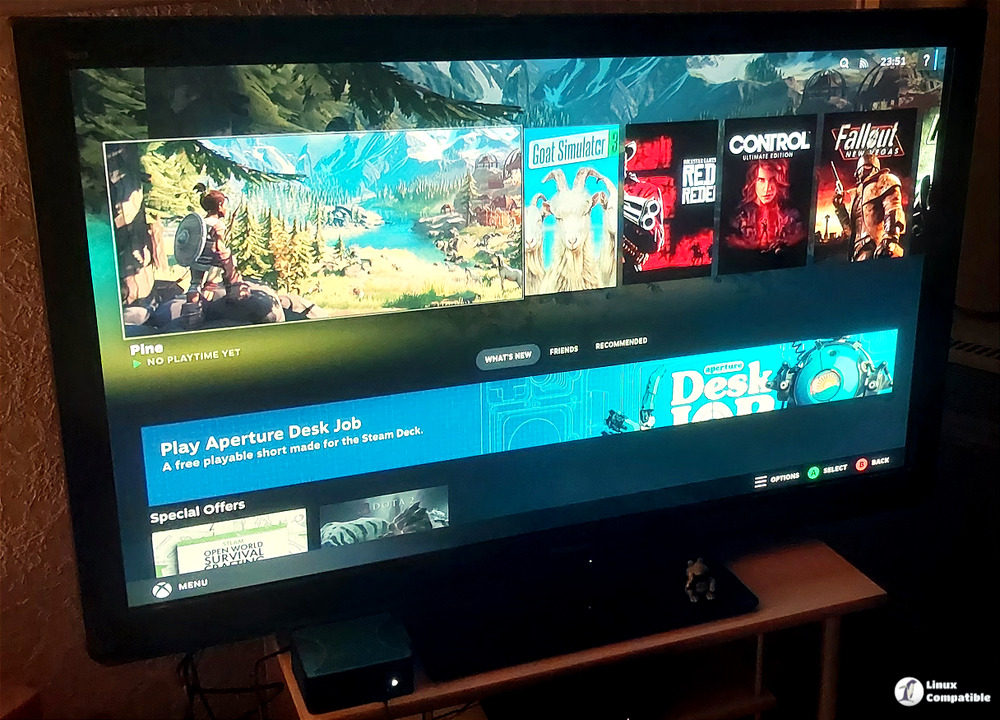
Non-Steam games get a real backend
The single biggest addition here is UMU Launcher, version 1.4.4-1. Lead maintainer Kyle Gospodnetich (who goes by KyleGospo on GitHub) added it to the build and the changelog in a September 15 commit.
UMU Launcher bills itself as a "unified launcher for Windows games on Linux." It's an Open-Wine-Components project, a GPL-3.0 Python tool with roughly 3,700 stars on GitHub. More importantly, it bundles the same Steam Runtime machinery that Proton already relies on, so you can launch Windows games without Steam running at all.
The reason that matters for Bazzite is the ecosystem angle. The distro already leans on Lutris and friends to launch non-Steam storefronts like Xbox Game Pass, the Epic Store, GOG, and itch.io. UMU gives those workflows a first-class backend backed by one shared database of game-specific Proton fixes, called protonfixes. Fewer per-launcher headaches. Better out-of-the-box compatibility.
Keep in mind that's exactly the kind of thing you want when you're trying to get a Windows title running cleanly under Steam Gaming Mode on a handheld. You'll still need to test your own games, but the shared database helps.
Turning off Wi-Fi power saving
Among Bazzite's own commits since the last build is one that actually touches wireless gamers.
fix(deck): Disable wifi power saving by default, this can be toggled back on in Steam Gaming Mode. Fixes issues with latency on a lot of hardware. Related to PR #5795
Kyle committed it on September 13. The change shuts off power saving across Bazzite installs by default, though you can still re-enable it in Steam Gaming Mode settings if battery life trumps latency. Bazzite flags it as tied to an open issue (#5795), so it reads as an ongoing fix rather than a one-and-done patch. Honestly, this is the kind of low-key change you won't notice until it's working.
A handful of smaller patches
There's more going on under the hood. Community contributor addmix (PR #5817) restored SteamVR's 32-bit support by bringing back the missing mesa-libEGL.i686 library, which Bazzite says is required by SteamVR. VR users on the platform should benefit.
Another fix from Nilesh Chakraborty (#5811) stops input-remapper from auto-starting when its service is off, sparing the annoyance of remapping kicking in when you didn't ask for it. Bazzite also dropped some legacy workaround services and an unneeded package, trimming code that only mattered for older images. And contributor Saltane added Ukrainian translations to several desktop entries (#5813), plus keywords to the Discourse app (#5814), continuing the project's steady localization grind.
The rest of the stack
Bazzite's auto-generated changelog lists one representative package per newer version, but the full list of bumped packages is a little longer. InputPlumber jumped from 0.79.5-1 to 0.81.0-3, OpenGamepadUI nudged to 0.46.1-5, and PowerStation crept to 0.8.4-2. Two smaller pieces moved too: ffmpeg went 8.1.2-1 to 8.1.2-2, and the intel-vaapi-driver ran 2.4.1-8 to 2.4.5-1.
The desktops are ahead of the Fedora base. Bazzite ships GNOME 50.4 and KDE Plasma 6.7.5 here. Fedora 44, which landed April 28, shipped with GNOME 50 and KDE Plasma 6.6. So Bazzite tracks a touch newer than its base, which is the usual practice for the project.
The graphics stack is fully modern. Mesa 26.2.2 covers AMD and Intel, Gamescope 3.16.28 rides alongside a September 12 Gamescope Session snapshot, and MangoHUD 0.8.4 handles in-game metrics.
The context
Bazzite is one of several images under Universal Blue, which applies cloud-native, image-based tech (rpm-ostree and Atomic Desktops) to the Linux desktop. Its angle is gaming: Steam pre-installed, HDR and VRR support, CPU scheduler tweaks, and a curated set of community tools. You can grab a KDE image styled after SteamOS's Holosee desktop or a touch-optimized GNOME image, and Steam Gaming Mode stretches via Decky Loader plugins.
Because it's image-based, updates are atomic and reversible. After each one the previous OS image stays put, and you can boot into it or rebase to any of the last 90 days of images straight from the terminal. That safety net pays off hard when a driver or kernel update throws a regression.
The project runs on a small band of maintainers, with Kyle being the most active, plus community contributors. It follows an "upstream-first" philosophy, pushing its improvements back to Fedora Atomic, SteamOS, and the wider Linux gaming scene. As of this release, the GitHub repo sits at about 9,100 stars and 1,100 forks, with 1,400 open issues and 32 open pull requests.
Grabbing 44.20260915
Existing users on the stable branch should rebase rather than do a clean reinstall.
# Rebase to the latest stable image
bazzite-rollback-helper rebase stable

# Or pin this exact image
bazzite-rollback-helper rebase 44.20260915
New users can pick hardware, GPU vendor, and desktop from the download form on bazzite.gg for a tailored ISO link. Existing Fedora Atomic Desktop users can rebase in place without reinstalling, though it's wise to keep the same desktop environment when you do.


