AnduinOS 2.0.1 adds ARM64 support and local LLMs to the Windows refugee distro
The updated LTS release builds on Ubuntu 26.04 with Kernel 7.0 and GNOME 50, shipping a generic ARM image and a fully offline Gemma 4 package.
AnduinOS v2.0.1 is here. The Linux distribution designed to look like Windows 11 just got its Long-Term Support refresh with ARM64 support and fully offline local AI. Developer Anduin Xue announced the update on July 24, 2026, rounding out the v2.0 lineage that replaced Ubuntu 26.04 LTS as its base.
Xue is a Hong Kong-based former Microsoft engineer running the project on donations and his own dime. That puts AnduinOS firmly in the anti-corporate corner of the distro ecosystem, even as the desktop mimics the Windows 11 Fluent design. No Snap. No telemetry. No tracking. Just a Debian-compatible package system and a GNOME session that feels familiar to anyone migrating from Redmond.
This update follows the v2.0 debut on June 30, 2026, which swapped the messy Bash scripts of v1.x for a declarative build system using aosproj. The rebuild tightened the ISO footprint to 2.53 GB and improved native APT compatibility through a global CDN.
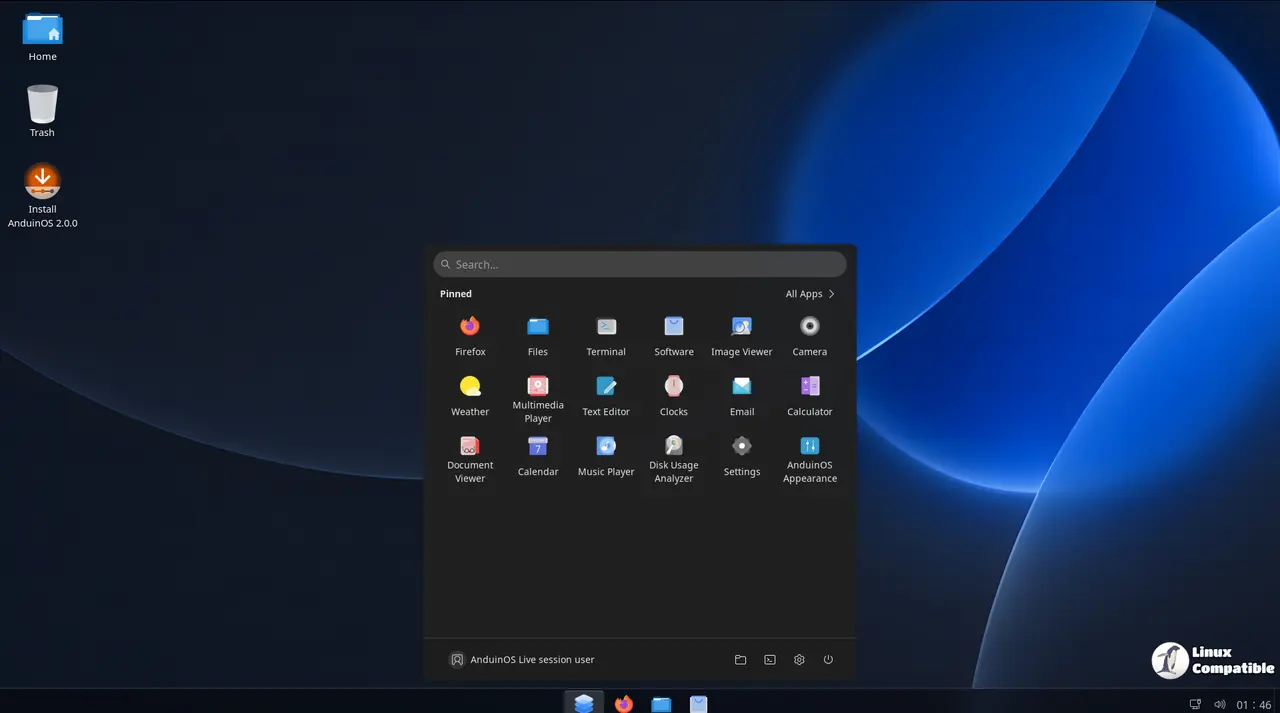
ARM64 lands in first-class support
The headline shift in v2.0.1 is the generic ARM64 ISO. AnduinOS now ships alongside the standard AMD64 builds, validated on QEMU and the Microsoft Windows Dev Kit 2023. This targets the fragmented ARM Linux desktop scene, which has historically required patching kernels just to get a desktop environment to render on devices like the Qualcomm Snapdragon X laptops or Raspberry Pi boards.
The build uses a pure UEFI-only boot chain. Keep in mind that out-of-the-box compatibility with random ARM hardware isn't guaranteed. Unsupported devices may still need manual firmware provisioning or custom Device Trees.
That said, having a polished distro with a Windows-lookalike interface that boots on ARM without the usual hacks is a meaningful step forward. For what it's worth, the project also maintains a clean slate regarding hardware support. Drivers for Wi-Fi, Bluetooth, webcams, and audio tend to just work, based on reviews from Tom's Hardware and FOSS Force.
Edge AI without the cloud
v2.0.1 also introduces the anduinos-why-ai package, an opt-in install to keep the base system lean. It brings fully offline local LLM capabilities powered by Google's Gemma 4 E2B Q4_K_M model via llama.cpp. No daemons running. No cloud calls.
The package offers a UNIX-style CLI where you can pipe logs, configs, or Git diffs into why for instant analysis. There's also a local OpenAI-compatible HTTP server if you want to feed the model into GitHub Copilot CLI.
It's a feature that feels strategically aligned with the distro's mission. Users fleeing Microsoft are often looking to escape proprietary integrations, and a local AI tool that rivals Copilot's clippy-like behavior without the privacy costs fits the narrative. Solo funding. Donation-backed. No corporate overreach.
Users with less than 16 GB of RAM should skip the model if they also want to run Firefox with a handful of tabs open. The Gemma 4 E2B model still consumes a respectable chunk of memory.
Other updates include Zram enabled by default with 50% of RAM allocated via LZ4 and swappiness set to 100. The new OOBE wizard handles graphical setup for Secure Boot MOK enrollment, a task that has plagued ARM and Secure Boot users in the past. AnduinOS Exe Launcher now supports .exe file associations using Bottles without touching the host OS, and an Xbox controller driver is available as an opt-in kernel-space add-on.
Documentation has been rebuilt in 28 languages using AI translation, covering English, Spanish, Mandarin, Arabic, Hindi, Finnish, and more. The project sits at ~1,300 GitHub stars and holds the #13 spot on DistroWatch with an average of 857 hits per day and an 8.9/10 rating from 40 community reviews.
AnduinOS v2.0.1 runs on Linux Kernel 7.0 and GNOME 50, with support extending until April 2031. Minimum specs require 4 GB of RAM and 20 GB of disk, though 8 GB and 50 GB are recommended for a comfortable experience at 2560×1440 resolution.
The ISOs are available for both x86_64 and ARM64 architectures. Head here to download AnduinOS 2.0.1.


