Alpine Linux 3.22.5 and 3.23.5 releases patch critical OpenSSL and Xen flaws
Alpine Linux 3.22.5 and 3.23.5 releases drop today with a massive OpenSSL security overhaul and a handful of Xen hypervisor fixes. Administrators will get a clear path to upgrade container images and virtual hosts without guessing which CVE actually breaks production.
The OpenSSL updates touch certificate parsing, network handling, and encryption routines. Skipping this update leaves systems open to heap corruption, authentication bypasses, and sudden denial of service crashes.
Parsing flaws that break certificates and crash services
The OpenSSL team fixed a heap buffer overread that triggers when a crafted DER encoded ASN.1 structure exceeds two gigabytes in length. This flaw affects sixty four bit Unix platforms and forces applications to read past the end of allocated memory while decoding X.509 certificates or PKCS7 blobs.
A malformed input might crash the process or silently truncate the decoded object. Services parsing untrusted certificates through d2i_X509 functions walk right into the trap. Another parsing issue handles PKCS12 files that use PBMAC1 integrity without proper validation. A forged certificate and private key pair slips through with a one in two hundred fifty six chance. That probability drops to zero when strict password authentication is enforced, but any service accepting PKCS12 bundles without careful checks walks right into the trap.
A separate ASN.1 bug causes a signed integer overflow when sizing Unicode output buffers. The calculation wraps to zero when input reaches roughly half a gigabyte, and OpenSSL allocates a single byte before writing gigabytes past it. X.509 processing routes through size limit checks that normally prevent this, but applications calling ASN1_mbstring_copy directly with attacker controlled input face the overflow entirely.
QUIC and network stack vulnerabilities
Network handlers get hammered by a path challenge memory exhaustion bug. A remote peer floods the QUIC stack with path challenge frames, and the server allocates a response frame for every single one while the attacker refuses to acknowledge the reply.
Heap space drains until the application terminates. Disabling client address validation in OpenSSL listeners makes this trivial to trigger. A NULL pointer dereference also surfaces when an initial QUIC packet carries an invalid token on servers with address validation turned off. The process crashes immediately. Applications processing Certificate Management Protocol responses face a similar NULL dereference risk when a crafted certificate response omits required parameters. The crash is guaranteed for any CMP client that does not sanitize server input properly.
A PKCS7 use after free condition appears when a signed message contains an empty digestAlgorithms field, and OpenSSL incorrectly frees a caller owned BIO during signature verification. Subsequent application calls to BIO_free trigger heap corruption. Container developers building custom Alpine images should rebuild affected services immediately. Manual recompilation remains pointless for most deployments when the package manager handles everything automatically.
Encryption bypasses and signature traps
CMS and S MIME decryption functions carry a Bleichenbacher style attack vector that allows adaptive chosen ciphertext probing. Applications that iterate over recipient information without stopping at the first successful key match hand attackers a decryption oracle. An attacker crafts messages with multiple recipient entries to force OpenSSL into revealing padding validity through error codes.
Providing the correct recipient certificate blocks this path. Another CMS flaw allows tag length reduction to a single byte, opening the door for brute force decryption on applications that blindly trust the output. Password based decryption triggers a heap out of bounds read when an attacker specifies a stream mode key encryption cipher instead of a block cipher. The guard check relies on block length assumptions, and stream ciphers break that logic entirely. Applications calling CMS decrypt functions on untrusted data face potential crashes when the overread hits unmapped memory pages. AES OCB contexts silently discard caller supplied initial vectors when driven through the one shot EVP_Cipher interface.
Every message encrypted under the same key uses the same effective nonce, resulting in key nonce reuse and total loss of confidentiality. Applications that drive AES OCB through the documented streaming AEAD API remain unaffected. AES SIV and AES GCM SIV implementations mishandle authentication of additional data when paired with empty ciphertext. An attacker forges empty messages with arbitrary additional data to the victim application using these ciphers. No TLS or standard protocol relies on these modes, but custom implementations that skip ciphertext updates before verifying tags walk right into the trap.
Xen hypervisor patches and Alpine deployment reality
Alpine Linux 3.22.5 and 3.23.5 releases also bundle Xen security updates addressing four host virtualization flaws. The patches resolve memory handling issues and hypercall validation gaps that could compromise guest isolation. Container users running Alpine in Kubernetes or Docker stacks do not need to worry about the Xen fixes, but bare metal or virtual host administrators must apply them immediately.
Package manager execution handles the OpenSSL changes without manual intervention. Alpine users typically pull these changes through standard upgrade routines. The package manager resolves dependencies automatically and restarts affected services if configuration scripts trigger a reload. Running the upgrade during low traffic hours prevents unexpected connection drops while keeping the certificate chain intact. Checking the version string after the update verifies the patch landed correctly.
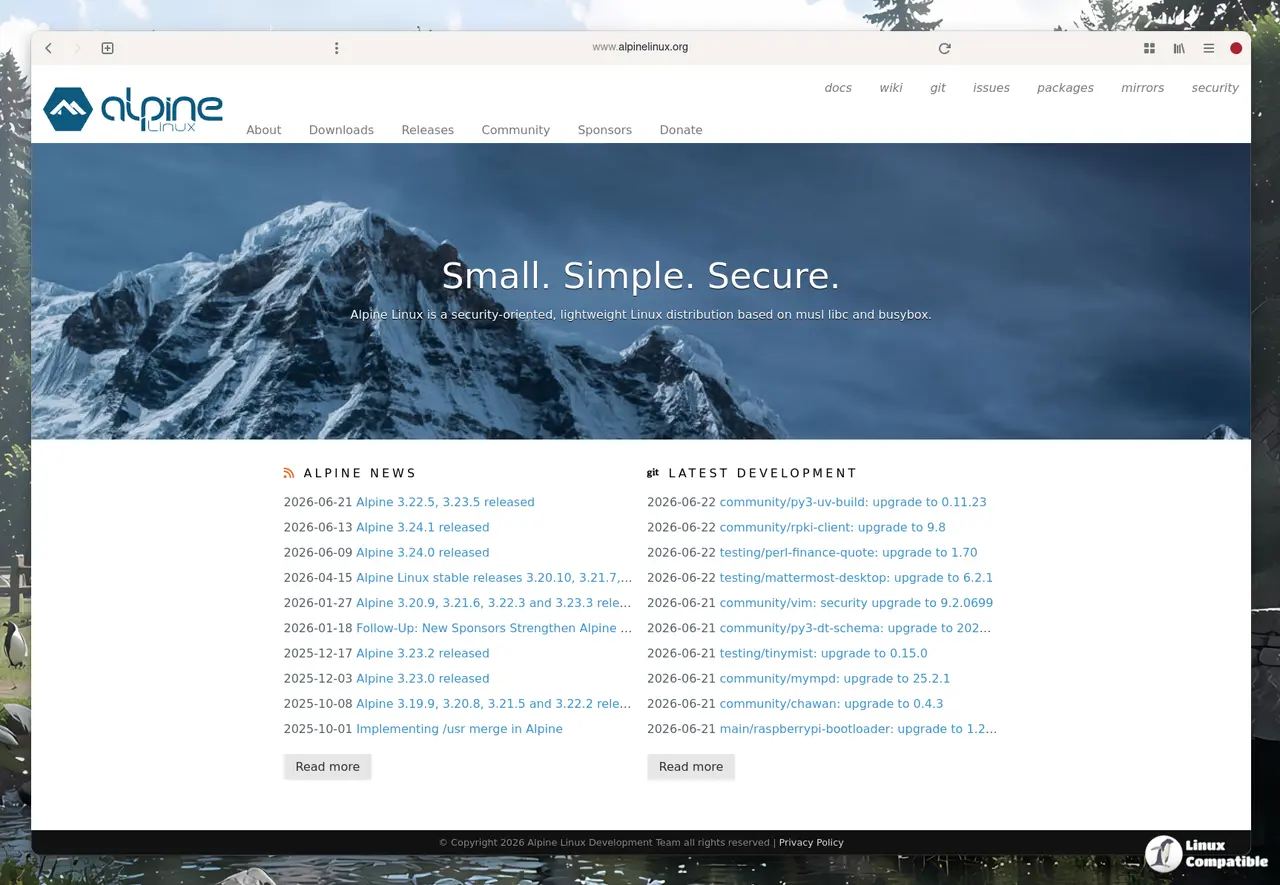
Alpine 3.22.5, 3.23.5 released
Alpine 3.22.5, 3.23.5 released
Grab the latest packages, watch the service restarts, and breathe easier. The patching window stays open a few more weeks, so scheduling the upgrade beats scrambling later. Drop a comment if the update breaks a custom Alpine container build.


