4MLinux 53.0 BETA launched as a full desktop-and-miniserver image rather than a half-built prototype. It rides on a modern core built from source with what the project calls "a huge number of updated packages." The Polish distro sidesteps traditional package managers, delivering software as self-contained addons and rebuilding its tiny core on boot to stay comfortably light on old hardware. It is one step toward a November STABLE release, with old-stable support through March 2027 and end of life in July.
4MLinux 53.0 BETA Ships Ahead of a November STABLE Release
The ultra-lightweight Polish distro opens its next stable cycle with a fully rebuilt software stack on Linux kernel 6.18.43.
4MLinux 53.0 BETA is downloadable now, and it is the whole thing rather than a prototype wearing a BETA badge. The full desktop-and-miniserver image launched Monday, September 28, 2026, packed with what the project calls "a huge number of updated packages" and aimed squarely at testers who want to shake out problems before the planned STABLE version lands in November.
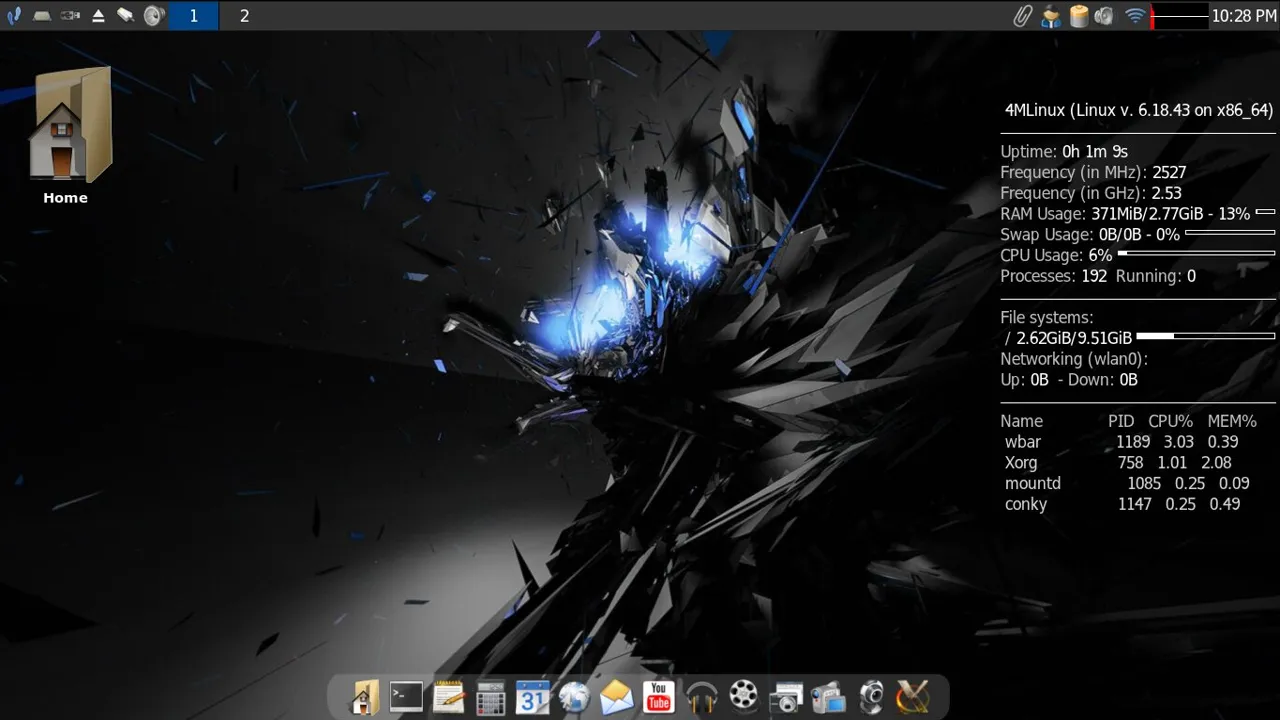
4MLinux has existed since 2010, built by Zbigniew Konojacki (who signs online as zk1234) out of Poland. He has been deliberately ignoring the conventions of mainstream distros ever since the first release, and the project's name comes from the four M's he groups all software into: Maintenance, Multimedia, Miniserver, and Mystery.
Maintenance is a rescue-oriented Live CD for backing up data and repairing machines that refuse to boot. Multimedia, branded "Media" by the project, previews image, audio, and video files the instant you point at them. Miniserver is one of the lightest server suites you can train on a box, throwing in FTP, HTTP, SSH/SFTP, Telnet, NFS, DNS, a proxy, and a mail daemon, all channeled through a single inetd-style process. Mystery is, fittingly, just a stash of classic text-mode games.
The Mystery section is where you kill boredom on a headless server box. It is arguably the least practical of the four M's, but honestly I am not sorry about that.
The detail that earns 4MLinux its niche is how little it consumes. There is no package manager here, at least not in the apt or dnf sense. Software ships as self-contained addon archives (those addon_*.tar.xz files) that the system installs and rebuilds from a tiny core on every boot. It runs the JWM window manager and preinstalls utilities like Conky. The hardware bar is astonishingly low, which is exactly what makes it a favorite life-extender for dead laptops and a pocket-sized rescue kit.
A Surprisingly Modern Core
53.0 BETA is not the first 53 artifact to appear this cycle. That credit goes to the 53.0 Core BETA, dropped August 24, a roughly 16 MB image bootable on both BIOS and UEFI that set the foundation for the whole series. The desktop build stands on top of that core, and the stack underneath looks surprisingly modern for something this small.
It rests on Linux kernel 6.18.43, glibc 2.44, and BusyBox 1.38.0, with GCC 16.1.0 compiling everything for x86_64. Because 4MLinux builds its own stack from source, the project selects and integrates these versions itself instead of inheriting them from an upstream tree. That freedom is also why updates can sprint past any single vendor's schedule.
How It Takes Care of Itself
Understanding 53.0 gets easier once you see how the distro maintains itself. Skip apt and dnf entirely, and you will find a small script called zk. It installs an addon, wraps a folder of files into a new addon, or updates the whole system to the latest stable version with a single, fully automatic command.
The core rebuilds on the fly. One rcS script lays down the directory tree, device nodes, and config files from scratch on first boot and patches anything missing on the next one. Drop an addon into /etc/init.d and it installs automatically at startup, then relocates to /var/4MLinux.
Every program arrives this way. Midnight Commander, mpv, SoX, even the ClamAV antivirus come as xzipped tar archives you can poke at with Midnight Commander and install on demand. Rescue tools such as TestDisk, PhotoRec, cfdisk, GNU Parted, and the nwipe disk-erasure utility round it out, and the antivir command wraps ClamAV for spot scans.
The Miniserver is arguably the project's flashiest trick. A super-server daemon shepherds FTP, HTTP, and SSH (SFTP included) alongside Telnet, with optional Polipo proxying (and optional Tor), NFS, BIND DNS, Postfix mail, and an iptables firewall that throws on brute-force and DDOS protection. The project insists you need as little as 512 MB of RAM to stand it up and even browse a site against it. The 53.0 BETA's "64-bit Miniserver & Desktop" image means a single ISO covers both the desktop and that server toolset, so you do not have to choose a side.
Keep in mind that 53.0 BETA is just one step in a published timeline. The Core BETA arrived in August, the full BETA lands now, and STABLE is targeted for November 2026. Old-stable status follows in March 2027, with end of life in July 2027. That roughly mirrors the project's long habit of pushing monthly STABLE updates through Core BETA, BETA, then STABLE before settling into a long old-stable run.
The 53.0 BETA and the rest of the 4MLinux family are free to download from SourceForge, with a donation-optional mirror on the official site.


