XanMod ships 7.3.3 and 6.18.62 kernels in coordinated drop
New builds land on the record-breaking mainline 7.3 and the long-term-support 6.18, plus real-time twins, all at once.
XanMod released two new Linux kernels today. One rides the freshest mainline code available today, the other stays put on the maintained long-term-support track. They arrived together, so you get to pick.
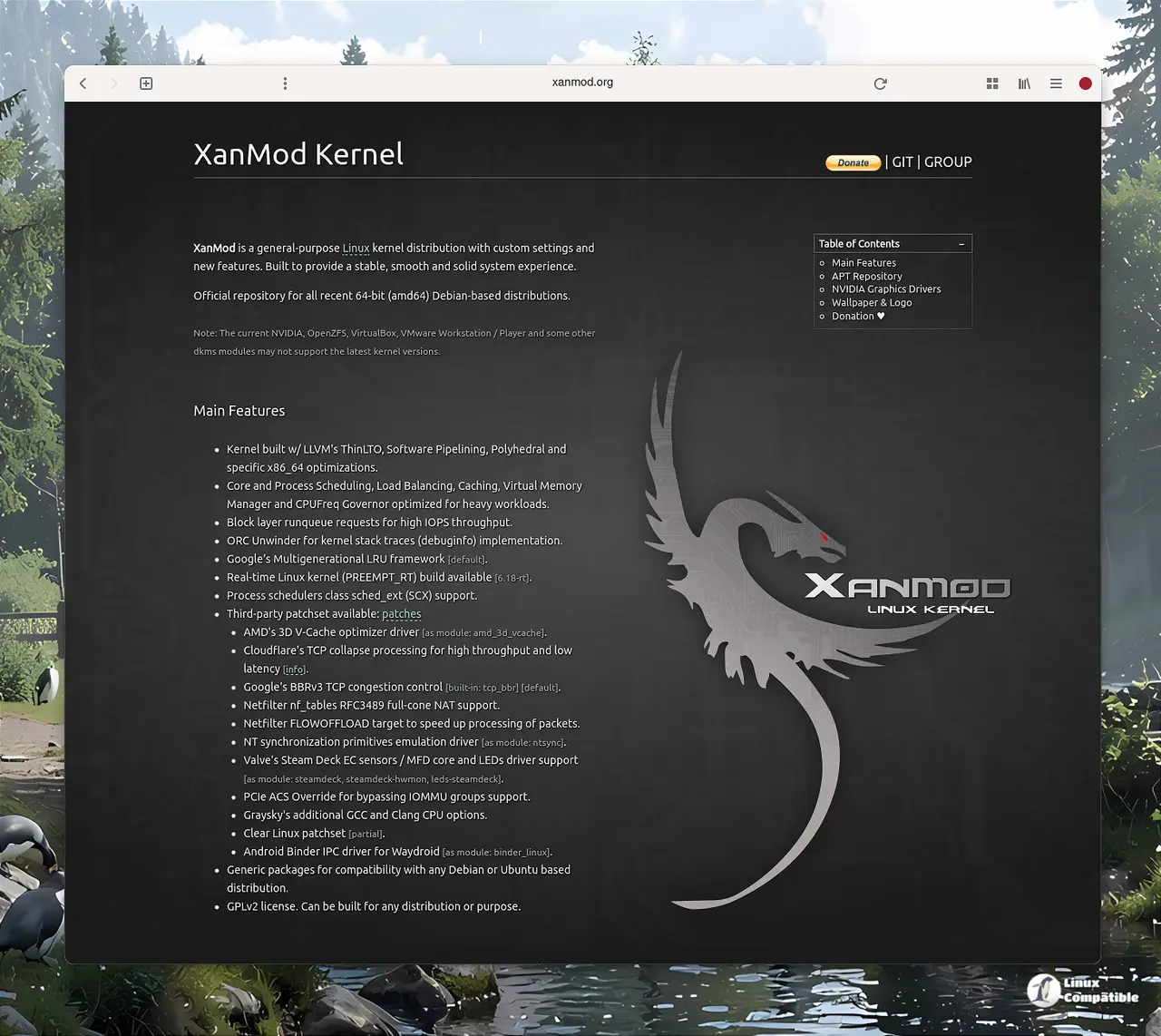
The drop was coordinated across the project's active branches. The main and LTS tracks, along with real-time twins, were each rebased on upstream stable code Greg Kroah-Hartman published the day before.
For those not in the loop, XanMod isn't a new kernel. It's a repackaging project. Alexandre Frade has run it solo since 2015, taking Greg's stable mainline code and rebuilding it for x86-64 systems with a pile of optimizations bolted on. The project aims to make desktop, gaming, and heavy-workload machines feel "stable, smooth and solid," in its own words.
It's a community effort, partly funded by donations. The project's page lists expenses like test hardware, web hosting, and a coffee. Far from an enterprise kernel team, it has served Debian and Ubuntu enthusiasts for over a decade anyway.
Two tracks, one drop
The MAIN branch hands you 7.3.3-xanmod1, built on the freshly released Linux 7.3. That version dropped from Linus Torvalds on October 18th, and it set some records along the way: 18,765 non-merge commits from 3,021 developers, including 807 first-timers. The source tree grew to nearly 41 million lines of code.
Torvalds described it with his usual restraint. "Nothing very special seems to have happened this last week," he said, with fixes "random across the board."
The LTS branch is where you go if longevity matters. You get 6.18.62-xanmod1, based on Linux 6.18, which reached mainline in late November 2025 before Greg promoted it to long-term support. Its end-of-life is set for December 31st, 2027, with room to stretch further.
Both land the same day, which is unusual enough to matter. You can chase the newest mainline code, or stay on the maintained line. A real-time variant based on 6.18 also shipped, targeting low-latency scheduling for workloads that can't afford hiccups.
What actually changed today
These are stable-point releases, so don't expect a feature parade. The security content is the headline.
Three Xen virtualization fixes stand out. XSA-526, XSA-527, and XSA-528 all hit the xen-netback and xen-blkback drivers, covering use-after-free and NULL-dereference bugs during teardown. Juergen Gross and Jan Beulich did the patching.
There's also a wave of fixes for ksmbd, the in-kernel SMB file server. It gets coverage for use-after-free, out-of-bounds reads, and a baffling empty-DACL check that previously handed out full access. If you share files with Windows machines, that one alone might be enough to get you to reboot.
Keep in mind that io_uring also got a batch of fixes touching memory accounting leaks and BPF capability bypasses, and tun/tap had a ~20-year-old loophole closed that required CAP_NET_ADMIN to attach to ownerless devices.
The caveat you shouldn't skip
Before you install anything, know that XanMod splits its builds by CPU generation. You pick x64v1, x64v2, or x64v3. Match the tier to your processor and everything just works. Choose a too-new one on old hardware and it won't boot. Pick one that's too old and you leave performance on the table.
A companion script, check_x86-64_psabi.sh, detects your level. But it's easy to get wrong, and picking the wrong tier is a classic newcomer mistake. XanMod isn't a one-size-fits-all kernel, contrary to what the casual reader might assume.
Installation runs through APT. You register the PGP key, add the repo line for your distro's codename, install your chosen tier, and reboot. bookworm, trixie, noble, and plucky are all in the mix.
wget -qO - https://dl.xanmod.org/archive.key | sudo gpg --dearmor -o /etc/apt/keyrings/xanmod-archive-keyring.gpg
echo "deb [signed-by=/etc/apt/keyrings/xanmod-archive-keyring.gpg] http://deb.xanmod.org $(lsb_release -sc) main" | sudo tee /etc/apt/sources.list.d/xanmod-release.list
sudo apt update && sudo apt install linux-xanmod-x64v3
Where it lands
It's a strong release for people who want mainline freshness without compiling anything themselves, and the same-day cadence across main, LTS, and RT shows a project that knows its craft.
The catch is that MAIN 7.3.3 rides a newer series with a shorter support window, so it suits enthusiasts more than production servers. However, at the same time, the choice isn't hard. If you're running something important, the 6.18.62 LTS line, good until late 2027, is the safer bet. The enthusiast gets the fireworks. The operator gets the longevity. You decide which one you are.
Head here to the XanMod website for more information.


