Ubuntu Linux 26.10 "Stonking Stingray" Snapshot 3 is now available on cdimage, delivering 35 images across desktop, server, and preinstalled categories. The milestone marks the first time Canonical ships official WSL builds directly from its standard release tree, ensuring Windows Subsystem for Linux images stay perfectly synced with upstream updates. The development stack runs a 7.0 kernel, GNOME 50.1, glibc 2.44, and GCC 15.2, all being assembled through a new automated pipeline built on Go and Temporal.
Ubuntu 26.10 'Stonking Stingray' Snapshot 3 Is Live, Ships With Official WSL Images
Ubuntu Linux 26.10 "Stonking Stingray" Snapshot 3 dropped on cdimage.ubuntu.com today, and the build server has 35 new images waiting for you. If you have been following the monthly snapshot cadence since the 25.10 cycle began, this third milestone follows the same playbook. You get a curated, testable slice of the development stream. You also get a chance to break things before they break your production servers.
These snapshots are explicitly designed as throwaway artifacts. The goal is to exercise the release pipeline every single month, catch regressions early, and slowly replace tribal knowledge with repeatable automation. Canonical is rewriting the release machinery in Go and Temporal, treating each step of the old manual checklist as a function that composes into a durable workflow. The team's philosophy reads like a naive engineering mantra: "Write code as if failure doesn't exist." Given how Ubuntu's daily builds historically find creative ways to fail, that is either optimistic or deeply misguided.
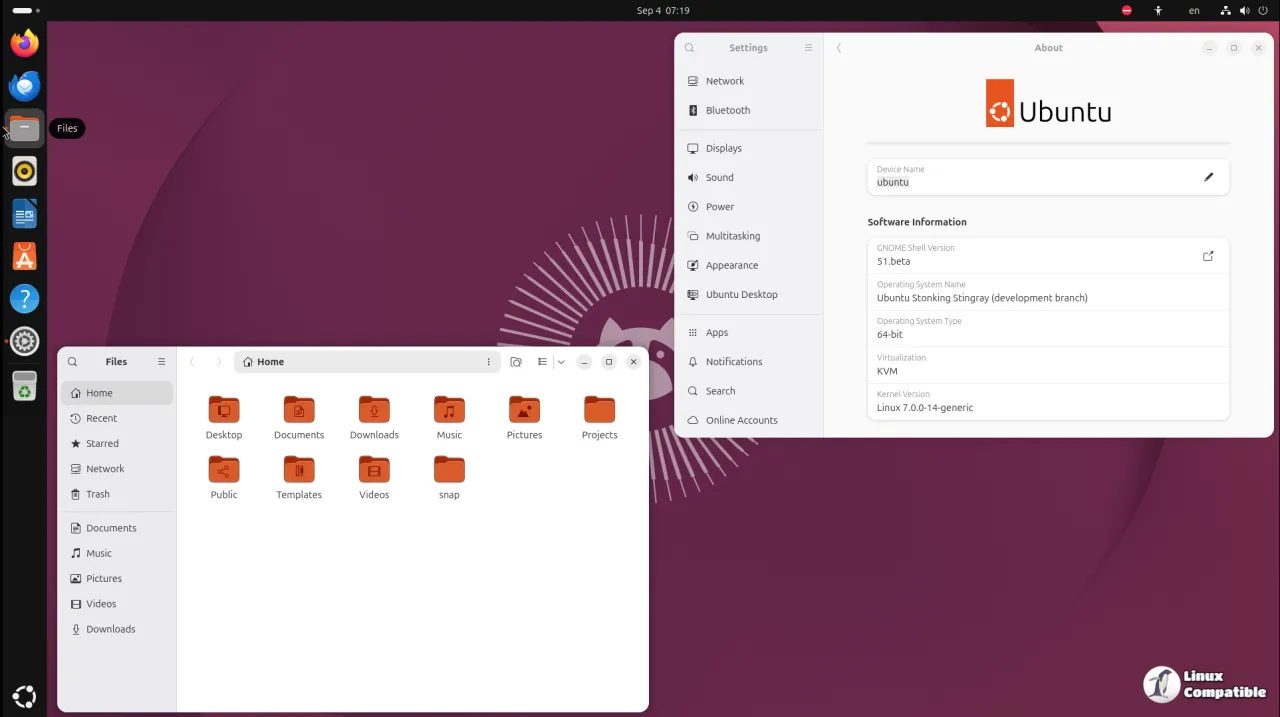
What is actually in the box
Community testers running the daily builds have confirmed a kernel version of 7.0.0-14-generic, GNOME 50.1 running Wayland through GDM3, and GCC 15.2.0 as the default compiler. glibc 2.44 has merged and is sitting at the core of the system, landing just in time for the August 20 feature freeze. Firefox is also getting a treatment, with the snap-stub transitioning away from a traditional deb package. If you grab the ISO and run it, those are the versions you will see.
The real headline here is the addition of two .wsl files to the official release tree. Canonical is finally consolidating Windows Subsystem for Linux image distribution under its standard release machinery. Before this, WSL builds lived in a completely separate Microsoft partner pipeline. Shipping them directly from the Ubuntu cdimage server means they will stay in sync with upstream releases. Windows users who just want a fresh Ubuntu environment on a dev machine will notice the difference.
Architecture support and known headaches
The snapshot covers the usual spread: amd64, arm64, riscv64, ppc64el, and s390x. An amd64v3 variant targeting Zen 4 and Intel 12th Gen or newer hardware is currently being built. Every major flavor is available too, including Lubuntu, Kubuntu, Xubuntu, Budgie, MATE, Studio, GNOME, and the ones most people forget exist until they see them in a release announcement. The flavors aren't just branding anymore. They actually ship.
Keep in mind that development snapshots are not exactly known for their stability. This cycle has already seen a snapcraft track issue that halted amd64 daily builds for roughly two weeks in June, a Firefox preinst script bug that blocked upgrades, and a glibc 2.44 merge that triggered about 219 build failures across the archive. Most of those glibc failures came from Launchpad switching to sha512-only hashes, which flagged a 5 percent failure rate against a 2.6 percent reference. The team deemed it manageable, but rewriting release tooling means dealing with a lot of friction in the early days.
The timeline from here is tight. Beta week runs September 24, with a mandatory freeze kicking in on September 21. Kernel feature freeze lands on October 1, and the final release is scheduled for October 15. If you need a stable system right now, you will want to stick with an LTS or wait for the official release candidate. These snapshots are built to exercise automation, and they will occasionally exercise you.
Head here to grab the images directly. The desktop amd64 ISO sits at roughly 6.1 gigabytes, while the server images range from 724 megabytes to 2.9 gigabytes depending on your architecture.


