Strata ships 0.1.44 with Mac support, a hotfix arrives five hours later
The open-source inference engine now runs a 125-billion-parameter model on a single gaming GPU, adds Apple Silicon support, and gets a bug patch before most users finish installing the first version.
Open-source inference engine Strata released version 0.1.44 on October 13, followed by a hotfix just five hours later. Both builds let a single consumer graphics card run Qwen3.8-Flash-Next, a 125-billion-parameter model that normally demands data-center hardware. The feature release also adds native support for Apple Macs.
That cadence is worth pausing over. A week earlier, Strata shipped 0.1.43.1 as its own hotfix for faster NVIDIA decode. In four days, three releases stacked on top of one another, and the bug patch went out before most users had even finished installing the first version.
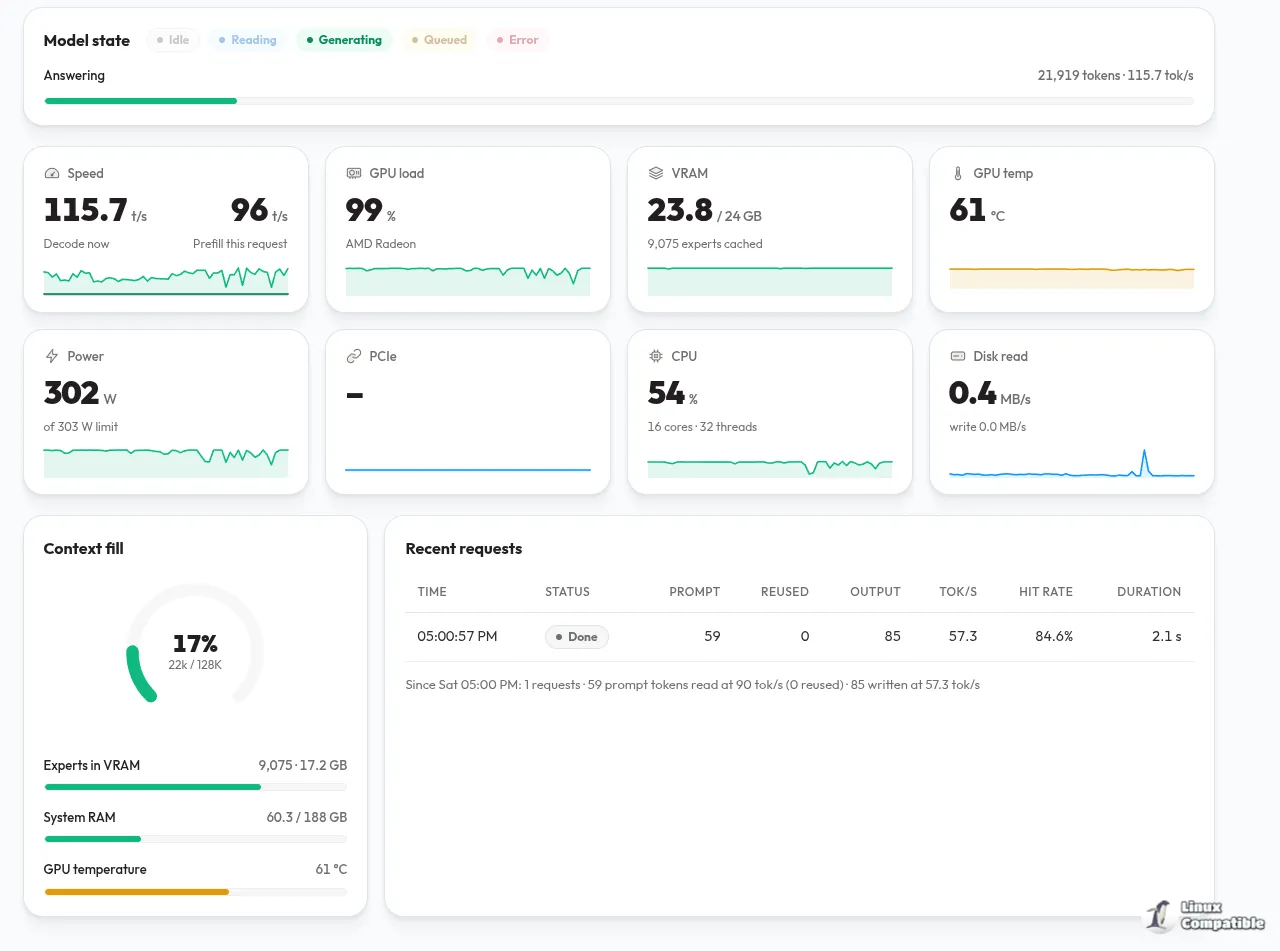
A frontier model, downsized to a gaming card
Let's clear up the framing first. Strata isn't a language model. It's the software that runs one, built by a developer who goes only by "Niko" and hosted under the permissive MIT license. Its own tagline is blunt: run a 125-billion-parameter AI model on your own gaming PC.
What it runs is the interesting part. Qwen3.8-Flash-Next comes from Alibaba's Qwen team and packs 125 billion total parameters, though only about 6 billion are active per token. The model has 24,576 experts but fires off just 10 of them for any single word. That sparsity is the whole trick. Your graphics card only has to process the handful of experts a word actually needs, rather than the whole thing at once.
The project's README puts it another way. "The model is a team of 24,576 small specialists," it says. "Each word needs only 10 of them."
The rest of the engineering is about keeping those experts handy. The hot ones stay pinned in your GPU's memory. The full set waits in system RAM. Whatever misses the cut gets computed on the CPU, and a massive N-gram lookup table lives on your SSD with only a few rows pulled per token. Most engines that tackle oversized models do layer offloading, shuffling whole transformer layers back and forth. Strata skips that and routes around the hot experts instead.
To run it you need a GPU with at least 12 GB of VRAM, 32 GB of system RAM, and around 80 GB of free disk space, on Windows or Linux. It runs on NVIDIA or AMD cards.
Perhaps the most headline-worthy addition this round is Mac support. Strata now runs on M1 through M5 chips, building its Metal engine from source in roughly seven minutes. On an M5 Max it decodes 1.6 to 1.9 times faster than vanilla llama.cpp on the same files, and it keeps memory use under 60% on 64 GB models. One request at a time, and you're capped at 32K context, but the output matches the PC engines byte for byte.
On the PC side, the big change is that Unsloth's quantized files are now first-class. UD-Q4_K_XL used to be experimental and NVIDIA-only. Now UD-Q6_K_XL, UD-Q5_K_XL and Q8_0 join it as real setup options. Quality tests put UD-Q6 and UD-Q5 at 94.6% match to full precision. Speed is the sell: a UD-Q4 file runs roughly 85 to 88 tokens per second on code for an R9700, versus maybe 16 to 20 from vanilla llama.cpp on the same card.
NVIDIA owners get their own path through NVFP4 packs, using the hardware FP4 cores in RTX 50 cards. AMD and Intel setups simply don't list them.
That leaves the .1 patch, and it fixes three launch-breaking bugs. Older CPUs without AVX2 were dying at startup with an illegal-instruction error before logging anything. Builds using CUDA 12.0 or 12.1 couldn't compile. And M2 Macs were silently producing garbage because a kernel got too few threads to ever run. All three are closed now, and answers stay byte-identical to 0.1.44.
The maintainers are explicit about it. They want anyone still on 0.1.44 to upgrade, and the release page itself points forward to 0.1.44.1.
Head here to the 0.1.44.1 release page if you're installing fresh.


