Raspberry Pi Imager 2.1.0 first public candidate drops the always-elevated model
The new public beta for the Foundation's flashing tool trims its admin surface, adds licence gates and fixes 32-bit writes past 2 GB.
The Raspberry Pi Foundation just posted the first release candidate for Imager 2.1.0, and the headline change is about how the tool earns its way onto your storage. Starting with this build, Imager no longer elevates itself. A small "privileged helper" takes over the device I/O, and only when a write actually needs it to.
Dewey tagged the candidate on Thursday, and it closes out roughly a year since the 2.0 overhaul. It sits directly on top of that redesign, and marks the first major re-architecting of how Imager talks to hardware since that big rewrite.
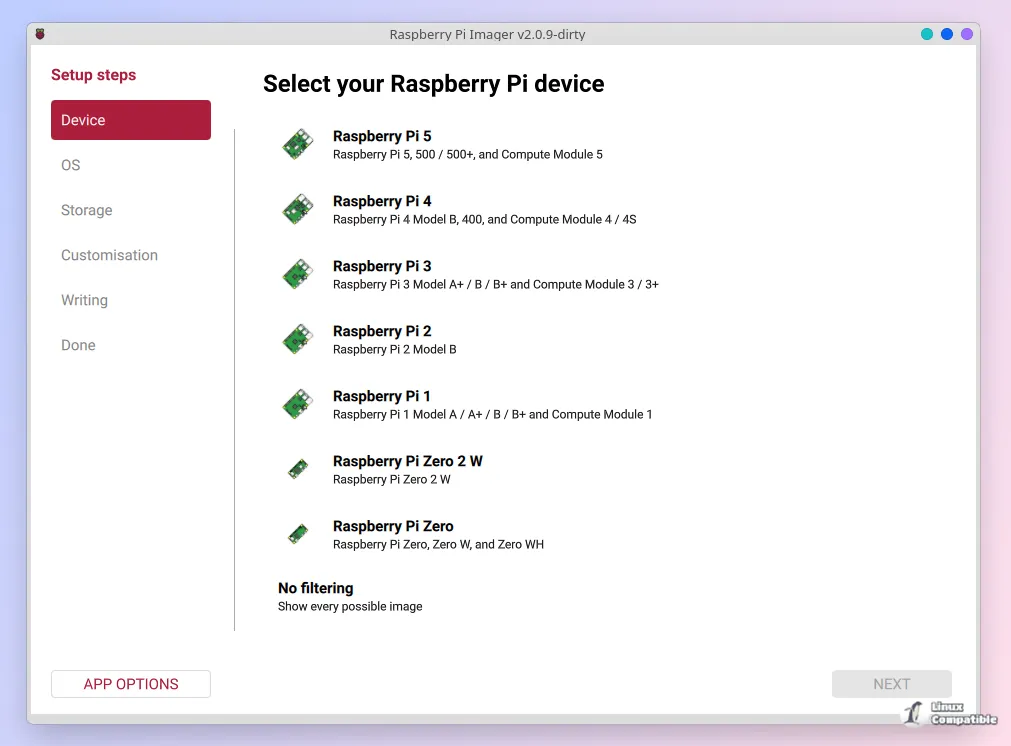
Here's the authoritative feature list, pulled from the release commit: the helper runs on every platform, licence acceptance and required user accounts now attach to OS entries, keyboard and screen-reader access flows through the wizard, Windows gets DPAPI-sealed secrets, armhf writes run past 2 GiB, and Qt 6.12.0 bumps the macOS floor to 14.4. SBOMs accompany every artefact too. Curl, libarchive, zlib and protobuf get refreshed as well.
A smaller window for admin rights
Historically Imager raised its own privileges. On Linux it relaunched through sudo or pkexec, and on Windows it asked for admin rights, holding broad access to the machine for as long as the elevated process stayed alive. Both of those change now. The GUI that lets you pick an OS, tweak settings and browse drives runs at normal user level, and the narrow bit of privileged work only kicks in right before the actual flash.
Dewey frames this as a win on both security and reliability. The privileged surface is smaller and shorter-lived, and heavy device access gets sequestered from the rest of the program. The commit history makes clear this was no small lift across platforms. It forced block-aligned memory buffers so O_DIRECT I/O isn't rejected on 4K-native drives, correct reporting of each drive's real logical block size instead of a hardcoded 512 bytes, and padding for images that aren't a whole number of blocks.
Keep in mind that you'll still see a small elevation prompt when a write begins. It's just narrower than the broad admin access the old model demanded. On Linux it's arguably a partial answer to the long-running complaint about the big ugly terminal window that appears on every run.
The rest of the changes
The 91 commits touching roughly 300 files also fold in smaller fixes that matter to particular crowds. On Windows, sensitive values like Wi-Fi passphrases, SSH keys and the Raspberry Pi Connect API key now live in DPAPI, bound to the signed-in account. There's a subtle safeguard baked in: because an earlier design forced elevation, a standard user logging in with an admin's credentials would otherwise write into the admin's shared secret store. The new build keeps those session-only secrets and won't overwrite stored ones when the logged-in user differs from the process account.
Then there's the 32-bit armhf bug. The 32-bit Linux build used a 32-bit off_t for device offsets, which capped writes at roughly 2 GiB and threw an "Invalid drive parameter" error. The fix sets _FILE_OFFSET_BITS=64 across the tree, vendored libraries included, and patches a RAM buffer overflow that pinned low-memory boards to tiny buffers. Meaningful for anyone still running 32-bit Pi hardware or the embedded installer path.
The Foundation has also leaned hard on its automated test suite. ThreadSanitizer runs reportedly turned up data races in the CA bundle lookup, the icon fetcher and the drive-list poll thread, all now fixed. That's a strong tell that this cycle cared about concurrency correctness, not just bolt-ons.
I'll flag the popularity of this thing for scale. The preceding stable v2.0.12 moved some serious numbers on GitHub alone: about 195,000 macOS .dmg downloads, 14,000 for the Windows .exe, 4,200 for the x86_64 AppImage and 2,500 for the amd64 .deb. That's the GitHub release page only. Most people install via apt or the downloadable installer, so the real-world reach runs much higher.
For what it's worth, the community is still shaking off some 2.0 aftershocks. Write speed versus reliability was a big theme, with users reporting 30 to 60 minutes on built-in card readers. Dewey called it a performance drop in favor of hard reliability, and the aligned direct-I/O work in 2.1 may ease things, though early RC users should still expect correctness over speed. The capital-city selector and the restrictions on custom-image customisation remain recurring gripes, and Dewey has said an Android version of the desktop tool is off the table since it would demand a different permissions model entirely.
It's a rather substantial candidate for what is essentially a flashing utility. Though that's fair, given how much ground 2.1 covers in a single cycle. The privileged-helper shift is the kind of least-privilege maturation this category has needed, and shipping it in public with a full commit trail, AI-assisted commits and all, is unusual for a tool adopted at this scale.
The candidate is live right now at the GitHub releases page under v2.1.0-rc1. If you want to poke at it, feedback flows through the issue tracker and the Raspberry Pi forums beta section before the stable launch.


