PikaOS 26.08.20, codenamed "Nest" 4.0, is now available as a Debian Sid-based distribution optimized for gaming and content creation. The update introduces five desktop editions, GNOME, KDE Plasma, Hyprland, COSMIC, and Niri, along with x86-64-v3 compiled packages and a custom kernel featuring performance patches. A new unified tool called Pikman streamlines package updates, kernel switching, and scheduler selection, while the distro ships with pre-configured gaming and streaming utilities. The project remains open source, offering both Standard and NVIDIA-specific ISOs to deliver a polished, ready-to-use system without extensive manual configuration.
PikaOS 26.08.20 "Nest" 4.0 lands with COSMIC, Niri, and x86-64-v3 optimization
Debian-based gaming and creation distro PikaOS has released version 26.08.20. Codenamed "Nest" 4.0, the update brings a refreshed desktop lineup, x86-64-v3 compiled packages across all repositories, and a custom kernel with performance patches. PikaOS bills itself as "Linux for gaming, creating and everything after that," and this release leans harder into that identity.
The distro maintains its own kernel, graphics stack, and repositories on top of Debian Sid. That's a step beyond layering gaming tools onto stock Debian. The goal is getting users to "the good part faster" — playing games or rendering content without spending a weekend chasing drivers. The version number encodes the date. 26.08.20 means August 20, 2026. Build 4 sits at the end.
What's new in Nest 4.0
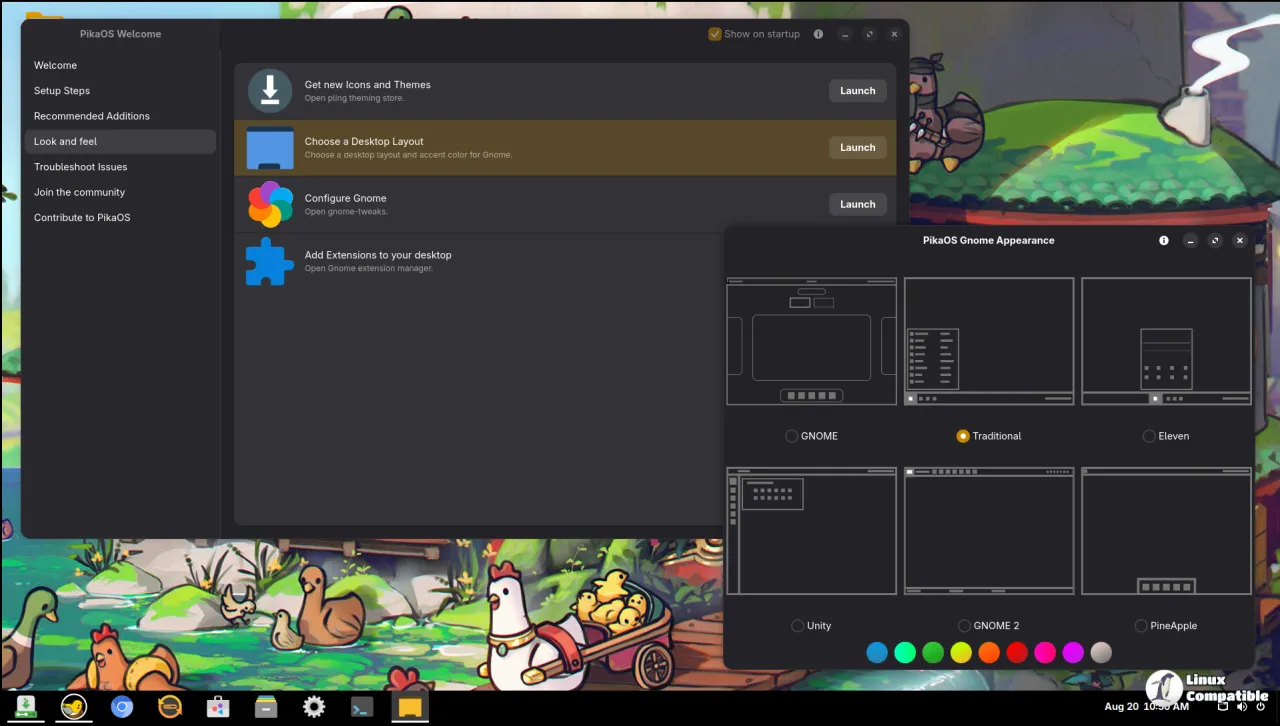
The headline changes are in the desktop lineup. PikaOS now ships editions for GNOME, KDE Plasma, Hyprland, COSMIC, and Niri. Niri joins as a new scrollable tiling window manager for keyboard-first workflows. COSMIC gets first-class status for System76's Rust-based desktop, rather than relying on snaps or PPAs.
Each desktop edition is available as both a Standard ISO and an NVIDIA-preconfigured ISO. The NVIDIA variant pre-installs driver 610.57.04 and is recommended for RTX cards and GTX 1650 or newer.
Optimization and tools
Every package in the base repositories is compiled with -march=x86-64-v3 optimization flags, plus O3 and Link Time Optimization. If you're running Intel Skylake or newer, or AMD Zen 1 and up, you're getting builds that take advantage of your CPU's specific instruction sets. Stock Debian sticks to more conservative flags, so this is a meaningful difference for performance on modern hardware.
The custom kernel includes CachyOS performance patches and switchable SCX schedulers. You can flip between scheduling algorithms via the GUI without touching a terminal. Pikman, a new unified manager, lets you handle APT updates, Flatpak apps, kernel switching, and scheduler selection from a single interface.
"The useful choices are exposed; the chores are not," PikaOS says.
The distro also ships a pre-configured gaming and creation stack. Steam, Wine, Gamescope, MangoHud, Lutris, and Heroic Games Launcher are ready to go. Blender includes full CUDA, OptiX, HIP, and OneAPI compute support. OBS Studio comes with game capture and stream-key integration. The pitch is simple: boot the ISO, install, and play or render.
However, at the same time, the NVIDIA driver stack is proprietary. If you're a pure open-source advocate, the Standard editions with Mesa might be your move, though the proprietary stack does offer better out-of-box gaming support for Nvidia hardware. Some users have flagged Bluetooth pairing issues specific to the Debian stack. The community is active on Discord, where developers respond quickly to migration questions and troubleshooting.
PikaOS is fully open source. All packages, patches, and tools live on the project's self-hosted Gitea instance at git.pika-os.com. The wiki at wiki.pika-os.com covers installation, drivers, and tool usage. Translation contributions are accepted via Hosted Weblate.
Head here to download the new release.


