Microsoft announced the public preview of Azure Linux 4.0 at Build, expanding its first-party Fedora-derived distribution to Azure VMs, VM Scale Sets, and container images starting today. The new release features a kernel 6.18 LTS, a rewritten dnf5 package manager, and OpenSSL 3.5 with post-quantum cryptography, all backed by a security model that includes SELinux enforcing by default and full supply chain control. Azure Linux is free on Azure with no OS licensing cost, offering a general-purpose edition and an immutable container variant already validated by partners like Databricks, who migrated over 100,000 VMs with zero customer-facing incidents.
Microsoft Unveils Azure Linux 4.0 Public Preview, Expanding First-Party Linux Reach at Build
Microsoft has officially pushed Azure Linux 4.0 into public preview today at Build. The company is expanding its first-party Fedora-derived distribution beyond internal infrastructure, making it available for Azure Virtual Machines, VM Scale Sets, and container images starting now.
Azure Linux isn't a greenfield project. It's been the operating system underneath Azure Kubernetes Service (AKS) since 2023 and has been powering core services like Azure SQL, Cosmos DB, and Databricks for years. Version 4.0 marks the moment Microsoft decides to share that proven foundation with customers directly.
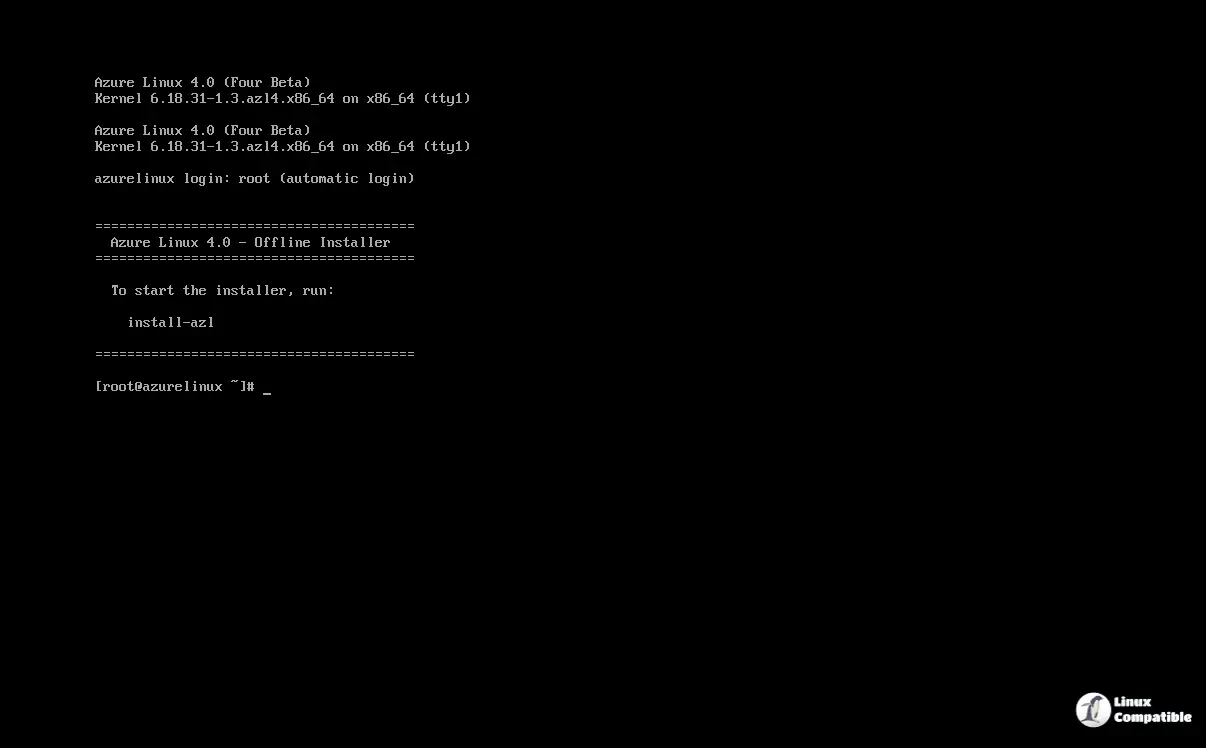
A Modern Stack, Built for the Cloud
The technical stack in 4.0 is fresh. You're looking at a kernel 6.18 LTS build, tuned for Hyper-V and equipped with new drivers for GPU and AI accelerators. The package manager is dnf5, a complete rewrite from Python designed to cut dependencies and speed up resolution.
OpenSSL sits at 3.5, bringing post-quantum cryptography support. systemd is at 258 for faster boot sequences. Even Python lands at 3.14 with JIT compiler improvements. It's a clean sheet of software that feels optimized for cloud workloads rather than retrofitted.
Head to the Azure Marketplace to deploy an image today or download ISO images for x86_64 and ARM64 directly.
Free on Azure, Security-First by Default
Here's the deal on cost. Azure Linux is free on Azure. You pay for the compute, storage, and networking, but there is no OS license fee. Not cheap. Actually, it is free. You just pay for the metal.
Security is where Microsoft is leaning hard. SELinux is enforcing by default on all images. Secure Boot and Trusted Launch are baked into the hardware-rooted security model. FIPS 140-3 certification is in progress and will be available at general availability.
The supply chain is fully Microsoft-owned. That means faster CVE patches. You won't have to wait on a third-party vendor to sign off on a critical fix. Identity management includes Entra ID SSH support, and all packages are cryptographically signed.
Proven at Scale with Real Numbers
Microsoft points to operational data from early adopters. Databricks migrated over 100,000 VMs and more than one million CPU cores to Azure Linux. The migration resulted in zero customer-facing incidents. The company also reported a 27% reduction in image pull times and a 5% boost in query execution speed across its serverless compute fleet.
LinkedIn completed a major stack upgrade to Azure Linux 3 across its infrastructure. The transition enabled configuration as code and modern kernel integration, resulting in performance improvements the Grid team describes as significant.
Two Paths: General Purpose and Container Linux
Azure Linux 4.0 splits into two variants, though both share the same kernel and security update cadence.
The general-purpose edition uses dnf5 for full package management. It's best for web apps, databases, and general workloads where you need flexibility.
The Azure Container Linux edition is immutable, image-based, and auto-updating. Based on the upstream Flatcar project, it offers a locked-down surface area with SELinux enforcing by default. This variant is aimed at regulated, high-security environments.
Get started by deploying from the Azure Marketplace or checking the full documentation at aka.ms/AzureLinuxProduct. The source code and release notes are available on GitHub.


