LACT 0.10.0 Adds Nvidia Overclocking, Blackwell Sensor Support
The open-source AMDGPU controller tool for Linux finally brings real Nvidia overclocking controls and per-chip memory temperature monitoring to the table.
LACT, or Linux AMDGPU Controller Tool, is a Rust-based application that gives you a unified interface for managing AMD, Nvidia, and Intel GPUs. It's built by Ilya Zlobintsev and has been growing steadily on GitHub, where it's now sitting at over 5,300 stars. The project has been expanding its Nvidia support for a while now, and version 0.10.0, which dropped August 12th, represents one of the biggest jumps yet.
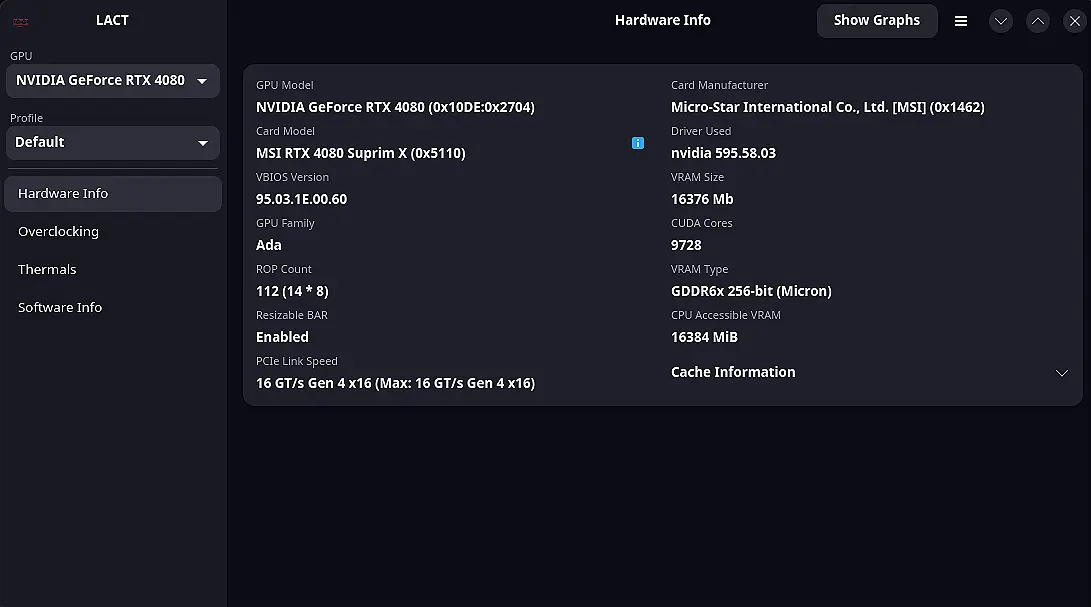
Nvidia Overclocking and Sensors
The headline features for this release are two new Nvidia overclocking controls. First, there's a PowerMizer Mode setting that forces your GPU into its highest performance p-state. Think of it as locking your card at maximum frequency regardless of what's running. It's the Nvidia equivalent of AMD's performance level setting.
Then there's a Voltage Boost slider. Developer makarov-roman described it as comparable to MSI Afterburner's voltage slider on Windows, though intentionally conservative. It's not a full voltage offset, just a slight bump above the standard curve for extra headroom. The PowerMizer feature came in pull request #1092, the Voltage Boost slider in #1133.
On the sensor side, LACT now has dedicated parsing for NVIDIA's Blackwell architecture GPUs. Previous versions returned bogus temperature values for these cards. More interestingly, it can now read per-memory-chip temperatures from GDDR6x and GDDR7 modules. This includes both sides of clamshell cards like the RTX 5090. Community contributor Paulo Games, a YouTuber, discovered the sensor paths that made this possible.
That Blackwell support is genuinely significant. NVIDIA's newest architecture getting first-class monitoring in a community tool marks a real shift from the reverse-engineering days of previous generations.
Usability and Other Features
The initial setup experience has been completely overhauled. New users previously had to manually copy a terminal command to enable the LACT daemon service. Now there's an interactive wizard that walks you through enabling, disabling, starting, and stopping lactd. It directly addresses one of the most commonly reported friction points for newcomers.
For AMD integrated graphics users, there's a new status bar showing GTT (Graphics Translation Table) memory usage. This is the GPU-accessible system memory, and it's useful for monitoring how close you are to the VRAM capacity ceiling when running memory-intensive applications.
Admin actions now use Polkit for authentication instead of a custom mechanism. You'll see standard Linux desktop authentication dialogs, and system administrators can fine-tune which users or groups can perform privileged GPU operations via polkit rules. The policy file ships automatically with make install.
There's also a new CLI command for GPU detach and reattach:
lact cli --gpu-id=<GPU-ID> detach
lact cli --gpu-id=<GPU-ID> reattach
The primary use case is temporarily handing off a GPU to a virtual machine for PCIe passthrough in KVM/QEMU without uninstalling or fully stopping LACT. If you're running Bazzite or another gaming-VM setup, this is directly relevant.
Other minor additions include forced light/dark theme locking, more reliable settings restoration after suspend/resume, and profile change hooks that now require proper admin authentication.
What This Means
LACT is clearly moving beyond its hobbyist roots. The interactive setup wizard and polkit integration show that UX polish is becoming a priority. The Nvidia feature set is narrowing the gap with Windows tools like MSI Afterburner. And the Blackwell support suggests the open-source GPU ecosystem is maturing faster than many expected.
The tool is available on Arch Linux, Debian, Ubuntu, Fedora, OpenSUSE, Gentoo, NixOS, and Solus. There's also a Flatpak on Flathub and a Docker image for headless operation.
Head here to the GitHub release page for the full details and changelog.


