Intel releases Linux NPU driver 1.38.0-rc1 with Wildcat Lake optimizations
The release candidate arrives September 4, bringing compiler updates, new firmware, and fixes for the latest Core Ultra silicon.
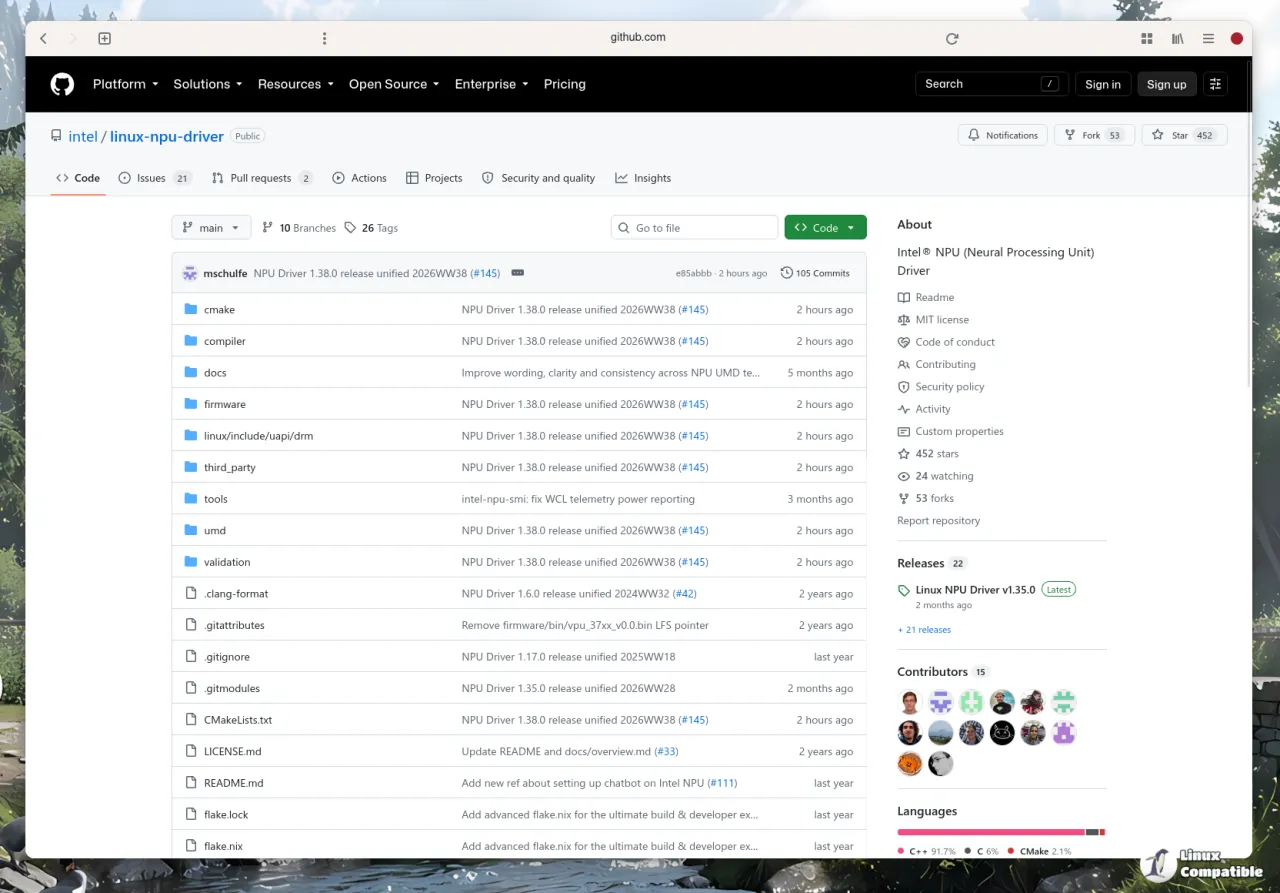
Intel has pushed version 1.38.0-rc1 of its Linux NPU driver to the release candidate stage. The update dropped on September 4, 2026, tagged by Intel engineer Magdalena Schulfer. It's a routine cadence for the open-source stack that powers AI acceleration on Intel's neural processing units, but the changes here are specific: compiler tweaks, fresh firmware binaries, and a few adjustments to the driver core itself.
The intel_vpu kernel module is now officially intel_npu territory. That rebrand happened back in v1.16.0, reflecting the shift from "Versatile Processing Unit" to "Neural Processing Unit." You're looking at a fully open-source stack under the MIT license that spans from the kernel mode driver up through the Level-Zero loader and into user-space applications like OpenVINO. If you've got an Intel Core Ultra chip or anything newer, this driver is how you actually talk to that dedicated AI silicon.
Compiler and firmware updates
The headline changes in 1.38.0-rc1 are tight. The NPU compiler submodule has been bumped to a new tag: npu_ud_2026_38_rc1. The commit hash for this release is e85abbb0a0bc8b8a6de554905e192d9e0dd704d3.
You'll also find updated firmware binaries for the NPU hardware. Intel hasn't laid out a feature list that screams "game-changer," but that's typical for a release candidate. The focus is usually on stability, compiler optimizations, and ensuring the firmware behaves. The test suite has been updated to validate the new functionality across the supported hardware.
If you're tracking the hardware roadmap, Intel NPU support has stretched out nicely over the last two years. Meteor Lake kicked things off in late 2023. Arrow Lake and Lunar Lake followed in 2024. Panther Lake arrived in 2025. And Wildcat Lake, the 2026 platform, was added in v1.32.0. That Wildcat Lake jump is the big expansion move Intel made recently, and this RC likely includes the necessary fixes and optimizations targeting that silicon.
Features you actually need
For devs building on this stack, a few capabilities are worth keeping in mind. Model caching has been around since v1.5.0, storing compiled models in ~/.cache/ze_intel_npu_cache/. It uses an LRU strategy and kicks in automatically when you hit 1GB. You can tweak that with the ZE_INTEL_NPU_CACHE_SIZE environment variable.
Then there's zeMutableCommandList, introduced in v1.6.0. It lets you tweak inference arguments without re-recording commands. Big win for dynamic workloads where you're changing inputs frequently.
Granular logging is still controlled via environment variables. Set ZE_INTEL_NPU_LOGLEVEL to INFO and use ZE_INTEL_NPU_LOGMASK to target specific groups like DEVICE, DRIVER, or CACHE. And if you want to run the NPU without root privileges, drop your user into the render group with sudo gpasswd -a ${USER} render.
Security matters to the community, and Intel finally obliged on that front. Debian packages now come GPG-signed, a move that started in v1.22.0. The public key is available on OpenPGP keyservers. It's a small thing, but it matters when you're piping driver updates into production systems.
Installation
Installing the stack is a multi-step affair. You're pulling three packages: intel-fw-npu, intel-level-zero-npu, and intel-driver-compiler-npu. On Ubuntu 24.04, you'll want to grab the Level Zero loader from the kobuk-team PPA as well.
Head here to the GitHub releases page to grab the release candidate. Keep an eye on the final tag; that's when the bugs get ironed out and the docs get polished.


