Greycard v0.13.0 and v0.13.1 arrive with Fujifilm X-Trans denoising and Pentax support
Greycard v0.13.0 and v0.13.1 just dropped, marking a major jump for the open-source RAW editor. Jess Olmstead's free, professional-grade photo editor now supports learned AI denoising on Fujifilm X-Trans files and adds full Pentax support. The two versions arrived on November 28 and November 29, 2026, signaling another sprint in a project that seems to be pushing boundaries for community-driven software.
Greycard is written in Rust with the Slint UI toolkit. It targets Linux, macOS, and Windows, using Vulkan or Metal for GPU acceleration. The project is maintained by Olmstead, a software engineer and photographer who describes the origin as taking favorite parts of every editor he knows and building the one he wanted to use. The project has already gathered 283 stars and 15 forks, with an active community on discuss.pixls.us.
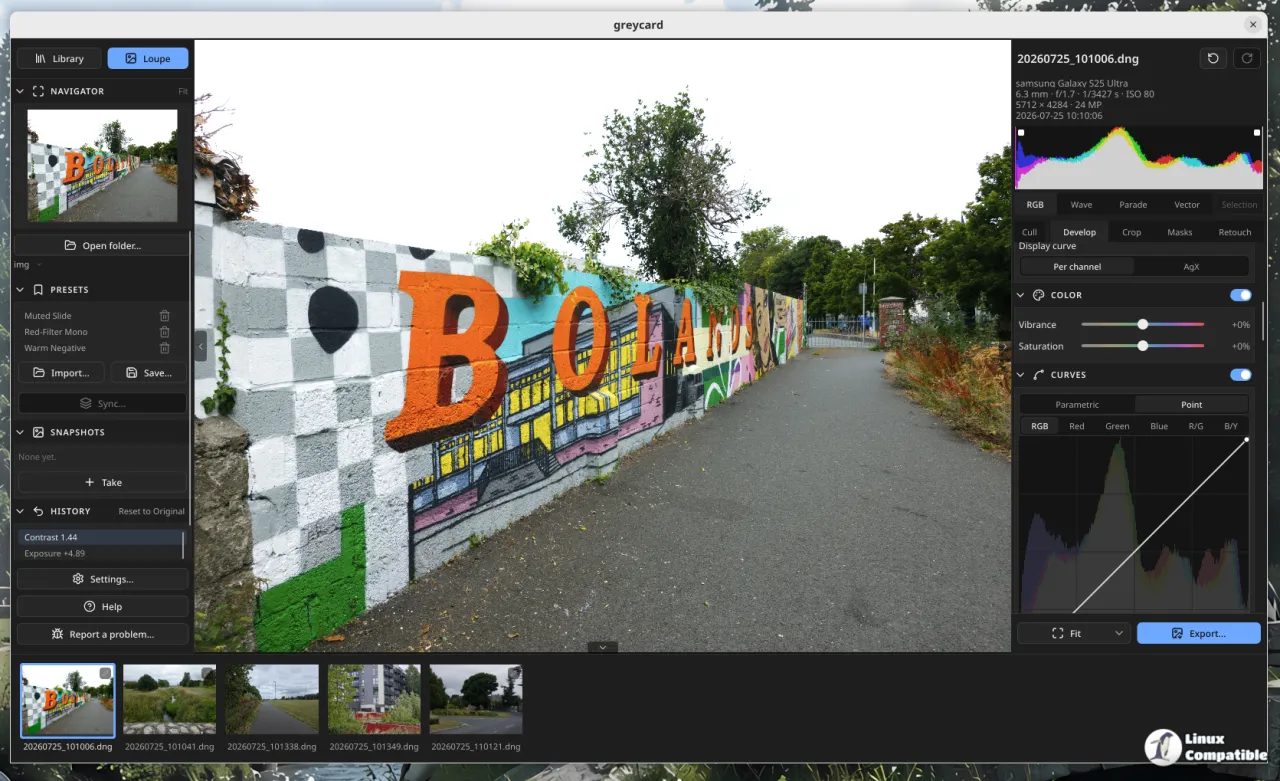
The big release
v0.13.0 is what Olmstead calls "The Big One." It covers roughly 38 commits. The most significant technical achievement is extending the learned denoiser to Fujifilm X-Trans raws. The custom-trained neural network previously supported Canon, Fujifilm GFX, Nikon, Sony, and Panasonic. Three tiers of processing are offered now. Each tier's X-Trans network is a separate download.
Pentax support is also included. .PEF raws open in the editor, library, and import. Lens corrections from Ricoh/Pentax lensfun files apply automatically for models like the K-1 and K-3 III. A Pentax DNG reads its lens from the maker note for automatic correction.
Focus stacks retain faint, fine texture that was previously averaged away. Corners align better across many frames. Blown highlights no longer ring with contours and dark halos. You can re-run the merge with denoised frames using greycard merge again --denoise, carrying a noise profile through the process.
Gamut operation has changed. Saturated and bright colors now reach the export's gamut limits at their hue. They were previously clipped per channel. This means fewer clipped-out-of-gamut artifacts for vivid colors. Existing edits will look different where colors are highly saturated or very bright. Kept pictures regenerate once.
Sidecars are ~75% smaller thanks to Schema 10. It omits default-valued settings. Old versions open them read-only. The library index has the same protection.
The fix
v0.13.1 arrived just two days later. It addresses regressions from the big feature release. Viewport rendering is smooth past 100% zoom. A new setting, "Show actual pixels at 200% and above," lets you opt back into block rendering. Camera preview JPEGs no longer enlarge past their native resolution when standing in during development.
Hasselblad X2D 100C .3fr raw files are now listed and opened. That matters for medium-format Hasselblad users. A regression where ratings from other programs' sidecars were lost is fixed. The XMP rating now correctly reads on the next pass, overriding Greycard's own stored rating.
With no usable GPU, AI features hold far less memory. Export batches rest at 1.7 GB between frames instead of 13 GB. That's a ~90% reduction. Failed AI mask runs retry automatically on the next develop rather than staying empty.
What's next
Olmstead has posted a roadmap for the coming months. It includes AgX as the default display curve, replacing the per-channel approach. Camera match refinement uses pinned-frame fitting. Monitor profile reading on Windows goes via WCS. Chart-based profile creation from a 48-patch color checker is in the works.
AI masks will get free-text prompts using SAM 3's text encoder. People masks will cover all parts at fine edge quality. Mountain, Grass, and Rock landscape masks are coming. Face recognition across outfits and days is pending a license search.
The editor also gets proxy develop for fit view. First-frame open takes under 2 seconds at 45 MP on no GPU. Clarity/Dehaze at 102 MP takes ~1 second instead of ~2.2 s. Search by phrase using CLIP-style image embeddings will appear in the index. People discovery and grouping arrive via face recognition pending the SFace license.
Greycard's development pace is unusual. It's released roughly one major update per week during this period. The project stays free and open source under GPL-3.0. Donations are accepted via ko-fi.com/jessolmstead. Code signing comes from SignPath Foundation.
Head here to download the latest version.


