Greycard 0.12.0 quietly stacks up against Lightroom and Capture One
The indie RAW editor Greycard just released version 0.12.0, and if you follow the open-source photography crowd this is one worth a look. It landed today, bringing a midtones slider, sharper blown-highlight recovery, and a first-ever French translation. In a category dominated by Lightroom Classic, Capture One, darktable, and RawTherapee, this is a genuinely fast-rising name.
The thing worth pausing on is who's actually behind it. Greycard is essentially a one-person project by Jess Olmstead, a software engineer and working photographer. He built it in native Rust because the tools he already loved kept holding him back, and over the past two months he pushed through 0.1.0 all the way to 0.12.0. That's a release every few days.
I'll keep the architecture brief, since the story is really in the details. Greycard does its work in a scene-referred, linear Rec.2020 color space rather than the sRGB world most apps live in. Edits render on the GPU via Vulkan or Metal, which is what lets sliders move live instead of lagging behind your cursor. His learned AI denoiser was trained on raw sensor data, the same trick DxO uses for DeepPRIME, and he's reported strong results on Canon, Fujifilm, Nikon, Sony, and Panasonic.
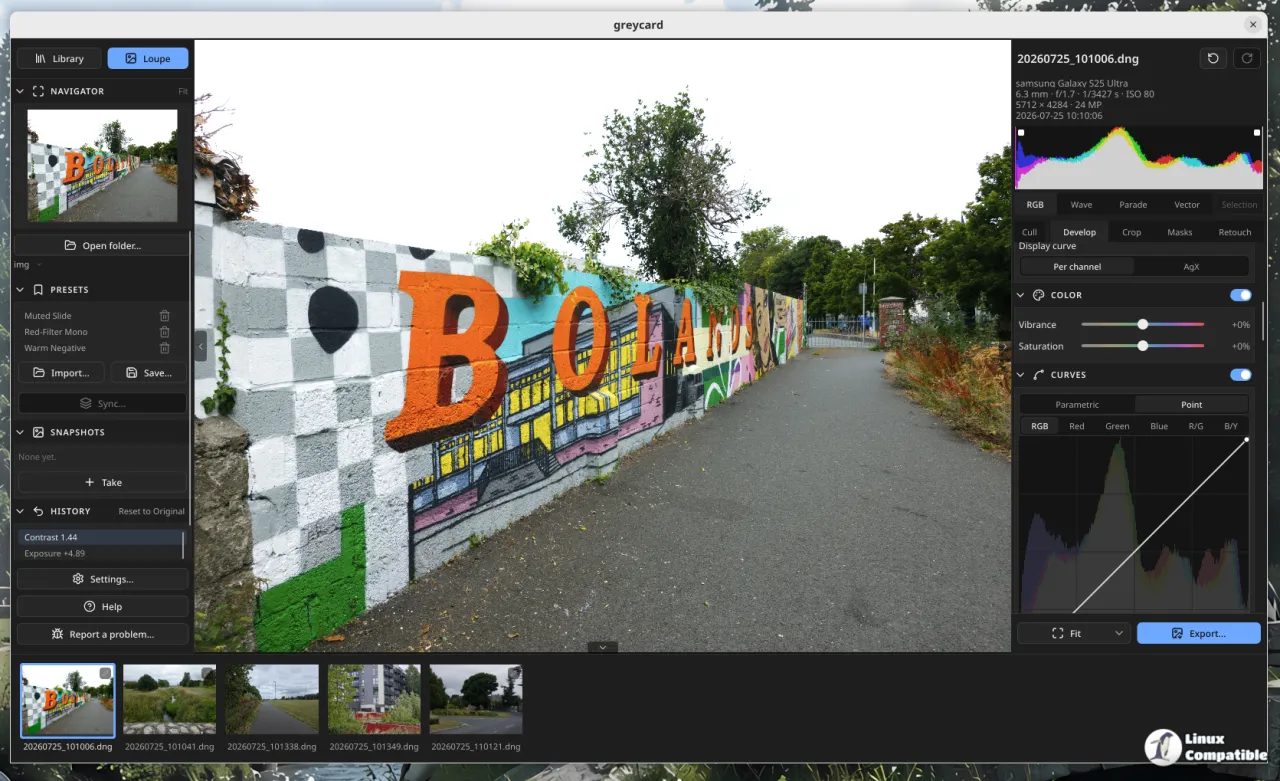
What actually shipped
The develop pipeline got the biggest updates. The Whites slider now recovers blown highlights better, addressing a community issue (#132) that had been dragging for a long time. Midtones control is a brand-new slider that lifts or sinks the middle tones while leaving blacks and highlights untouched, and it's by popular demand. You also get an output-sharpen section after Sharpen, white balance presets on the arrow beside Auto, and import for Lightroom's older .lrtemplate format.
The camera color work picked up some attention too. DCP profiles now apply their look table, so Adobe's profiles render distinctly and greens stop coming out olive. Olive greens. Ugly. That's a small detail, but it's the kind of thing that makes a RAW workflow feel cheap.
There's a lot of workflow glue as well. Undo and redo now track ratings, flags, and labels, and middle-clicking a frame in the filmstrip syncs its edit onto other selected frames. ISO and focal length filters now use two handles instead of one chip per value, and a screen reader can name panel toggles and buttons. Each section header gets a reset arrow, sections can be reordered by dragging their titles, and accessibility improves across the board.
The packaging changes matter for anyone who cares about supply-chain hygiene. Every export can carry an author and copyright. Each package now ships THIRD-PARTY-NOTICES alongside the LICENSE, a SHA256SUMS file so downloads verify cleanly, and a from-source build that shows its commit hash. WebP also joins JPEG, PNG, and TIFF, and it's smaller than the equivalent PNG.
The fixes worth noting come from testers, and some are quietly impressive. A focus stack no longer grows its memory with frame count, so 100 × 24 MP frames now merge in about 2.4 GB. That's not a typo. Monochrome sensors, like Leica Monochrom bodies and Ricoh GR IV Monochrome, open and develop to a neutral grey. A picture taller than the GPU's max texture no longer crashes on launch. And the SQLite bump to 3.54.1 puts Greycard past CVE-2026-119375, which is worth saying since photography tools so often ship with an older build.
Keep in mind that sidecars written by 0.12.0 are refused by 0.11.x, so don't downgrade without thinking about it. Greycard has done this across releases: each new minor version rejects the previous one.
Head here to the GitHub release page for a detailed change log.


