Godot 4.8 RC 1 Ships, Signals Stable Release Coming This Quarter
The Godot Engine's first release candidate for version 4.8 has arrived. Published today by the Godot Foundation, RC 1 marks the point where the team considers the engine feature-complete and ready for broad stress-testing ahead of the stable launch expected before year's end.
For context, the 4.8 cycle ran seven dev snapshots from July through September, followed by five betas that ran from mid-October to late November. Beta 5 cleared its last blockers on November 24. RC 1 followed three days later with a notably small patch list: 14 contributors submitting 22 regression fixes across 2D, audio, the editor, input, physics, rendering, and platform integrations.
"We firmly believe that Godot 4.8 is suitable for existing projects," the announcement states, "but you will play a crucial role in ensuring that no major issues have somehow snuck through the cracks." The team strongly recommends backing up projects with version control before upgrading.
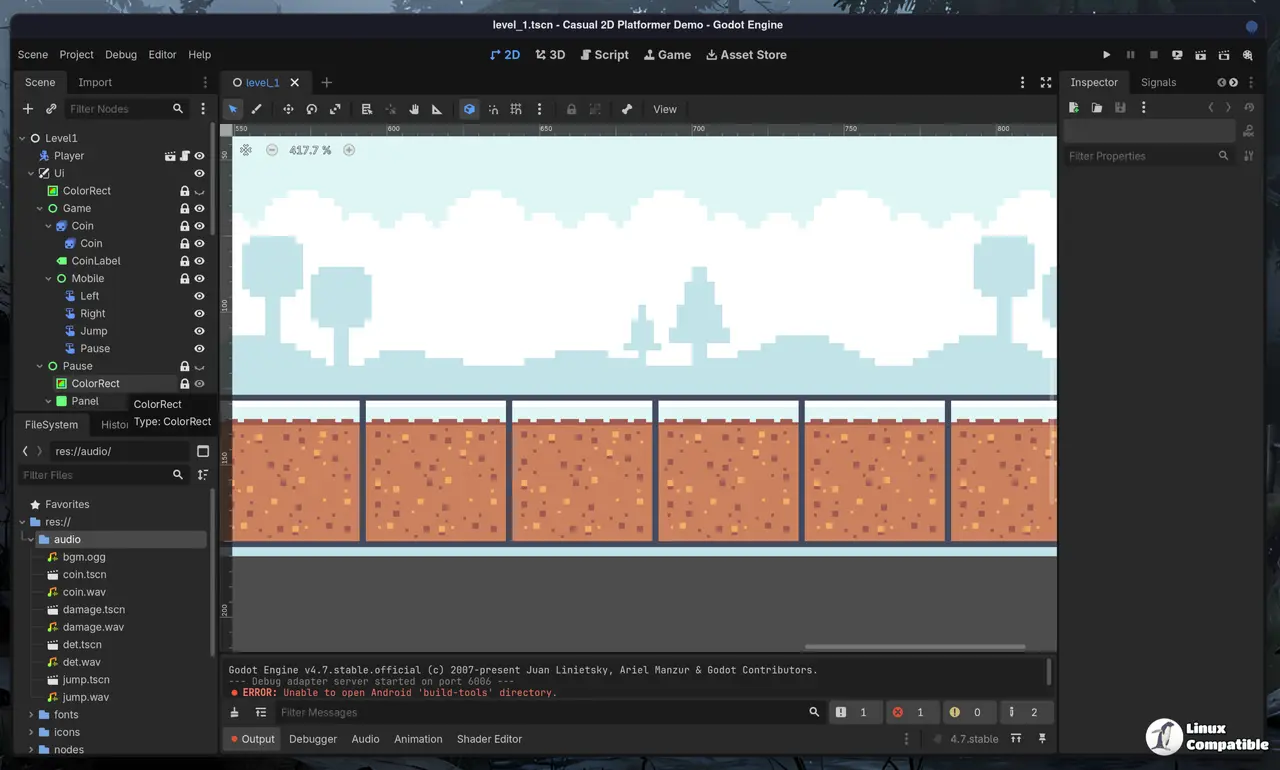
What RC 1 Actually Means
Godot's release life cycle is explicit: dev snapshots, then betas, then a release candidate, then stable. Hitting RC is a gate. Feature work is locked. The only thing that can be merged now is a showstopping regression, something that worked in a previous 4.x release but broke, with no workaround.
The bar is deliberately high. RC 1's 22 fixes stand in sharp contrast to beta 1's 1,523 fixes from 340 contributors. That lean footprint reflects an engine that has already converged on its final behavior. It just needs broad validation.
The fixes themselves are narrow. Trail crashes in rare edge cases, volume ramping issues in polyphonic audio, wrong-file selection bugs in the FileSystem when names collide. The kind of work that matters when you're pushing the engine hard.
The Feature Set Locked In
RC 1 doesn't introduce new functionality. The headline additions were shipped during the dev and beta phases and are now final.
The editor is the biggest visible change. The main screen is now a dock. Building on the EditorDock system from 4.6, the 2D, 3D, Script, and other main views can be closed or floated into separate windows. A Game view stays integrated. Jayden Sipe's toolbar work gives the Game, 2D, and 3D panels a unified design language emphasizing clarity.
Workflow wins stack up: "Play Scene" from the FileSystem context menu, drag-to-toggle visibility across multiple scene-tree nodes, Ctrl+scroll zoom and glob-based search in the FileSystem, pseudolocalization for catching layout issues early, auto-expansion of inspector resources, and runtime CanvasItem manipulation directly in the game view. There's also an experimental symbol-rename-across-the-project tool.
Rendering gets several long-requested upgrades. Trail3D is a native trail-effect node that removes manual mesh and UV work. Multi-bounce ambient occlusion approximates light interreflections. Directional lightmap specular lighting bakes specular detail for static directional light. Screen-space contact shadows blend a lightweight R8 texture with existing shadow maps. Mip-level texture streaming loads only the mipmap level a texture needs, delivering significant VRAM savings for large 3D worlds. Alpha-preserving mipmaps fix alpha-scissor materials that dissolved at distance. Decals are now fully animated and supported in the Compatibility renderer.
GDScript improvements include warnings and errors that underline only the relevant portion of a line, faster syntax highlighting, and a ban on using strings as comments. Label and RichTextLabel gain auto-resize-to-fit text. Native touch support lands for TextEdit, CodeEdit, TabBar, and PopupMenu, including tap, drag, inertial scrolling, and word selection.
Under the hood, Jolt Physics is upgraded to 5.6.0. Non-allocating physics queries replace per-call dictionary allocation, reducing GC pressure. A FuzzySearch API is exposed to users and plugin authors. Property maps moved into GDType speed up Object property access 1.6x and cut roughly 12 MB of runtime RAM.
Platform work brings automated Android SDK and Java setup, per-architecture macOS binaries for smaller downloads, high-polling-rate mouse support on Windows, desktop toast notifications, and a custom COM+ implementation replacing a WinRT dependency. visionOS returns as a module with hand tracking and PSVR2 controller support on Apple Vision Pro, with groundwork laid for future tvOS support.
Breaking Changes You Should Check First
Godot minimizes breakage, but this cycle does ship several necessary changes.
.NET builds now require .NET 10 or newer, the minimum was raised from .NET 8. Scripts can no longer inherit their own inner classes. Joypads are ignored on unfocused windows by default in new projects. Android OS.alert() is now blocking. Bone Follower FTI is disabled by default with a warning. Default dialog titles have been reworked. mbedTLS is updated to 4.1.0 with PSA Crypto, and the local debugger now fails in release exports.
The full list is filterable on GitHub under the 4.8 milestone with the "breaks compat" label.
Head here to download the release.


