Godot ships 4.8 beta 5, probably the last one before a release candidate
All release blockers are cleared; the team just wants one more safety checkpoint before committing to stable.
The open-source Godot engine has cleared its final release blockers and, choosing caution over speed, is asking you to test one more build. That's Godot 4.8 beta 5 and per the team, almost certainly the last beta before a Release Candidate. It arrived less than a week after beta 4. In software release terms, that's practically a blink.
Godot is the free, open-source engine co-founded by Juan Linietsky and Ariel Manzur, then kept ticking by a sprawling volunteer community plus a small band of paid contributors. Its minor releases are among the most actively developed in the engine space, taking on Unity and Unreal on a "no royalties, you own your project" pitch that still draws people in years later.
What actually changed
Most of beta 5's fixes landed across core subsystems. The ones worth your attention:
Linux audio users get lower microphone latency on PulseAudio, with input now tracking output. That's a genuine win for voiceover or live-audio work. macOS Metal users get a fix to MetalFX jitter, Apple's temporal upscaling, where the offset units and sign were previously wrong.
One callout that's more eyebrow than excitement: the team reverted Feral Software's Linux GameMode integration. GameMode lets games request higher CPU and GPU performance profiles. Pulling it out in the final stretch is the team saying stability beats an unready feature, and honestly that's the right call this late in the game.
The rest are the quiet kind of fixes you only notice when they're broken: CanvasLayer workspace switching, Trail3D updating with its process disabled, "Find in Files" not copying filters, and the Game dock not showing after a debug break. Small. Necessary. Unglamorous in the best way.
What 4.8 is actually about
Beta snapshots only report changes since the previous snapshot, so the real substance of 4.8 lives in the beta 1 round-up. A few things define this cycle.
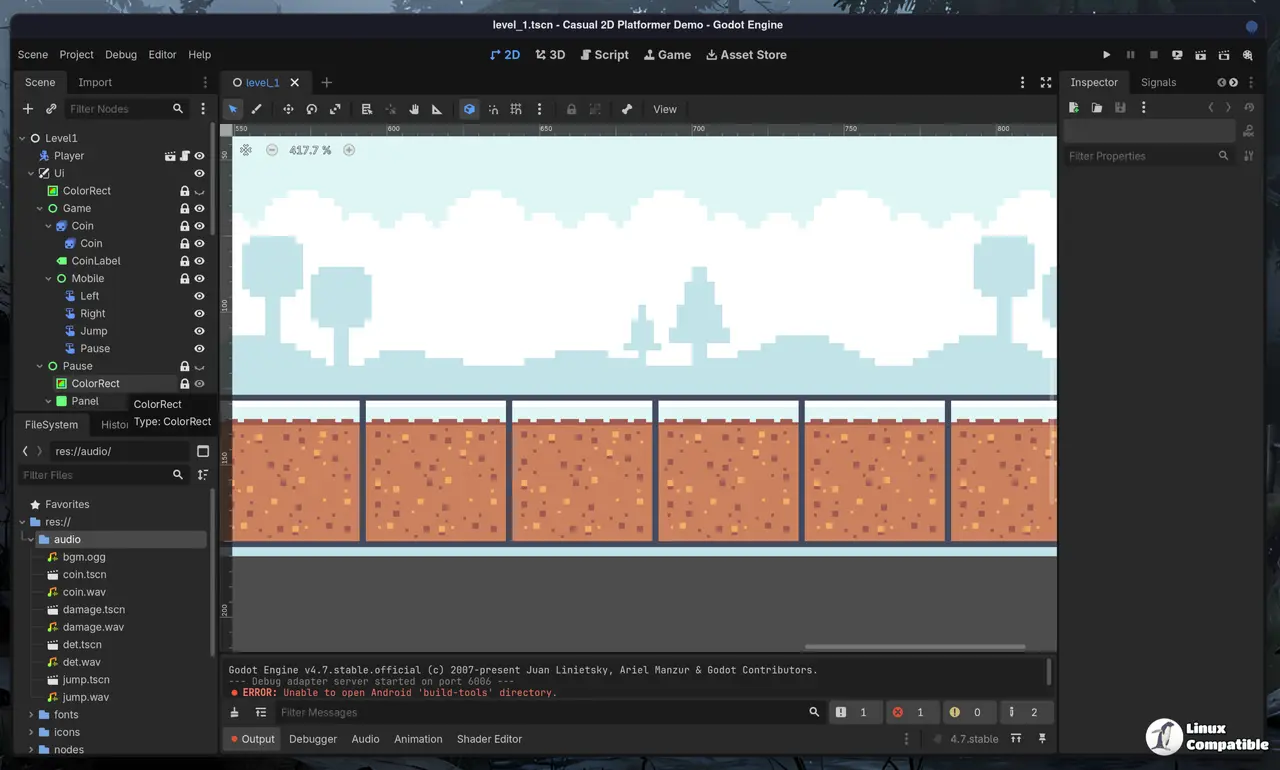
The editor got the biggest structural overhaul. Main screens are now docks that you can float into independent windows, and you can drag in the scene tree to toggle visibility across multiple nodes at once. There's pseudolocalization for testing translated UI early, plus a runtime CanvasItem manipulation tool that lifts the move, rotate, and scale handles straight from the game view.
Rendering is where the visual muscle shows. Trail3D ships as a native node so you stop hand-managing mesh trails, there's multi-bounce ambient occlusion approximation, directional lightmap specular, and mip-level texture streaming that trims VRAM on large 3D worlds. Screen-space contact shadows and fully animated decals round it out.
Performance gains are quieter but real: roughly 12 MB of runtime RAM saved by unifying object property storage, property access about 1.6 times faster, and fuzzy search across the whole engine. Jolt Physics is now on 5.6.0 with non-allocating queries that reuse buffers instead of allocating per call.
Platform support got the same treatment. Android gets a one-button SDK setup, macOS ships per-architecture builds by default to keep downloads smaller, Windows fixes high-polling-rate mouse issues and adds native toasts, and a returning visionOS module lays the groundwork for future tvOS.
Breaking changes worth checking
Godot tries hard to avoid breaking changes, but some are unavoidable. The one to check first: the .NET build now requires .NET 10, up from 8. Update your SDK before testing anything C#.
Other changes: scripts can no longer inherit their own inner classes, joypads are now ignored on unfocused windows by default in new projects, Android OS.alert() is now blocking, and mbedTLS moved to 4.1.0. A full, filterable list lives under the "breaks compat" label on the 4.8 milestone on GitHub.
Head here for the download.


