The GNOME Shell development team has published a comprehensive roadmap outlining nine major design improvements for the desktop environment, ranging from a spatial search overlay to mobile-inspired quick settings. The most immediate update is a new search interface that spawns results as an overlay from the search field, a change currently in progress via Merge Request #4307 and expected to ship in GNOME 51 this fall. While the design team emphasizes that developer capacity remains the primary bottleneck, they plan to use community extensions like MosaicWM to prototype complex tiling and window management concepts before integrating them into the core Mutter compositor. Other proposals, including a visual login grid, dynamic battery icons, and a transparent panel system, are still in early stages and will likely span multiple release cycles as the desktop focuses on incremental refinement rather than structural overhaul.
GNOME Shell Outlines Its Long-Term Desktop Roadmap, With Search Overhaul and Tiling on the Near Horizon
The GNOME design and shell development teams dropped a comprehensive vision document on Monday that maps out nine major interface overhauls for the desktop environment. Published as both a blog post and a companion Discourse discussion, the roadmap points heavily toward refined spatial interactions, mobile-inspired quick settings, and a search experience that might actually ship in GNOME 51 this fall.
If you've been following the GNOME development cycle since 40 shipped, you know the post-GNOME-40 era has been about polish rather than structural revolution. This document shifts that narrative just enough to keep the design conversation moving forward. The team is explicitly targeting how you interact with windows, search, and system controls. None of it is locked in, but several ideas already have active merge requests or community prototypes ready to test.
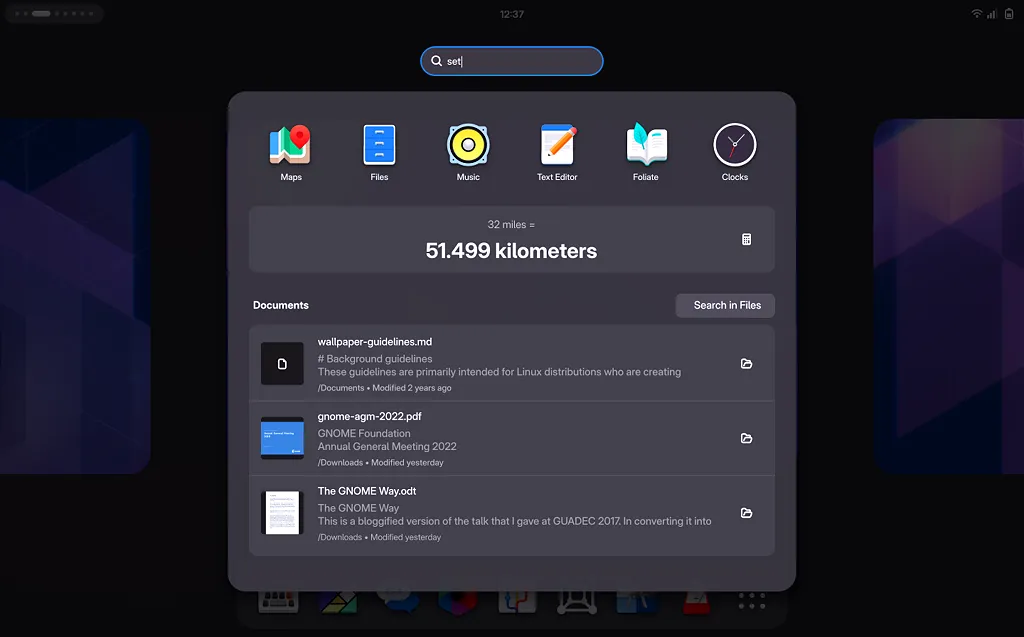
The search redesign is the most concrete piece on the list. Right now, typing in the overview just swaps out the workspace thumbnails for a flat results list. Next cycle, that behavior shifts. Search results will spawn directly from the search field as an overlay, using the spatial animation language GNOME introduced back in version 40. Merge Request #4307 is already in progress, and the team is fairly confident it will land before the GNOME 51 freeze this fall. As of right now, that search overlay is the only proposal sitting comfortably inside a finished merge request.
Tiling window management gets a serious upgrade too. The team is calling it mosaic, a system that auto-resizes windows to negotiate space rather than snapping them into rigid grids. It's a more flexible approach, though it demands deeper Mutter compositor support that extensions can't fully replicate on their own. Cleo Menezes Jr.'s MosaicWM extension is already handling most of the heavy lifting for prototyping, which is exactly how the team wants it. Mobile-era UX conventions have played poorly on desktops for years, but GNOME's borrowing battery icons and quick settings toggles from iOS and Android actually makes more sense on cramped panel layouts.
What Actually Gets Built
Here's the catch. The design team is blunt about developer capacity being the real bottleneck. Proposals pile up fast, but implementation depends on volunteer interest and external funding. Prerequisites like rounded clipping in Mutter also need to land first before some of the visual changes can ship cleanly.
That's why extensions keep serving as the testing ground. The spatial-overview extension and MosaicWM both let the community iterate on complex interactions before the core shell commits to them. Building and testing have gotten easier too, with Mutter Devkit in Builder and GNOME OS sysext tools letting you daily-drive experimental branches without jhbuild or a VM. It's a pragmatic extensions-first strategy that lowers risk, even if it means waiting on someone else's unfinished work for months.
Other ideas are still more conceptual. The login screen user picker will eventually move to a visual grid layout instead of the familiar vertical list. The Alt+Tab and Super+Tab switcher needs to blend recent-window and app-grouped browsing into a single interface. Both are in the early stages, which means they'll likely get hammered out through prototypes over the next few releases. The top-center popover will also finally lose notifications, grouping them with Quick Settings instead of mixing them with calendar and weather.
It's a practical roadmap. The team is trading structural overhaul for incremental refinement, and that suits GNOME's current phase of development. However, at the same time, relying on community extensions to prototype core functionality sometimes stretches the testing window longer than you'd hope. The search overlay is the safest bet for fall, but the rest will probably spill into GNOME 52 and 53.
Keep in mind that GNOME 51 targets a fall 2026 release window, and the design team will be tracking progress on Matrix in #gnome-design. Head here to the Discourse thread if you want to follow the merge requests in real time. The full list of mockups, extensions, and technical notes lives at the bottom of the official blog post.


