The GNOME Project launched GNOME OS Preview, a new edition of its self-built Linux distro aimed at non-developer early adopters. Unlike the older Nightly image, Preview freezes GNOME OS to the latest stable release, GNOME 51.1, so it tracks the same versions shipped in Fedora and Ubuntu. It's an immutable, image-based system assembled with BuildStream and managed by systemd-sysupdate, running alongside the classic Nightly build. Though it's still early-stage and not promised for perpetuity, it represents the closest GNOME has come to shipping a complete, stock Free Software desktop built entirely on its own infrastructure.
GNOME ships first stable-based "Preview" edition of its own Linux distro
Two years after promising to turn a developer-only image into a real desktop OS, the GNOME Project is finally doing it, for early adopters who don't want a nightly.
Today, exactly two years after a manifesto-style post that promised to turn GNOME's internal testing image into an actual operating system, the project announced GNOME OS Preview. It's a new edition of its homegrown Linux distribution aimed squarely at people who aren't developers.
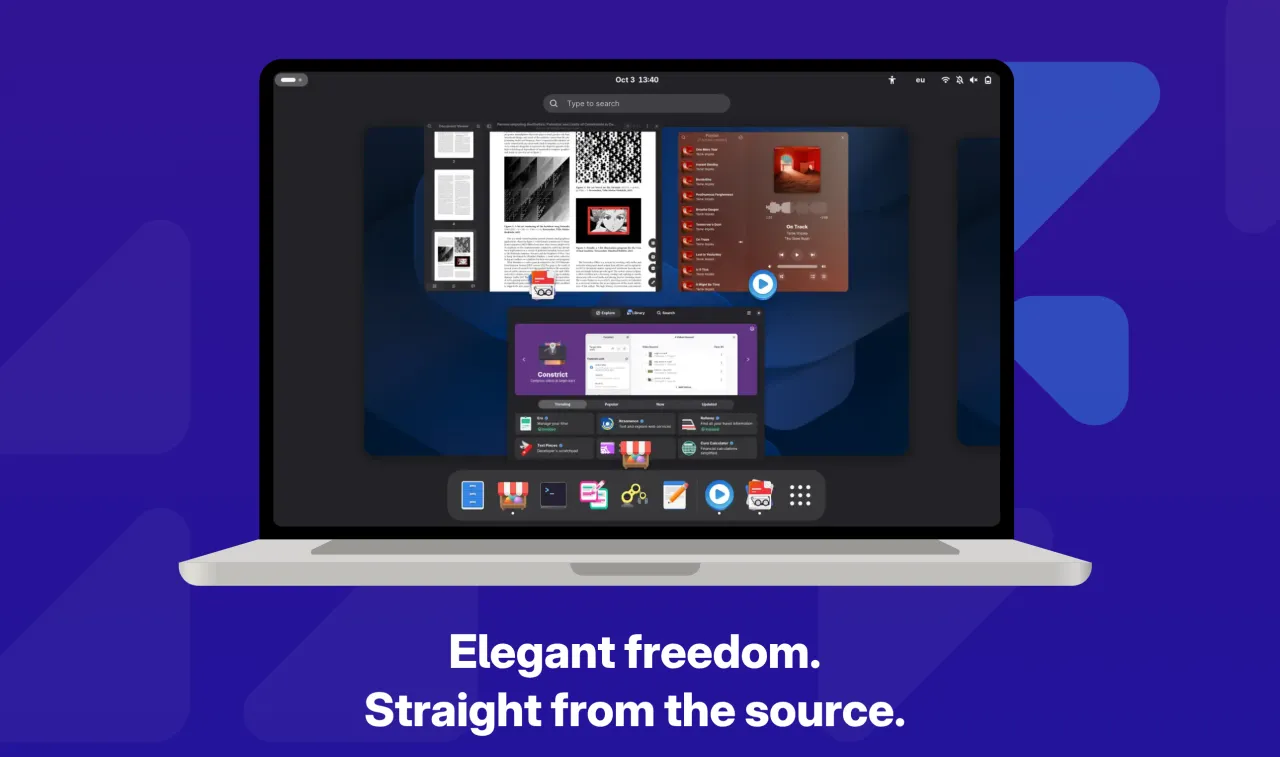
For years, GNOME OS existed almost as a Nightly-only image: a rolling snapshot rebuilt continuously from the latest git commit of every component. It was invaluable to developers, but niche. It was software for people who enjoy chasing bugs and filing reports about them.
The new Preview edition draws a line under that era. Same underlying system, but frozen to the stable branch, so enthusiasts who aren't quite adventurous enough to run a nightly can try running an official GNOME distro as their actual computer. There's an honest caveat: it's still early-stage software, and the project is clear it isn't meant for the broader public yet.
What it actually is
GNOME OS Preview is, in the words of the announcement, "the current GNOME OS Nightly, but without the 'nightly' aspect." Concretely, it's built from the latest stable GNOME release, GNOME 51.1 at this point, not the development branch.
It lives in the same GitLab branches as the stable org.gnome.Platform Flatpak runtimes, meaning it tracks the same software versions that ship in Fedora, Ubuntu, and other downstream distros. It's just assembled as a complete OS image by GNOME itself now.
The Nightly edition still exists for developers who want to test unmerged changes. Preview targets non-developer enthusiasts who want something more predictable while still running GNOME's own reference build.
As the project itself puts it, Preview is "only a few weeks old," so it has only seen limited real-life testing and people will "uncover some issues initially." But since Nightly has been daily-driven by dozens of people without major issues for over a year, the team feels Preview is reliable enough for enthusiasts. They're also explicit that they're "not promising updates in perpetuity."
Keep in mind that you should be willing to reinstall in a few years to switch to a future GNOME OS Stable. That's the deal.
The road that led here
The origin story traces back to Adrian Vovk's October 25, 2024 blog post, "A Desktop for All." Vovk had spent years building an independent image-based distro called carbonOS with the stated goal of building an OS that makes the Linux desktop usable for non-enthusiasts. His point was that Linux enthusiasts quietly bear the sharp edges of the platform so everyone else never gets a chance to try it.
Here's the interesting part. carbonOS and GNOME OS had independently arrived at nearly the same design, stock GNOME, Flatpak apps, immutability, atomic updates, Wayland, strong security, using the same build system, BuildStream. The only real difference was intent. carbonOS was built for mass adoption. GNOME OS was built for testing.
So Vovk folded his project into the larger effort, saying he'd stopped carbonOS as an independent project and that its mission would continue "ideally in GNOME OS and as part of the GNOME Project."
The two years since have been about making that vision technically credible. The Summer of GNOME OS initiative in 2025 challenged people to drive Nightly on their primary computer for four weeks, earning points for filing bug reports. FOSDEM 2026 got the team solving the long-standing /etc configuration-drift problem with systemd-confext and overlayfs. GUADEC 2026 got a full status review, including mobile support and new build approaches.
Under the hood
GNOME OS isn't built like a conventional Linux distro. Every copy is identical, and there's no traditional package manager, you can't just apt install or dnf install arbitrary packages into the system root. Instead the whole filesystem is an atomic image managed by systemd-sysupdate, which gives you auto-updating, rollback, factory reset, and uniformity.
The whole thing is assembled with BuildStream via a project called gnome-build-meta. Contributors fork the repo, change files in elements/, and CI/CD automatically rebuilds and deploys the image. A first build takes roughly 25 minutes on a decent workstation; after that you can see changes running in about a minute.
Apps ship through Flatpak and Flathub. GNOME leans fully into systemd now, using it for updates, measured boot, and encryption.
And it's not the only one doing this. KDE developers are reportedly nearing a decision point on their own BuildStream-based KDE Linux image, built on the same Freedesktop Flatpak SDK. GNOME's experiment is part of a broader shift away from package-based distros and toward image-based ones. Worth keeping in mind.
The road to "stable"
A recurring theme is that GNOME OS is not yet stable, and the team has set a specific high bar. At FOSDEM 2026 they decided they won't call it stable until they can confidently commit to maintaining a clear long-term upgrade path for existing installations.
A few major fronts still remain:
- systemd-homed for per-user disk encryption. Migration from pre-homed installs is currently judged too dangerous to automate.
- Delta updates to avoid downloading a full ~2 GB image on every update. Not available yet, which is a real friction point for people on limited bandwidth.
- A new installer to replace the current placeholder. It was demonstrated live at All Systems Go by Julian Sparber.
- TPM integration, including a graphical recovery UI, since typing recovery keys into Plymouth is no fun.
- ARM and mobile support, with experimental Android-install work but GNOME Shell mobile patches still being ported to mainline.
The team's framing is deliberate: "It's not ready for the masses yet, but it is ready for early adopters that aren't quite adventurous enough to run a nightly OS."
Who's behind it
Adrian Vovk, author of both the original "A Desktop for All" post and today's announcement, is a software engineer at Red Hat working on the GNOME desktop team, and is based in Cleveland, Ohio. He's been the driving force behind turning GNOME OS into a general-purpose OS.
He's a former contributor to the Sovereign Tech Fund's roughly €1 million investment into GNOME, working on systemd-homed, systemd-sysupdate, and installer work. He also ran for the GNOME Foundation Board of Directors in 2026.
Try it out
You can install it in Boxes, choosing "GNOME OS" from the virtual-machine dialog in the GNOME Boxes app. That's the lowest-risk way to get a feel for it.
Or you can install on real hardware. The ISO "should just work on many computers," provided UEFI is enabled and Secure Boot is disabled.
Head here to download the release.


