Garuda Linux has rebranded its "Nix subsystem" into Garuda Nix, a standalone, installable NixOS, according to an announcement by lead maintainer Alexander Reichle-Maschek (dr460nf1r3). The project, which began in May 2023 as a dual-boot add-on using BTRFS subvolumes, now offers full NixOS installations through both a Calamares GUI installer and an install-garuda-nix command-line tool. Two desktop editions ship: the vibrant "Dr460nized" and the dark Catppuccin Mocha "Mokka" built from Garuda's signature opinionated dotfiles.
Garuda Nix Released: The Subsystem Grows Up Into a Full-Blown NixOS Distribution
Garuda Linux's longtime Nix add-on has graduated into a standalone, installable NixOS built around the distro's famously opinionated defaults.
After roughly three years as a side project, Garuda Linux's Nix effort has become its own operating system. On September 20, 2026, the project rebranded its "Nix subsystem" into Garuda Nix, a standalone, installable NixOS built around the distro's famously opinionated defaults. The announcement came from lead maintainer Alexander Reichle-Maschek, known on the forums simply as dr460nf1r3.
The short version: a thing that used to be a dual-boot convenience is now a first-class installation option, and you can install it today.
The project started in May 2023 as a way to run NixOS and Garuda Linux off the same partition. Back then it went by the name Garuda Nix Subsystem. It used a BTRFS subvolume to keep both distros living side by side. Now that same flake does three jobs, and one of them is just being a normal OS.
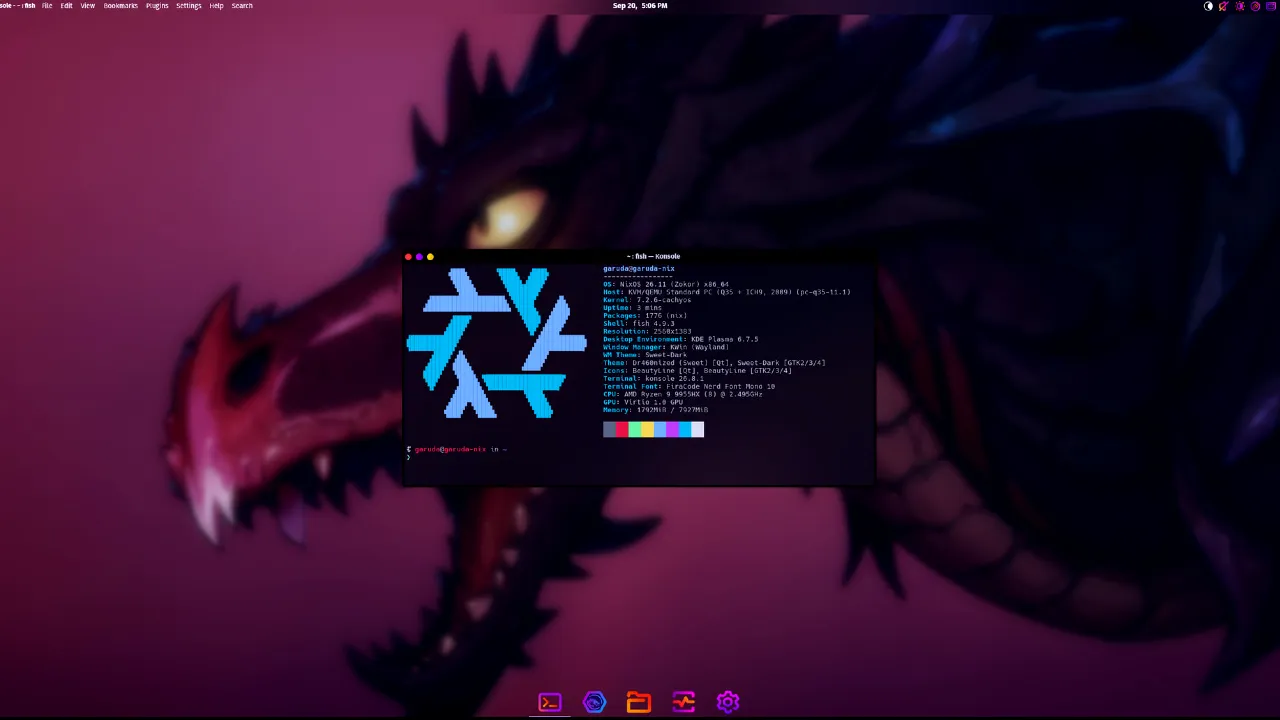
From add-on to a full OS
"As a huge fan of NixOS, I wanted to get more people to try it out," dr460nf1r3 wrote. "It is a very different concept from traditional distributions because of its declarative nature and how it does a lot of things differently than, e.g., Arch Linux."
The old subsystem still works. You can still run NixOS as a subvolume inside an existing Garuda install. There's also a garuda.* module you can drop onto any existing NixOS system to bolt on Garuda's defaults. But the new piece is the standalone installer ISO, a fresh Calamares or command-line install of a fully "Garuda-fied" NixOS. That matters, because Garuda has built a reputation for shipping things ready to go while NixOS is all about declaring exactly what you want. Garuda Nix splits the difference.
You get two editions: Mokka and Dr460nized. Both come from the same Garuda dotfiles, ported over to NixOS. Good thing is that NixOS base images are always netinstalls, minimal by design, so either installer can lay down either desktop. Dr460nized is the classic Garuda look, a vibrant "Sweet"-themed Plasma 6 gaming setup with matching login theme and apps. Mokka is the newer, calmer option, dark and in the Catppuccin Mocha palette. Maintainer elite noted in the thread that "Mokka is quite popular now days," while dr460nf1r3 stuck with being a Dr460nized fan, but admitted Mokka's edge is its large number of Catppuccin ports.
The two are mutually exclusive, by the way. Enable both garuda.dr460nized and garuda.mokka together and the flake refuses. That's the team's way of telling you to pick a side.
Getting it running
You have two installers, both generating the same underlying flake config from a shared template. The GUI path is Calamares, kept deliberately barebones. You pick an edition and a few features like gaming or printing, then customize everything else post-install. No surprises there. The install-garuda-nix command-line tool covers everything the GUI does plus a pile more: presets from desktop to laptop to server to handheld, partition layouts spanning ext4, btrfs, LUKS, and impermanence options. Expanding all of that into the GUI would have been "too much pain," per the maintainer.
One feature stands out. Impermanence, the CLI's main selling point, wipes non-persisted data on every reboot and turns a mutable system into effectively immutable infrastructure. Popularized by Graham Gilbert and written up by Graham Chesshire, it's a concept dr460nf1r3 clearly likes. Garuda's own infrastructure runs on it. On BTRFS the wipe happens through subvolume rollback; on ext4 a tmpfs replaces your root. There's even a motto, and it's rather dramatic: "Erase Your Darlings." You're kept whole out of the box (Wi-Fi passwords, your .config, users), but everything beyond those defaults needs to be declared explicitly.
You can also skip the installer entirely and run straight from the published GitLab flake on any internet-connected NixOS box. The --flake-ref defaults to stable, so configs rebuild cleanly with a plain nixos-rebuild switch --flake /etc/nixos#mypc.
Every install ships with Chaotic Nyx, the "Nix counterpart" of Chaotic-AUR. Same Chaotic LUG that keeps Arch users fed with that bleeding-edge AUR cache. Nyx itself recently came back from the dead with a "WE'RE BACK FROM THE DEAD!" blast. It serves too much bleeding-edge like mesa_git, firefox_nightly, sway_git, plus experimental modules for HDR and DuckDNS. Garuda turns the binary cache on by default, so you get prebuilt binaries instead of compiling from source. As of the announcement it's built against nixpkgs commit 20b1ddd1, serving binaries for x86_64, aarch64-linux, and aarch64-darwin. That's a lot of platforms for a cache.
Daily ISO builds are churning out through CI right now. The Dr460nized and Mokka images are both tagged 26.11, following Garuda's date-based versioning. Oddity worth flagging: the announcement landed in September, but the ISO says 26.11. I'd call it a scheduling quirk in Garuda's monthly cycle rather than anything more alarming. If you build from source you'll just track stable and not worry about it.
For anyone new to the config-file-driven NixOS workflow, the announcement links a few starters, including a NixOS & Flakes book and the module options reference. There's also a devshell with all the deployment tools and aliases, entered via nix develop. The flake lives on GitLab under GNU GPLv3, and it's now a mature tree with 1,452 commits since it kicked off in May 2023.
It's a genuine step for Garuda, turning a subsystem into a first-class OS and signaling intent to treat NixOS alongside its Arch flagship. That's no small thing given how wildly different the two paradigms are. Whether that actually wins over the Arch users who keep the project going is the open question.
Head here to download the Garuda Nix ISO image. Check out the Garuda Nix homepage for the documentation.


