Faugus Launcher 2.5.0.1 Adds a GPU Selector and Deletes the Discrete GPU Option
The maintainer of a popular Linux game launcher wants you to test its new GPU picker before it hits the stable branch.
Faugus Launcher, the small GTK front-end that lets Linux users fire off Windows games through UMU-Launcher, pushed a pre-release on October 17 that quietly changes which graphics chip a game runs on. It adds a per-GPU selector. It also removes the "Discrete GPU" toggle that some laptop users have leaned on for years. And it's asking you to test the whole thing before it lands in the stable branch.
The move is smaller than it looks. The downloadables are each under 3 MB. But GPU selection is one of those things that quietly decides whether your game launches or just spits an error and dies. For a lot of people on hybrid-graphics laptops, picking the right chip between integrated and discrete has been endless fiddling. Now Faugus flips the model entirely, and admits it doesn't yet know whether the new approach actually works. That's honest. It's also exactly why the maintainer opened GitHub issue #1033 as an open call for volunteers.
Why the Discrete GPU toggle is gone
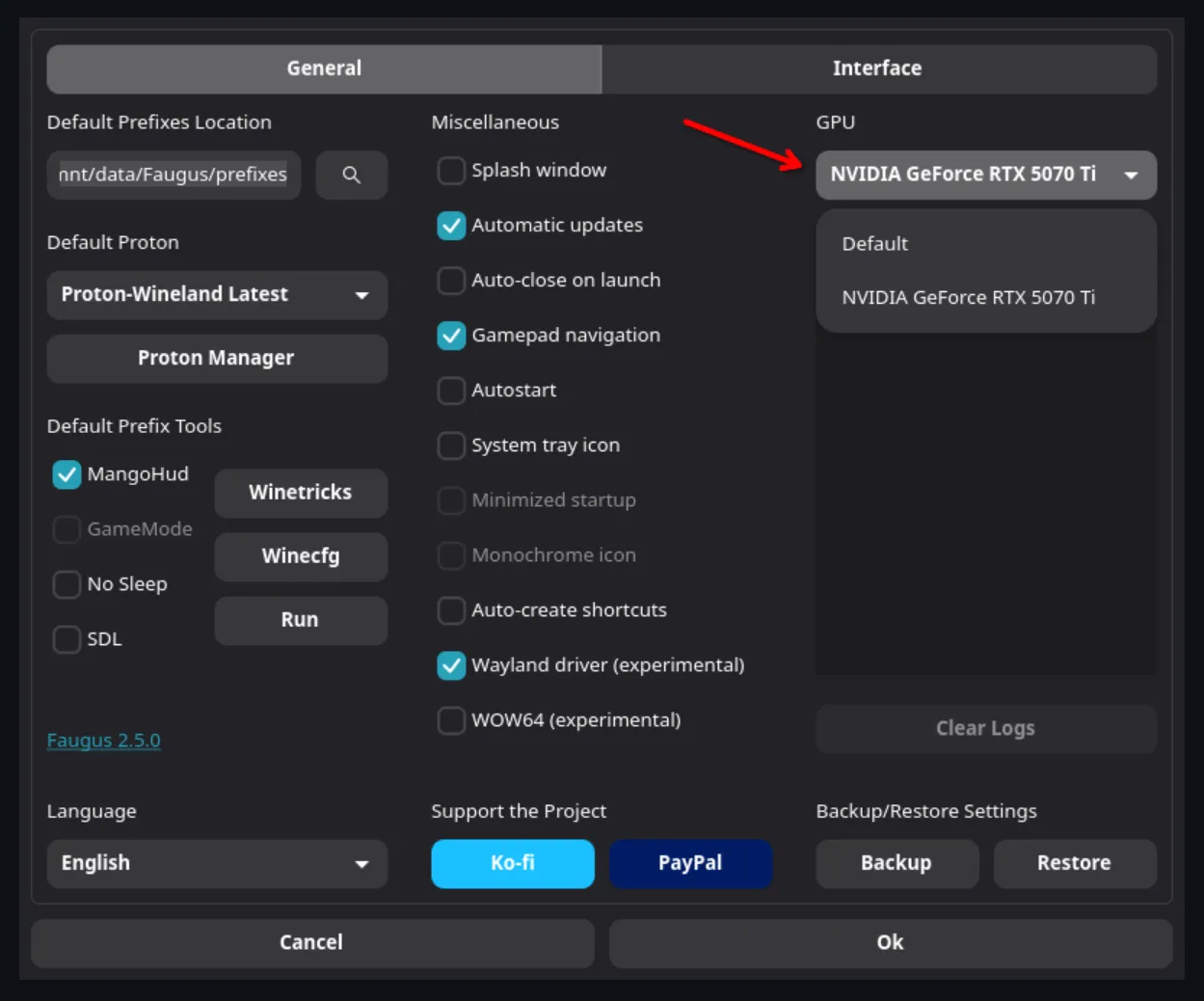
For years Faugus and several peers shipped a blunt "Discrete GPU" switch. It was aimed squarely at NVIDIA Prime hybrid laptops, the efficient integrated chip plus the more powerful discrete one, and picking it forced rendering through the discrete card via Prime offload. In 2.5.0.1 that on/off option is gone. It's replaced by a selector that lists individual devices and lets you choose one directly.
The release notes don't pretend otherwise, noting plainly that "as a result, the Discrete GPU option has been removed." The maintainer calls the change "sensitive" and insists it needs community testing before merging into main.
There's history here worth remembering, too. The 2.0.1 hotfix earlier this year fixed a bug where games simply failed to launch when the Discrete GPU feature was active. Retooling that whole subsystem means those fixes get examined from scratch. If you've ever cursed a launcher over a hybrid laptop that refuses to hand off to the fast GPU, you understand why this feels risky.
How the selector actually works
Under the hood this is a small commit, "Fixed GPU selection," that touches just two files: launcher.py and runner.py. The UI shift is mostly cosmetic. The GPU control moves from one settings column to another so the new selector sits beside the environment-variable options. The real work happens in runner.py, which sets Linux graphics variables based on the selected GPU's vendor and device.
For AMD or Intel hardware, it sets DRI_PRIME to trigger Prime offload, pins the Vulkan device with MESA_VK_DEVICE_SELECT, and new in this build, adds MESA_VK_DEVICE_SELECT_FORCE_DEFAULT_DEVICE to force Mesa to honor your choice as the default. NVIDIA cards get the familiar render-offload trio. Anything that isn't NVIDIA falls back to Mesa by default.
That last part is the tell. Forcing a default device and pinning Mesa for the non-NVIDIA crowd is exactly how you'd refine the integrated-versus-discrete handoff. The proof will come from real hardware, though. And that's where you come in.
The maintainer wants testers, not testimonials
Alongside the release, issue #1033, "Looking for Laptop and Multi-GPU users to test a new feature," asks anyone willing to dig in to do something specific. List the GPUs in your machine. Pick one inside Faugus. Then check whether your games are actually using it. Report back in the thread.
The maintainer is framing this as collaborative validation, not a finished product. As of right now the issue stays open with no labels and no milestone, which fits an early-stage request. Faugus itself is a modest project but it's one of the more reliable entry points into UMU-Launcher, and it runs on a clean GTK4 interface that doesn't require Steam.
Five formats ship for x86-64. The AppImage is about 2.4 MB, the Flatpak roughly 2.9 MB, and the distro-native packages land in the 700 KB to 875 KB range. Arch users can run yay -S faugus-launcher, Fedora folks can enable the copr repo, and Debian/Ubuntu users have a .deb on the release page. Keep in mind that the Flathub Flatpak is the version most people end up running, so you'll want to be aware that this pre-release lives only in the 2.5.0.1 tag, not in the store.
It's a small release, no question. But the instinct to ship a targeted build and ask people to help break it , and confirm it, before committing is arguably the healthiest thing in this update. If you run Windows games on a laptop or a multi-GPU rig, it's worth a try. Just don't treat it as stable yet.
Head here to the 2.5.0.1 release page if you want to dig in.


