Faugus 2.4.2 ships with custom colors and a slimmer Flatpak
The lightweight open-source launcher for running Windows games on Linux, Faugus, has rolled out version 2.4.2. It landed on September 26, 2026 with a few tweaks, a bit of housekeeping, and notably no sweeping new features. Which is honestly exactly what you'd want from a minor version bump.
Faugus exists to keep you from opening a terminal every time you want to play an Epic or GOG title on Linux. It's a thin graphical layer on top of UMU-Launcher, the tool that repackages Steam's Proton machinery so Windows games can run without Steam. It handles the environment variables, the Wine prefix, the Proton version. You click a button. The game launches.
I'll admit I still reach for a terminal out of habit, a bad habit some of us never quite shake. Faugus exists precisely to kill that reflex.
The project draws on roughly 2,400 GitHub stars and nearly 90 forks since it was started in June 2024. That's no match for Steam-adjacent popularity, but it's a solid following for a small organization that leans on community contributions for translations and bug reports.
What actually changed
The 2.4.2 changelog is short, and it covers both looks and maintenance. The headline feature is a custom color picker for the Overview panel and the app background. This builds on customization work from earlier 2.x releases, and it matters most in the Grid, Covers, and Carousel display modes, which show that overview panel with your game name, playtime, and last-played timestamp.
Less flashy but arguably more useful: automatic updates now get disabled when you turn off the runtime for Linux games. That stops Faugus from silently re-enabling a compatibility runtime you deliberately switched off. Useful for those native Linux titles that misbehave (or simply refuse) under the Steam Runtime that UMU manages.
There's also a fix for the system tray, where the working directory went missing when launching games from the notification area. A separate regression fix restores the "Stop" button, which had broken on the Flatpak build.
Then comes the part Flatpak users will appreciate: a leaner build. Faugus dropped a now-unnecessary Wine dependency from the Flatpak, which the team says "significantly reduces the build size." It also bumped the Flatpak to GNOME 51 to match the latest runtime.
Not cheap to run, though. The AppImage still needs several system libraries it can't bundle inside the portable format: pygobject, gtk4, libadwaita, and libmanette.
Translation updates ride along too. German came from @MiStahl, Russian from @RevengeRip and @FiReOnok, and Swedish from @bittin.
The pace and the Flathub wrinkle
To make sense of 2.4.2, you have to look at how fast this project moves. Within a single week, Faugus shipped 2.4.0, 2.4.1, and 2.4.2. Earlier in 2026 you got the GTK4 port (2.0.0), Amazon Games support (2.1.0), a Carousel interface (2.2.0), and in-app playtime tracking (2.2.2).
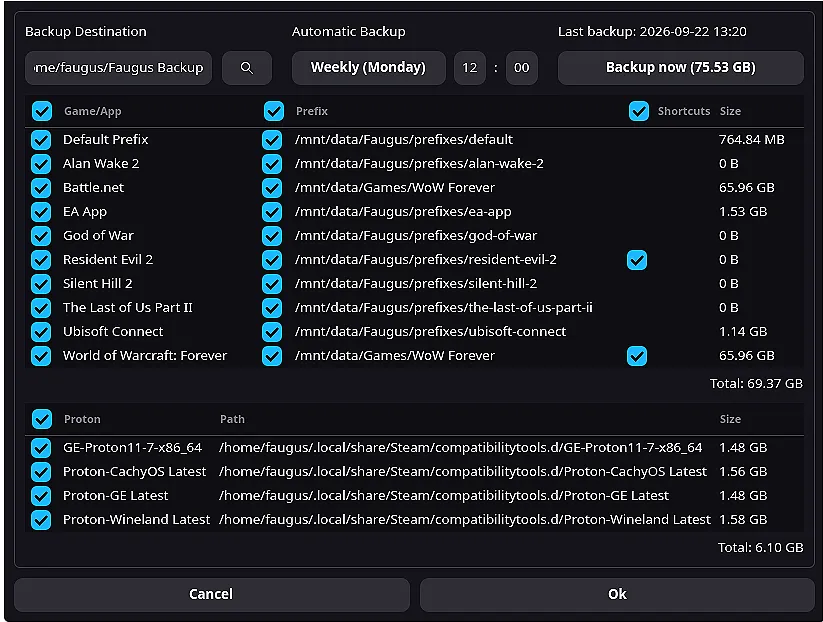
One detail is worth flagging. 2.4.1 existed because "the build was not accepted by Flathub," per the developer, forcing a rework of the backup notification system before the app could hit the official Flatpak store. So stripping that Wine dependency and bumping to GNOME 51 in 2.4.2 looks like part of an ongoing effort to keep the Flatpak clean and store-compliant.
However, at the same time, it's a reminder of the trade-off anyone distributing through a curated platform accepts: review guidelines can force last-minute changes. Not every fix is about users. Some are about passing a review board.
Head here to the GitHub release page.


