Debian GNU/Linux 13.8 "trixie" ships with 139 security advisories
The eighth point release of Debian's stable distribution patches everything from the Linux kernel to Chromium.
Debian 13.8 arrived today, and it is, to put it plainly, a lot of advisories. Debian calls it the eighth point release of the current stable distribution, codenamed trixie, a maintenance update that folds 139 security fixes into packages already shipping in stable.
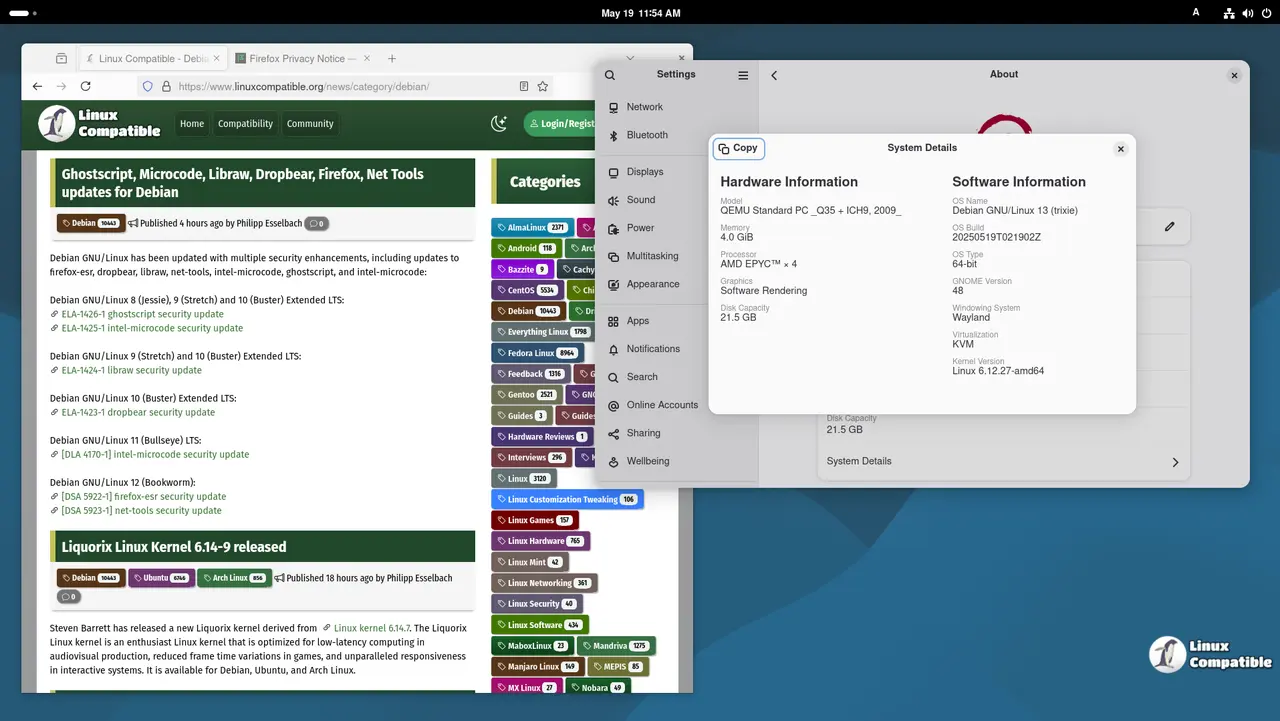
There's no Debian 14 lurking here. This doesn't change what version of Debian you're running. It just makes the version you already have a little harder to break. Keep in mind that point releases like this bundle up to a year's worth of upstream fixes that weren't already caught by the rolling security.debian.org stream, which is why they end up looking so big all at once.
By the numbers, 139 unique security advisories span DSA‑6408 through DSA‑6629. Count the repeated architecture rows for the Linux kernel separately and you get 150 advisory entries. Debian lists 159 distinct CVEs across both the security and misc-bugfix sections, touching roughly 217 packages in total.
On top of that, 122 packages got corrections for serious non-security problems, plus a fresh round of rebuilds for compatibility.
The browser eats the headlines
If you're keeping score, the single most-advised component in this release is Chromium. Sixteen advisories. That's roughly one out of every eight DSAs in the whole point release, and it's a fairly reliable signal that a large share of actively exploited client-side risk still lives inside the browser.
The kernel is next, with five DSAs affecting both signed and unsigned builds on amd64 and arm64. Tor picked up four. Firefox ESR, three. Everything else is spread across the rest of the archive.
Chromium 16 advisories aside, the breadth is genuinely staggering. You've got the usual suspects: openssl, nss, strongswan, libwebsockets, pcre2, brotli, cjose, and ca-certificates for the crypto and transport stack. bind9, unbound, and c-ares cover DNS. Apache, nginx, haproxy, varnish, and exim4 handle the web and mail side.
Then there's the part of the list that makes you do a double-take. PHP 8.4, WordPress, Symfony, Rails, Roundcube, Sogo, Lemonldap-NG, and SPiP all landed fixes. So did LibreOffice, Ghostscript, ImageMagick, VLC, and Wireshark. It's a reminder that "the kernel" is only one of maybe a hundred ways your system gets reached.
The desktop angle is worth a paragraph on its own. sudo picked up a TZ-variable poisoning fix. sssd took hits for several issues including privilege escalation. And kwin got fixes for Wayland color management and monitor-unplug crashes, which, for anyone who's ever watched their second screen vanish mid-session, is its own small mercy.
glibc, MariaDB, and a GRUB secure-boot bypass
The misc-bugfix section isn't just clutter. The glibc update is arguably the most depended-upon fix in the whole release, fixing buffer over-reads, out-of-bounds writes, stack overflows, a wordexp state-preservation bug, a UTF‑32 decode hang, and a race condition. Because glibc is the fundamental C library, that's a fix nearly everything leans on.
MariaDB got a new upstream stable release plus fixes for code execution, authorization bypass, path traversal, SQL injection, and incomplete privilege checks, meaningfully relevant if you run a database.
One that deserves more attention than its row might earn is grub2. It fixes a use-after-free DoS, bumps the SBAT revision, fixes a crash on riscv64, and the part worth pausing on, addresses a secure-boot bypass, CVE‑2026‑97876. If you actually care about what boots your machine, that's the line to read.
GRUB's not the only firmware-adjacent win. intel-microcode picked up a batch of CPU microcode fixes, including several CVE‑2025 and CVE‑2026 entries. It's the kind of thing most people never notice until it shows up in an update log.
Speaking of update logs, here's a small bit of insider detail worth flagging: the release date had moved. Debian's schedule had November 14 on the calendar before it slipped up to the 21st, so if you watched the release team's calendar expecting an early-November landing, it showed up a week later than planned.
What this does and doesn't do to your system
Debian is explicit, and it's worth quoting directly.
"The point release does not constitute a new version of Debian 13 but only updates some of the packages included. There is no need to throw away old 'trixie' media."
Translation: 13.8 updates the trixie installation you already have. You don't need to reinstall. New images will show up at Debian's normal download sites once propagation finishes, but the ones you're using right now don't need them.
In lifecycle terms, trixie landed as stable on August 9, 2025, and this 13.8 release puts you comfortably inside its fully-supported window. Debian keeps full support until August 9, 2028, with Long Term Support extending to June 30, 2030, and Extended LTS running all the way to June 30, 2035. Two-plus years of runway from here.
The previous point release, 13.7, shipped September 12, 2026. So you're looking at a roughly quarterly release cycle, which means the next one is probably only a few months out.
What you should actually do
The guidance is standard and low-risk, but a couple of details trip people up.
First, make sure security.debian.org (or a full mirror) is actually configured in your sources. Most of what a point release offers overlaps with the ongoing security stream, so if you run apt update regularly you may find there's very little new to pull. That's normal and fine.
sudo apt update && sudo apt full-upgrade
Reboot afterward if the update pulled in a new linux or linux-signed kernel or a fresh glibc. The patched kernel and library don't take effect until the next boot.
Desktop users: prioritize the browser updates. Chromium and Firefox ESR are where this cycle did the most work, followed by whatever gnome or kwin bits came along.
As of right now, trixie 13.8 is a maintenance bump, not an event. It won't change how your system looks or runs, but it will close a large and genuinely wide set of doors that otherwise stay open. Not bad for a release most people will update without ever reading a word about it.
Head here to the official announcement for the full advisory list.


