CachyOS ships November 2026 release, brings Easy Anti-Cheat support to Linux gamers
CachyOS's sixth distro of the year adds a Secure Boot-signed EAC kernel, an on-disk recovery image, and a rebuilt package manager.
CachyOS has shipped its November 2026 ISO, build 261122, marking the Arch-based project's sixth release of 2026. There's no single killer feature here. Instead the update lines up three improvements that all point at the same problem: making a performance-tuned Linux actually usable for gamers who've been shut out of multiplayer titles by anti-cheat.
The centerpiece is Easy Anti-Cheat Linux v2 support, a dedicated Secure Boot–signed kernel that lets you play games guarded by Epic Games' newer anti-cheat system. There's also cachyos-recovery, a self-contained image that boots off your own disk so you can roll back a broken system without fumbling through a live USB. The package manager got a full rebuild this time around, now capable of compiling AUR packages and installing Flatpaks and AppImages.
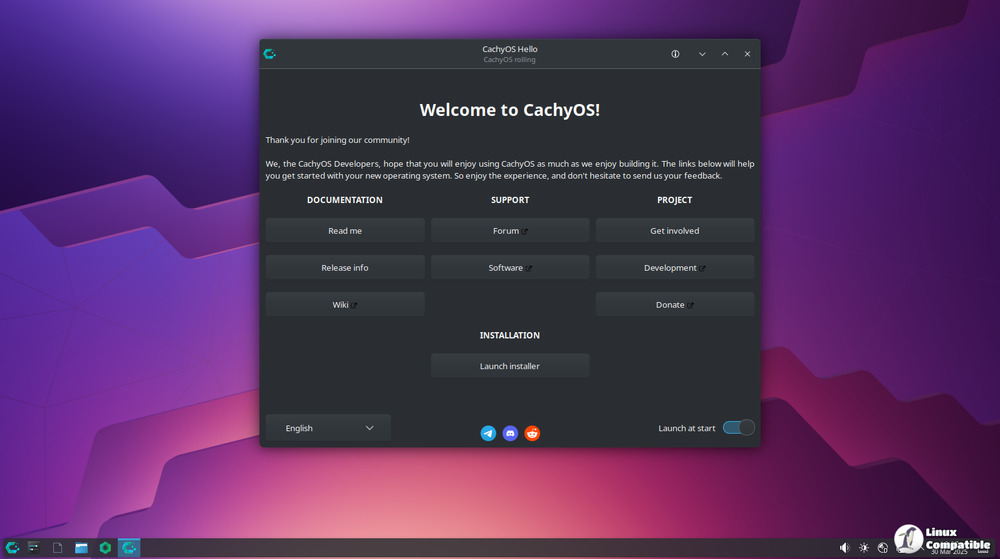
What CachyOS actually is
CachyOS is an Arch-based rolling-release distro founded in July 2021 by German developer Peter Jung, who goes by ptr1337 online, alongside Vladislav Nepogodin. The whole thing grew out of Jung's work on the cacULE CPU scheduler, and the name nods to an early version of that project. For the uninitiated, "cachy" comes straight from cachULE. It's a small easter egg if you've followed Jung's work since the Fedora mailing-list days.
What actually separates it from plain Arch is a relentless performance angle. Every package gets recompiled with modern instruction sets (x86-64-v3/v4 and Zen 4+) plus Link-Time Optimization and Profile-Guided Optimization.
It also ships a custom-patched kernel, linux-cachyos, with schedulers like BORE and a tuned EEVDF aimed at trimming latency. Add in a friendlier installer and tooling that abstract away much of the manual work Arch demands, and you've got a distro that leans hard into "fast out of the box."
The November release fits that character perfectly. It takes things that are technically true but practically painful on stock Arch and packages them so they work.
The EAC kernel
Epic Games rolled out Easy Anti-Cheat for Linux v2, a version that runs natively on Linux but only launches games when it can verify how your system booted. The requirements are strict, mirroring the trusted-computing model consoles have popularized.
Secure Boot needs to be enabled with a kernel signed by a key Epic trusts. A TPM 2.0 has to be present and doing measured boot, recording every step of the chain. The kernel must run in lockdown mode with only signed modules. IOMMU also needs to be on, with kexec disabled and the BPF LSM active.
Fortnite is the first marquee title confirmed, and that matters more than it might. A lot of PC multiplayer gaming has historically been gated by anti-cheat compatibility, so seeing a AAA game commit to Linux sends a real signal.
CachyOS doesn't make you hand-sign kernels or fiddle with UEFI keys. Instead it ships a dedicated variant, linux-cachyos-eac, signed with the CachyOS signing key and hitting every one of Epic's requirements. A signed systemd-boot loader comes along too, plus packages like cachyos-eac-signing-key and cachyos-eac-grub-hook for the experimental GRUB path.
Here's the part that catches my eye: your normal boot stays intact. The EAC kernel gets its own separate entry, and your own Secure Boot keys all remain untouched. The only thing added to the UEFI key database is the "CachyOS EAC CA" certificate, which just lets firmware accept the CachyOS-signed files.
To play, you trigger a one-time boot into it with sudo eac-setup boot, which sets UEFI BootNext. After your session, the system boots normally again. Keep in mind that some boot managers complicate things. Limine doesn't verify everything against the Secure Boot database the way EAC wants, and rEFInd and GRUB are signed with your key rather than one Epic trusts, so CachyOS drops the signed systemd-boot in as a separate firmware entry.
There are practical caveats you should know about first. This changes your Secure Boot state, which changes what the TPM measures. On a Windows dual-boot with BitLocker, that can trigger a recovery-key prompt, and a LUKS disk bound to your own TPM may ask for its passphrase. CachyOS tells you to back those up beforehand. DKMS modules don't load in the EAC entry, so VirtualBox and friends need the normal kernel. GRUB support stays experimental, and certain MSI boards have a default Secure Boot policy that doesn't record which certificate verified the boot.
A full walkthrough lives in the CachyOS Wiki guide, which is unusually thorough for what's normally a throwaway setup page.
It's a pragmatic middle path, honestly. EAC v2's signed-kernel and measured-boot requirements are hailed as a security win by some and skewered by open-source advocates who see a console-style walled garden taking shape. CachyOS signs only what's necessary, keeps your keys intact, and offers an opt-in separate boot entry. That's arguably the cleanest model I've seen so far.
Recovery, and a better package installer
The second story is cachyos-recovery, a self-contained environment delivered as a UKI built with mkosi. You can boot it from your bootloader or straight from UEFI, so rolling back a broken system no longer means wrestling with a live USB.
From its menu you can boot any Btrfs snapshot with a writable root via overlayfs to try it first, then roll back to it permanently from a desktop notification or the menu itself. The rollback regenerates the kernel, initramfs, and bootloader config for the restored snapshot, and re-signs them if Secure Boot is set up with sbctl.
It works independently of Snapper, supports LUKS-encrypted installs, takes only about 70 MB on the ESP, and installs via sudo pacman -S cachyos-recovery. Snapshot rollback is already a strength of distros like openSUSE and Bazzite, but packaging it as a tiny self-bootable image that lives on your system rather than something you build onto a stick is a genuine quality-of-life win, especially for gamers snapshotting before a driver update.
Then there's the CachyOS Package Installer 2.0, rebuilt from scratch. Beyond the CachyOS and Arch repos, it can now build packages from the AUR and install Flatpaks and AppImages, each opt-in.
The standout is the security-conscious AUR handling. Before building anything, the app shows the PKGBUILD and install scripts for review, with static analysis that flags suspicious lines. When you review an update, it shows a diff of what changed since the installed version. AppImages can be added from a local file or a GitHub URL, and ones previously added via Shelly or Gear Lever can be imported.
The AUR review plus static-analysis step is the real winner. It addresses one of the most legitimate worries about compiling untrusted AUR source directly, without forcing you to drop to the terminal. This follows the earlier introduction of Shelly as CachyOS's default GUI package manager back in April 2026.
Everything else under the hood
This release reworks quite a bit beneath the surface.
A new package, cachyos-drm-awaiter, replaces early KMS and the old nvidia-module-loader. It waits for the GPU driver to load before starting the display manager, for any driver not just NVIDIA, and shows a QR code if the driver failed to load so you can pull up troubleshooting info from your phone. The kms hook is no longer added to the initramfs by default now, and Plymouth uses simpledrm for the splash.
The installer got unified too. Calamares now uses CachyOS's shared installer libraries, called "gucc," the same backend the CLI installer relies on. The root partition now defaults to the Fedora-style SD_GPT_ROOT_X86_64 label, Plymouth is optional, and the rEFInd plus AI SDK bootloader option was cut.
Kernel-wise you're on Linux 7.3.5, with LTS 6.18.64 also available. NVIDIA sits at 620.73.04 and Mesa at 26.3.1. The kernel can now be built with Rust alongside ThinLTO, and Rust Binder is enabled.
CachyOS also ships an official WSL image for the first time. It's an interesting move to meet users inside Windows instead of only persuading them to switch over entirely.
Existing users have one required manual step, since cachyos-drm-awaiter replaces early KMS. After the big upgrade you'll need to reinstall your driver profiles:
sudo pacman -Syu
sudo chwd -a -f
The release drew coverage within a day by several independent outlets, all landing on the same three pillars. The ISO is powered by the Linux 7.3.5 kernel and flagged the new WSL image.
Why it matters
This is a textbook case of Arch-based distros maturing from power-user DIY toward curated performance with guardrails. Gaming infrastructure is now a distro responsibility, recovery is built into the system itself, and there's a recurring theme of security-aware convenience woven throughout.
The one caveat worth flagging: EAC v2's strict trusted-boot model remains controversial in open-source circles, and its full game library is still rolling out. But for anyone who wants to play EAC-protected games on a fast Arch-based system, CachyOS has now made the setup genuinely turnkey.
Head here to the official announcement to grab the ISO.


