Bazzite Linux 45.20261111 Ships With Linux 7.3 Kernel and Nvidia 620 Drivers
Universal Blue has published the latest stable image for its gaming-focused Linux distro, Bazzite 45.20261111. It arrived today, roughly a week after the previous build, and two headline upgrades carry the release: a jump to the Linux 7.3.3 kernel and an open Nvidia driver leap to the 620 series.
If you've been following the project, you know the pattern. Bazzite ships on a loose weekly cadence on its stable branch, so this isn't a massive overhaul. It's an incremental-but-substantive update on the 45 stream, which itself opened on November 3 over Fedora 45's Atomic Desktops.
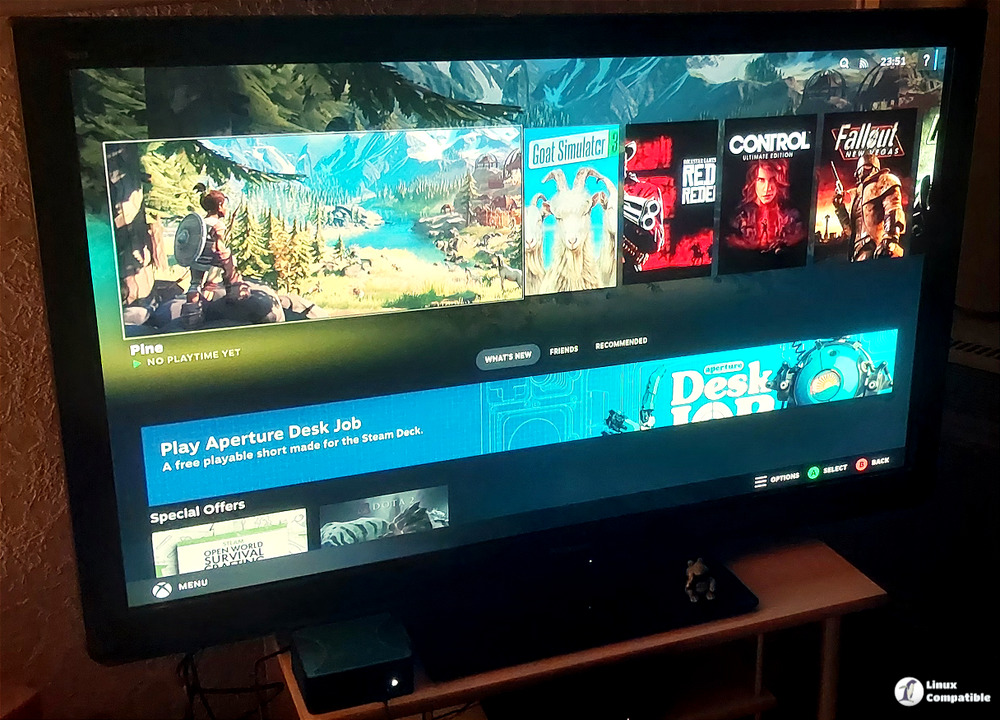
What makes it worth your time is what's under the hood. Bazzite runs a custom kernel built by the Open Gaming Collective, often called the "OGC" kernel, and this build stacks gaming patches on top of the 7.3 series instead of the older 7.2.15 base.
The Nvidia stack is where a chunk of the interest lives. The open NVK driver climbs from 615.78.08-1 to 620.70.06-1, while the long-term-support proprietary line sits at 580.196.07-1. You pick at install time and can swap later by rebasing, which matters if a new driver breaks your setup.
Headline changes and the gaming stack
The OGC kernel moves from 7.2.15-ogc1.1 to 7.3.3-ogc1.1, adding performance and power-management wins on top of Bazzite's usual gaming tooling: Xbox controller passthrough via the xone driver, FSync priority scheduling, and refined handheld support. The dedicated Nvidia LTS kernel also advances, to 6.18.60-ogc1.1.
The gaming tooling gets routine but meaningful bumps across the board. Gamescope moves to 3.17.0, MangoHUD to 0.8.4, and InputPlumber to 0.84.0-4. PowerStation, the hardware-monitoring overlay in the desktop bar, lands a major version bump to 0.9.0-1, which is the freshest thing in the stack by far.
If you play Windows games outside Steam, UMU Launcher is at 1.4.4-1, and sched_ext Schedulers are pinned at 1.1.4-1 for user-space CPU tuning. SteamOS-style package management lives on through SteamOS-Manager, and OpenGamepadUI rounds out controller UI at 0.46.1-8.
Desktop environments aren't ignored either. GNOME bumped to 51.1 with a patched localsearch package that works around an upstream crash, while KDE Plasma sits at 6.8.2 with fixes for desktop file handling. It's the kind of detail most distros ship without fanfare, but it's exactly the stuff that keeps an immutable system honest.
Behind the version numbers there's actual hardening. The release continues work on greenboot auto-rollback, keeps user services from running under the GDM account, and pins critical GitHub Actions to cut supply-chain risk. One small aside worth flagging: an attempt to add udev rules for Intel AX200/AX210 WiFi cards was reverted after causing dropouts, echoing a known trouble spot with certain MSI Wifi 7 cards. Not everything pushed makes the final cut, and that's a feature here.
The OGC model and why it matters
Here's the part that's genuinely interesting for anyone watching Linux gaming. Bazzite's recent pace is tied to the Open Gaming Collective, an early-2026 collaboration that unites ChimeraOS, Nobara, Playtron, PikaOS, ShadowBlip, ASUS Linux, and Bazzite/Universal Blue under one shared kernel.
The idea is simple: stop each distro from maintaining its own fragmented kernel patches and input tooling. Improvements get built centrally and shared, so a win for one project becomes a win for everyone. Bazzite adopted the OGC kernel and InputPlumber, replacing its older HHD input system, and feeds its Valve-package work upstream for all of them to use.
That cooperative model is a big reason Bazzite's kernel advances as fast as it does. It's also a bit of a contrast to how Valve runs SteamOS in-house, closed and proprietary. For anyone who's ever wished the Linux gaming ecosystem worked more like the open-source world it claims to represent, this is the story.
Can you even break it?
Bazzite ships in three editions: the Desktop Edition for gaming PCs and laptops, a Handheld Edition (Bazzite-Deck) that boots into a console-style Steam Gaming Mode, and Bazzite-DX for developers, which layers on Docker, VS Code, and container terminals.
Everything runs on rpm-ostree, which means the base OS is read-only and updated as a complete atomic image. You layer Flatpaks through the Bazaar app store, use rpm-ostree for core packages, and lean on Distrobox or Waydroid for containers. Change almost anything, and the system stays intact.
Durability features round it out. Bazzite keeps the previous image around for ninety days, and greenboot auto-reverts if an update fails to boot. SELinux is on by default, Secure Boot is supported, and optional LUKS encryption with TPM unlocking is available for those who care. Minimum specs sit at a 2 GHz quad-core, 8 GB RAM, a Vulkan 1.3-capable GPU, and 50 GB on a GPT SSD. x86_64 is the only officially supported architecture.
Should you update?
For existing users on a recent 45.x image, the upgrade is about as low-risk as Linux gets. Jump via:
# Move to the latest stable image:
bazzite-rollback-helper rebase stable

# Or pin this exact release:
bazzite-rollback-helper rebase 45.20261111
The 7.3 kernel and open Nvidia 620 drivers are the main draws for newer hardware and performance, while PowerStation 0.9.0, InputPlumber 0.84, and a run of stability fixes make the update worthwhile for everyone on the stream. If something does regress, you can rebase to the previous image or pin this one at will.
New users should skip the legacy installer, which Universal Blue is phasing out, and instead build a tailored ISO at bazzite.gg. You can pick device type, GPU (AMD/Intel or Nvidia, including a GTX-1080-or-older LTS option and an RTX path), Nvidia generation, and desktop environment (KDE or GNOME).


