Bazzite ships 44.20261012.1, another patch to keep its Fedora 44 gaming Linux running smoothly
Another build dropped on October 13. It isn't the headline feature you've been waiting for, and that's more or less the point.
Another Bazzite Linux update has been just released. Bazzite, the gaming-focused Linux project from Universal Blue, published stable build 44.20261012.1 today. It's a patch on top of the 44.20261012 image that rides Fedora 44, nudges the kernel and graphics stack up a notch, and quietly fixes a handful of problems under the hood along the way.
The honest framing is that this isn't a milestone. Bazzite moves fast. During active development the team ships multiple builds a week, and the whole 44.xxxxxxxx line just tracks Fedora 44. The real one already happened earlier this year, so this build is just keeping a major release healthy.
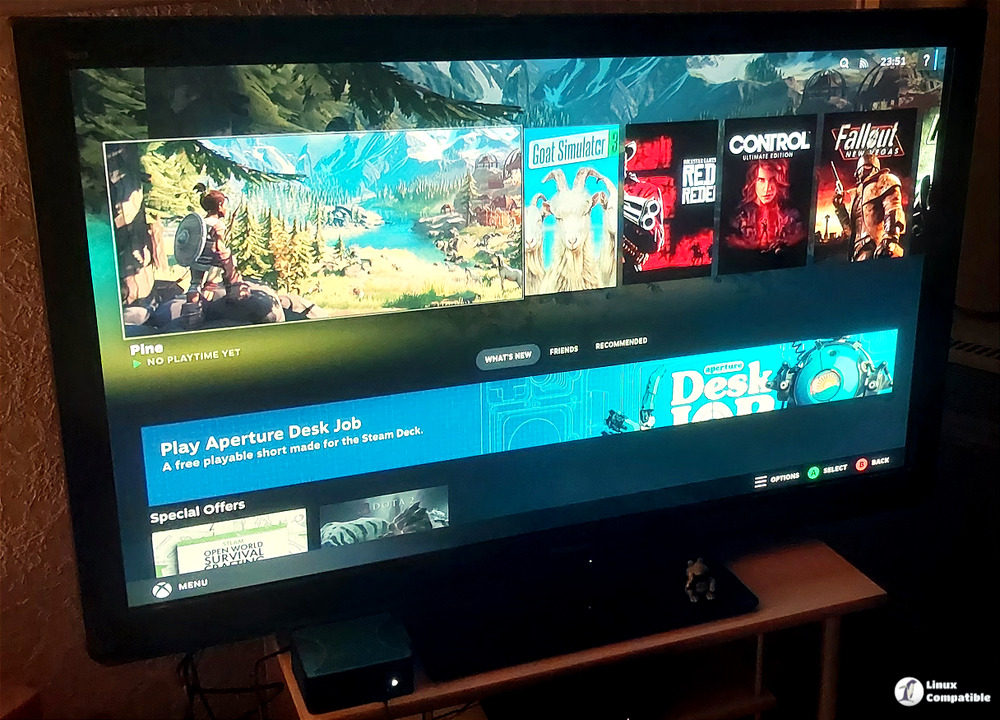
That's more important than a changelog that looks like a spreadsheet would lead you to believe.
Bazzite is a Fedora Atomic Desktop image rather than a standalone distro. It boots as an immutable, snapshot-based system, so updates land atomically and a previous version stays bootable for up to 90 days as a safety net. The goal is to bring a SteamOS-like, console-first experience to hardware Valve won't run SteamOS on, from ASUS ROG Ally and Lenovo Legion Go handhelds to a pile of self-built rigs. The name comes from a mineral, following Fedora's tradition of mineral-built names like Kinoite and Silverblue. It's a rare, lightweight stone, with the blue in the logo nodding to Universal Blue.
Why Bazzite 44 counts as the biggest update
This build belongs to the Bazzite 44 release, and that one reshaped the whole project. Desktop users got it first, back in April 2026. Handheld and couch-HTPC owners waited until August for the Deck images, closing a split that had left the two lines on different timelines. From here on, updates roll across the entire lineup at once.
The handheld stack got a complete overhaul built around four moving parts: InputPlumber, SteamOS-Manager, PowerStation, and OpenGamepadUI. Together they put TDP control, session switching, and unexposed Steam options into Steam's Quick Access Menu, mirroring Valve's own SteamOS.
Bazzite 44 also added a graphical updater, so you can push updates and read changelogs with just a gamepad. A redesigned Portal pushes a pile of tasks out of ujust shell commands and into a GUI: GRUB timeout, HDMI-CEC, AMD VRR, NVIDIA Flatpak updates, ProtonPlus actions, and adding the updater to Big Picture Mode.
Then there's the VRAM management, the piece most gamers should actually care about. It grew out of work Valve engineer Natalie Vock pushed upstream, using Linux dmem and DRM device-memory cgroups so a fullscreen foreground game gets first dibs on GPU memory before background apps touch it. On low-VRAM hardware that means fewer stalls. Some coverage claimed it could triple framerates on budget GPUs. A nice headline, though whether you hit that number depends on how badly your setup is already starving for memory. However, at the same time, you won't see it on a beefy desktop with 12GB to spare.
You'll also notice the Open Gaming Collective everywhere now, which is what that ogc in the kernel version means. The working group formed in January 2026 to stop every gaming distro forking its own kernel, and founding members include Bazzite, Nobara, ChimeraOS, Playtron, PikaOS, and ASUS Linux. They share one kernel and send patches upstream before shipping. CachyOS deliberately stayed out, with its founder laying out his reasoning in public. It's a rare moment of cooperation in an industry that usually thrives on fragmentation.
What actually shipped in 44.20261012.1
The kernel moved the most. The Open Gaming Collective kernel went from 7.2.9-ogc2.1 to 7.2.9-ogc3.1, a change baked into the entire system. Nvidia LTS users got a smaller bump, 6.18.52 to 6.18.56, explicitly tagged as fixing issue #6021.
The commits behind this build cap the Steam dummy updater to first launch only, killing a background nag that most people probably never even noticed. They also enforce the default Steam OS desktop session on Deck images and drop autologin overrides for non-Deck machines, so plain desktop builds stop misbehaving. Xorg, upower, and vpower now come from what Bazzite calls Terra packages, part of the same consolidation Universal Blue is running across its ecosystem.
It's a rather capable package for what it is, and the install-and-forget promise holds up well. Just keep in mind that the model trades some raw upgradability for that stability, so you're expected to stay in the immutable image or rebase back to a previous build if something breaks.
Fresh installs pull an ISO from bazzite.gg using the Anaconda installer. If you're already on Bazzite, the rest is a single command.
Rebase an existing install to the current stable channel with:
bazzite-rollback-helper rebase stable
Pin this exact build if you want it locked in with:
bazzite-rollback-helper rebase 44.20261012.1
Because updates are atomic, a previous deployment stays bootable. Pick it from the GRUB menu to roll back, where :0 is the newest and :1 is the previous build.
Head here to bazzite.gg to download the ISO, and check the GitHub release page for the full commit-by-commit changelog.


